Course Overview
Attendance
* Price for Foundation year only
Course summary
Our degree courses with Foundation year offer the opportunity to prepare you for advanced study before you progress onto a full honours degree at the University of Westminster.
Whether you do not feel ready for degree-level study, don’t have the right qualifications, want to change your subject specialism or return to study after an absence from education, we aim to encourage a broad range of students to undertake our Foundation year in order to progress onto their full honours degree with us.
The Foundation year is designed to give you the opportunity to explore new ideas, opening up new perspectives on the key debates within your chosen field. Core modules accelerate your academic and professional development and you will also take modules from areas closely related to your chosen field, giving you the chance to develop a cross-disciplinary perspective on your course.
On successful completion of the Foundation year, you will be able to move on to study for the English Literature and Language BA Honours degree.
Our English Literature and Language BA gives you the opportunity to study English literature by focusing on both the wider social context and the language that is being used.
You'll be able to engage with an exciting variety of texts, both traditional (such as Shakespeare, Jane Austen, and Charles Dickens) and non-traditional, alongside all sorts of other aspects of culture. You'll become a sophisticated reader of texts in their wider cultural contexts, at the same time as sharpening your skills in research. This training in critical and creative reading is particularly suitable if you are considering English teaching, the publishing or journalism industries, or any career that involves sophisticated communication skills and an advanced level of language use. It is of particular interest to those wishing to develop their skills as a writer. Our degree is strong in promoting the transferable and cognitive skills that employers value, and that contribute to lifelong personal and professional development.
We begin the course with an examination of what literature is and the tools that we use to discuss it, alongside focusing on how the English language works and the ways it is used to create different kinds of texts. As you progress through the course, you'll have the choice of a wide variety of literature from Old English, through Shakespeare, the 19th and 20th centuries to the present day; this may include texts from outside the traditional literary canon such as genre fiction and new forms of digital content.
Top reasons to study with us
- Learn from experts – You'll be taught by experts in their field, both in English literature and language and in neighbouring disciplines
- Benefit from small group learning – We offer weekly small group tutorials of five to eight students per tutor in addition to our regular seminars, which are designed to support your individual learning needs during the first two years of your degree
- Engage with a variety of texts – You'll be studying both traditional and non-traditional texts alongside all sorts of cultural works from film, the visual arts and museums
- Get experience before graduating – you’ll have the option to do a work placement as part of this course
- Learn transferable skills – Our degree will prepare you for a variety of careers by helping you to build your communication skills, research skills and creativity in problem-solving
Modules
There is a range of optional modules available from within the School of Humanities and across the University in each year of study. In Year 3 you have a particularly extensive array of modules to choose from, which allows you to tailor the degree to your own interests and future aspirations. In Year 3 you also complete a dissertation in a topic of your choice, with one-to-one supervisory support.
Our principal mode of teaching is through seminars of 15-25 students, with some larger university lectures. A key feature of our degree is our weekly small group tutorials (five to eight students per tutor). These are designed to support your own individual learning needs as you go through the first two years. The tutorials are specific to this degree and provide an important space for you to find suitable support in your studies more generally, alongside enhancing your study and employability skills.
At university, much of your learning is independent, conducted beyond the classroom (individually and in groups) in the library, at home, and via our online learning system (Blackboard), and the tutorials provide essential support for independent study.
Assessment on the English Literature and Language BA varies from traditional essays, presentations and small analytic exercises of texts through to the preparation and execution of small research projects and ultimately the preparation and writing of your own dissertation in the final year. Some modules combine coursework with a short exam.
Types of module
Our undergraduate courses comprise three types of module:
- Core modules: compulsory modules that you must take each year
- Option modules: modules that you can choose from to tailor your course to your interests, normally related to your subject area
- Elective modules (also called 'Electives'): wider, interdisciplinary modules that you may be able to choose from to broaden your academic experience and skills – covering everything from learning a new language to building enterprise skills
Module availability
We aim to offer a wide range of option modules and electives, but we cannot always guarantee your preferred choices as availability can be affected by timetabling constraints, staff availability or student demand.
Elective modules may be subject to change, but you can look through an indicative list on our University-wide electives page.
For more information
Full details on course structure, modules, teaching and assessment can be found in the programme specification below.
There are no optional or elective modules offered at Level 3, as the focus is on the development of key academic skills through a broad understanding of social sciences and humanities.
Core modules
Critical thinking is fundamental to our ability to progress in an increasingly complex and changing world. It is an essential skill across a range of academic and practice-based disciplines.
This module helps you understand the importance and function of critical thinking both at university and beyond. By working in partnership with academic staff and peers, you will explore how critical thinking aligns with disciplinary practices, shapes scholarly knowledge, and addresses inequalities. Through problem-posing education and anti-racist practices, you will engage with real-world problems, fostering the ability to create a more just and sustainable world.
This module introduces you to the concepts of history and memory. Using topical case studies, the module invites you to consider how the past is related to the present and how history and memory are constituted, challenged and constantly evolving. Through the module, history is made relevant to you by asking to whom history and historical objects belong and what they mean to individuals and society.
This module introduces contemporary political questions in the global context. Current political issues such as statelessness, politics of underdevelopment, power and inequality, and climate change will be discussed and analysed. The idea of nations and nationhood features prominently in the module, as do the issues related to faith, religion and ideological belief. The module is designed to introduce concepts and themes such as democracy, power and politics, inequality, global society, human rights and states, territories and statelessness.
This module provides a foundation in the theory and practice of intercultural communication, to help you better understand the complexities of communicating with people from other cultures. You'll explore what is meant by culture and the relationship between cultures and identities and examine how culture influences you and others. You will reflect on how the language and non-verbal communication you use can impact understandings and what strategies you can develop to manage misunderstandings both socially and in more formal contexts. Throughout the module, you are given the opportunity to practice your communication skills through a range of activities.
This module introduces you to the key academic, professional, and personal skills essential for success at university. It encourages good practices in writing, presentation, and time management, while also fostering reflection to help you build confidence as you transition to higher education. Open to all students enrolled in courses delivered through Westminster Foundation Pathways, the module provides a creative and supportive environment where you can reflect on and develop their academic and professional journey. You'll work with specialist facilitators who play a crucial role in guiding your academic and professional development.
With a focus on managing academic choices in a higher education setting, the module emphasises the importance of the United Nations Sustainable Development Goals (SDGs), using methodologies that prioritise equality, diversity, and inclusion. Through these lenses, you'll explore topics that prepare you to address real-world challenges as highlighted in the SDGs in a socially conscious, inclusive, and responsible manner.
This module explores some of the issues and intersections of identity through written and spoken expressions. It will include aspects such as language and gender, writing auto/biography, forms of writing, cultural identity and linguistic identity, and reading and writing about ‘others’ in fiction and non-fiction.
Core modules
This is a module where teaching and learning takes place in small groups, with students meeting their tutor on a weekly basis. The content of the tutorials is tailored to the group and used to develop a grasp and understanding of the degree as a whole at Level 4, to support the development of academic and research study skills, and to prepare for the synoptic essay.
This module gives you the knowledge and skills necessary to start analysing and describing the English language systematically (according to grammar, morphology and phonology) and prepares you for future modules at Level 5. The module develops your theoretical awareness of spoken and written mediums, how they are structured, and how they can be used as linguistic data. It also gives you a thorough understanding of the concepts of style, register and genre, and introduces you to some of the main historical developments of the English language over time.
This module introduces a series of ‘keywords’ that have been historically central to the study of literature, and explores these in relation to specific critical approaches to, and theoretical understandings of, literary works.
This module investigates how language works in texts, and how texts produce their effects through examination of writers’ lexical and grammatical choices. Students analyse how writers’ linguistic choices indicate the attitudes of characters and narrators, and represent characters as powerful or passive. Students discover how analysing the language of literary texts differs from the approaches taken by literary scholars.
This module examines English around the world as an international, intra-national, native, second, and foreign language. It considers the distinctive features of these varieties and the social and cultural implications of English as a global language. British varieties of English may be referred to as examples in the introductory part of the module but are not the main content or part of the assessment.
Option modules
This module introduces some of the most exciting developments in poetry over the last 200 years. It examines how poetry intervenes in the modern world, exploring the role poetic form plays in the poet’s critique of key social and political issues. Spanning work from William Wordsworth to Frank O’Hara, Emily Dickinson to Nat Raha, the module considers issues such as the role of poetry and the poet, the politics of form, poetry’s engagement with political resistance, social reform, gender, the body, sexuality, class and cultural identity.
This module samples a generic mix of Shakespeare’s plays and provides a broad introduction to contemporary Shakespeare study. The specific forms of Shakespearean drama are explored not only in their early modern contexts, including the performance practices of the time, but also in terms of other key approaches and topics in current Shakespeare performance, criticism and theory.
Core modules
This core module is central to the English Literature and Language degree, supporting you in the development of your ability to synthesise your studies on your core and option modules throughout your second year of study. Teaching and learning take place in small groups; you will meet your tutor on a weekly basis. The content of the tutorials is partly tailored to the needs of the group, and partly used to develop a wider synoptic engagement with the degree as a whole (working towards the final year dissertation), and nurturing study skills and awareness of skills relevant to the future workplace.
This module focuses on the role of the reader to the process of textual interpretation. You will be introduced to topics in cognitive poetics to examine the ways in which readers combine their real-world knowledge and their understanding of characters to create discourse worlds, and how they respond to cues in texts to build an understanding of text worlds.
The module gives you an overview of the history of the English language and focuses on specific lexical and syntactic variants present throughout the ages. It considers texts as discourses in order to demonstrate the varied history of English in all its historical forms through to the present day.
Option modules
The following modules are examples of study options on this course.
For the full list of option modules, see the programme specification.
The module provides you with the necessary tools to analyse spoken texts in terms of the phonological, lexical, morphosyntactic, and discourse features they display. Texts are analysed as products of discourse, that is, language that is situated in, and takes significance from, particular times and places, and is constructed with a particular purpose.
This module examines the development of different aspects of language in the early years. Within the module, you will focus on the development of (1) phonological abilities (how children perceive and produce words), (2) syntactic abilities (how children combine words to form phrases and sentences), (3) lexical and semantic abilities (how children build their vocabulary and map words and meanings), and (4) morphological abilities (how children acquire inflections). It also discusses theories which seek to explain the development of these linguistic abilities.
This module introduces you to the key debates and concepts that have been central to the formation of current understandings of memory, and its relationship to culture, history, and representation. Sample topics include slavery and its contemporary legacies; the Holocaust; and 9/11.
This module explores literature’s claims to ‘represent’ reality. It focuses on the emergence, development and contestation of realist aesthetics in literature from the rise of the English novel in the 18th century to the present. It investigates how these aesthetics have been challenged and consolidated, and on the many forms of realism that now constitute literature as a result.
This module is an introduction to the theory and practice of learning and teaching and is designed for individuals with little or no teaching experience. You are introduced to major pedagogic theories which have been influential in recent decades and invited to look at them critically. The main currents of contemporary education are explored in relation to practice and extended to broader contexts such as community and outreach education. You are introduced to some techniques commonly used to enhance learning, engagement and inclusion in teaching contexts and in the community. The last sessions of the module will familiarise you with the principles of lesson planning and evaluating teaching.
This module examines the literature, society and politics of the Victorian period, an age of considerable change and upheaval. Through close consideration of a range of texts – including poems, novels and visual material – you'll consider responses to pressing social and political issues such as industrialisation and the ‘Condition of England’, scientific developments, faith and doubt, psychology and the mind, gender, sexuality, imperialism and the empire, and decadence and the fin de siècle.
This module examines the literary innovations of the sixteenth and seventeenth centuries, relating these developments to the period’s central religious, social, and political upheavals. The module examines an array of literary and theatrical experimentation, emphasising works of the late Elizabethan period through to the English Revolution. It is organised in three thematic groups: religion, the social individual, and power and politics. The themes identify the transformations not only inspiring new formal experimentation in verse, prose, and drama, but also influencing changes in literary culture more generally, such as the establishment of the professional playhouse and the development of women’s authorship.
Between Years 2 and 3 you’ll have the option to undertake either a study or work placement at a partner institution abroad. The optional year abroad helps you develop cultural and intercultural awareness of the country you visit and gives you an opportunity to gain experience in a different setting.
Find out more about the costs involved in taking a study abroad or placement year.
Core modules
This module interrogates cultural constructions of the present by putting the contemporary into conversation with the past. The module will historicise current social concerns and aesthetic forms to question how and why particular cultural flashpoints have become so important. In so doing, this module asks students to question the value of literature today.
This module is an independent study module in which you plan and carry out a small year-long research project into a language topic of your choice resulting in the writing of a dissertation. The choice of topic, project planning and final writing up is supported throughout the year by a designated supervisor who meets with you on an individual basis and through regular workshops run by the module leader.
Option modules
The following modules are examples of study options on this course.
For the full list of option modules, see the programme specification.
In this module, you'll explore the English novel after 1950 through the lens of temporality. You'll examine how the legacy of modernism and the events of the Second World War challenged ideas about the relationship between past, present, and future. The module will guide you through the conceptual debates these challenges provoked and show how they influenced the shape and form of the novel. You'll focus particularly on novels that have most clearly experimented with formal conventions in response to these temporal concerns.
In the first part of this module, you'll explore a range of contemporary socio-cultural issues through readings by key theorists and commentators. Indicative topics include mass culture, privilege and intersectionality, cultural appropriation, public culture, bodies in public space, digital culture and surveillance, national culture, citizenship and immigration, and working culture. You'll examine how these issues manifest in everyday life as well as in contemporary art, film, literature, music, and popular culture. In the final part of the module, you'll be supported in developing an individual project in which you critically analyse a cultural issue and a chosen cultural object. This project is assessed through a linked presentation and essay.
From the mid-1800s to the present, ideas around sexuality and the politics of desire have been central to many literary and cultural artefacts. In this module, you'll examine the construction and deployment of notions of sexuality across that time period. Through close examination of a range of novels, poems, films and television series, you’ll consider how understandings of, and engagements with, sexuality have been represented. As you consider homosexuality, queerness, trans* identities, and heterosexuality, you’ll interrogate ideas of identity, the body, intimacy, desire, history, and representation.
This module is focused on putting pedagogical theory into practice in educational settings. You'll review some theoretical principles of contemporary learning and teaching. An educational setting will then be identified and appropriate approaches to supporting learning will be explored. You are supported in planning for and in facilitating a short learning activity, which could be for traditional classrooms, for online learning or non-formal education, such as museum outreach or community education. After the activity you'll evaluate and reflect on the learning and teaching that has occurred.
This module allows students to consider how linguistic theory and description can be applied in different ways. In doing so it shows how linguistics can be applied to real-world problems and workplace contexts and uses the students’ knowledge about linguistics to do so. Students may apply the expert linguistic knowledge required to determine the authorship of texts, for example, with accompanying theoretical and methodological understanding of the processes that enable them to do so. The module allows students a high degree of flexibility to select subjects ranging from the practice of translation, to forensic linguistics whilst maintaining a solid focus on the theoretical, analytical and critical thinking associated with the systematic study of language.
Through close analysis of selected key texts from the history of literary tragedy, you'll trace the development of tragedy as a genre. You'll explore its origins in the Ancient Greek polis through the works of Sophocles and Aeschylus, examine its revival in Renaissance England with Shakespeare, and consider its much-debated ‘crisis’ in modernity.
This is a work experience placement associated with employment with an appropriate employer that you as a graduate might eventually join, such as a small or large business, an arts organisation or a subject-based placement in a school.
Assessment consists of a portfolio which you'll complete. You'll need to source your own placement. Support is provided via three face-to-face teaching sessions: one introductory session, one session focused on the assessment, and one drop-in session to discuss work towards the assessment. You are also strongly encouraged to make full use of the support offered by discussing your placement and coursework with the module leader during the semester. In cases where you are unable to secure a placement by the end of the first week of the semester, or where a placement has fallen through, the University will support and facilitate a change in module.

For more details on course structure, modules, teaching and assessment Download the programme specification (PDF).
To request an accessible version please email [email protected]

Get your copy of the University of Westminster prospectus and browse the range of courses on offer.

Contact us for general course enquiries:
+44 (0)20 7911 5000 EXT 65511
(Mon–Fri, 10am–4pm BST)
Live chat with us
(Mon–Fri, 10am–4pm BST)
Hear from our students
Open days
Join us at an open day online or on campus. Get a feel for student life at the University of Westminster and talk to course leaders and our support teams.
Can't attend? See more open events
Careers
Graduates from this degree are prepared for a wide array of careers with their much sought-after skills in communication, analysis and research. This is not a narrowly focused vocational degree, but a degree that prepares you for any career that values advanced skills in spoken and written communication, and where you need to demonstrate initiative and creativity in problem-solving.

Get career-ready
Our degree enhances your communication skills, research skills, initiative and creativity in problem-solving – skills that are valued in a wide range of careers.

CV and interview skills
Get a head start in your graduate career with tailored support on CVs, job applications, interviews, psychometric tests and more through Zone29.
Employers around the world
Access a network of over 3,000 employers at the University’s new home for careers and enterprise, Zone29.
Job roles
This course will prepare you for roles in a range of fields, including:
- Advertising
- Further research in higher education institutions
- Marketing
- Public relations and communications
- Publishing and editing
- Recruitment and human resources
- Speech and language therapy
- Teaching English (both in the UK and abroad)
- Web content management
Work experience
You’ll have the option to complete a work placement as part of this course. Our students gain valuable skills and knowledge through this experience.
Graduate employers
Graduates from this course have found employment at organisations including:
- Base Quantum Ltd
- BBC
- Ignition People
- Red Consultancy
- St. James’s Place Wealth Management
- Tesco
- The Restaurant Group plc
Unlock your career potential at Zone29
Zone29 is our new home of careers and enterprise, offering game-changing opportunities such as:
- jobs, placements and work experience
- tailored career guidance and mentoring
- step-by-step career planning through the Westminster Award
- work and study abroad programmes
- start-up, business and freelance support

International Opportunities
Many of our courses offer international study and work experiences, and the University provides other global opportunities that all students can apply for – so whatever you're studying, you'll have the chance to go abroad.
Opportunities could include:
- Taking part in semester or year-long exchanges at institutions around the world
- Attending an international summer school or field trip
- Developing your CV through volunteering or work placements abroad
International experience broadens horizons, boosts self-confidence, and improves global understanding, alongside being fantastic for your career.
Find out more about our international opportunities, including funding options and where you can go.

Course Leader
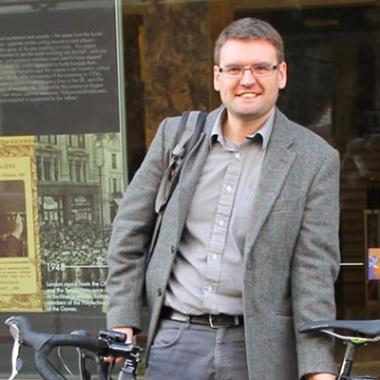
Dr Patrick Smylie
Senior Lecturer
Graduating with a First Class degree in Modern History at the University of Westminster in 2006, Dr Patrick Smylie was awarded a Master’s degree in Irish History from Queen's University in 2007 and gained his doctorate in 2010.
His research has examined Irish communism and more broadly the Left in Ireland from the late 19th century until the end of the Cold War.
Recently his research has focused on urban history with an interest on the impact of ‘the Troubles’ on everyday life in Northern Ireland. He's particularly interested in housing policies aimed at maintaining the peace, but which increased segregation by religion in ‘sectarian suburbs’.
I’m proud of how approachable we are. We know our students and they know us.
Course Team
- Professor Louise Sylvester - Professor of English Language
- Dr Sylvia Shaw - Senior Lecturer in English Language and Linguistics
- Dr Petros Karatsareas - Reader
- Dr Anand Syea - Reader in English Language and Linguistics
- Dr Sean Sutherland - Senior Lecturer in English Language and Linguistics
- Dr Saul Frampton - Senior Lecturer
- Dr Charles Denroche - Senior Lecturer in English Language and Linguistics
- Professor John Beck - Professor
- Dr Lucy Bond - Head of the School of Humanities
- Dr Kate M. Graham - Senior Lecturer in English Literature (Theatre)
- Dr Matthew Charles - Senior Lecturer in Cultural and Critical Theory
Why study this course?

A literary city
Study English literature and language in the heart of London, a historic literary city and home to some of the world's most celebrated writers.

Benefit from small group learning
Our fortnightly small group tutorials are designed to give you additional support during the first two years of your degree.

Gain a broad perspective
On our course, you'll study both traditional texts and texts from outside the usual literary canon, while focusing on the broader context of Western history and thought, and art and culture.
Entry Requirements
- A levels – DEE (56 UCAS Tariff points)
- T levels – 56 UCAS Tariff points
- International Baccalaureate – 56 UCAS Tariff points from all components of the Diploma Programme. International Baccalaureate Career-related Programme will be considered on a case-by-case basis
- BTEC Extended Diploma – MPP
- BTEC Diploma – MM
- Access – 56 UCAS Tariff points from the Access course
If your first language is not English, you will need an IELTS of 6.0 overall, with 5.5 in each component.
We also welcome applications from students who are taking a combination of qualifications listed above. For further information, please contact Course Enquiries.
View more information about our entry requirements and the application process
International Baccalaureate
56 UCAS Tariff points from all components of the Diploma Programme. International Baccalaureate Career-related Programme will be considered on a case-by-case basis. You can refer to the UCAS calculator to determine your point score. Find out more about acceptance of the International and European Baccalaureate.
Other international qualifications
We accept a wide range of international high school level qualifications. Please see information on Country-specific entry requirements.
International Foundation courses
We work in partnership with Kaplan International College London who provide International Foundation Certificate at their College based in London Bridge. These courses are for students who don't meet our direct entry requirements. Upon successful completion, you can progress to your chosen degree at the University of Westminster. Find out about the different university preparation courses that are accepted for entry.
English language requirements
If your first language is not English, you will need an IELTS of 6.0 overall, with 5.5 in each component.
Please note we accept a wide range of English language qualifications and assessments. Find out more at English language requirements.
If you don't meet the English language requirements yet, then we offer online and on campus pre-sessional English programmes to help develop your English language skills to the required level before you start your course. Find out more about our pre-sessional English programmes.
Study a University of Westminster degree overseas
We work in partnership with a number of academic institutions around the world that deliver a selection of our undergraduate programmes. Visit Transnational Education Partners for further information.
More information
- A levels – DEE (56 UCAS Tariff points)
- T levels – 56 UCAS Tariff points
- International Baccalaureate – 56 UCAS Tariff points from all components of the Diploma Programme. International Baccalaureate Career-related Programme will be considered on a case-by-case basis
- BTEC Extended Diploma – MPP
- BTEC Diploma – MM
- Access – 56 UCAS Tariff points from the Access course
If your first language is not English, you will need an IELTS of 6.0 overall, with 5.5 in each component.
We also welcome applications from students who are taking a combination of qualifications listed above. For further information, please contact Course Enquiries.
View more information about our entry requirements and the application process
International Baccalaureate
56 UCAS Tariff points from all components of the Diploma Programme. International Baccalaureate Career-related Programme will be considered on a case-by-case basis. You can refer to the UCAS calculator to determine your point score. Find out more about acceptance of the International and European Baccalaureate.
Other international qualifications
We accept a wide range of international high school level qualifications. Please see information on Country-specific entry requirements.
International Foundation courses
We work in partnership with Kaplan International College London who provide International Foundation Certificate at their College based in London Bridge. These courses are for students who don't meet our direct entry requirements. Upon successful completion, you can progress to your chosen degree at the University of Westminster. Find out about the different university preparation courses that are accepted for entry.
English language requirements
If your first language is not English, you will need an IELTS of 6.0 overall, with 5.5 in each component.
Please note we accept a wide range of English language qualifications and assessments. Find out more at English language requirements.
If you don't meet the English language requirements yet, then we offer online and on campus pre-sessional English programmes to help develop your English language skills to the required level before you start your course. Find out more about our pre-sessional English programmes.
Study a University of Westminster degree overseas
We work in partnership with a number of academic institutions around the world that deliver a selection of our undergraduate programmes. Visit Transnational Education Partners for further information.
More information
Learn new skills

Learn a new language
From Arabic to Spanish, you can learn a new language alongside your degree with our Polylang programme.

Develop your entrepreneurial skills
Access industry networking events, workshops, one-to-one business advice and start-up support through our award-winning WeNetwork.

Gain extra qualifications
We provide access to free online courses in Adobe and Microsoft Office applications, as well as thousands of specialist courses on LinkedIn Learning.
Fees and Funding
UK tuition fee: £5,760 (Price for Foundation year only)
The course fee applies to the Foundation year of your degree programme. When you progress from the Foundation year (level 3) to the degree (level 4), the fees will increase to match our standard degree-level fees for level 4 onwards.
Please note that if you defer your place, the first year’s tuition fees will be those of the academic year in which you enrol, which may be higher than the fee shown for this year.
Fees are subject to UK Government Parliamentary procedure.
Find out how we set our tuition fees.
Funding
As well as tuition fee loans, there is a range of funding available to help you fund your studies.
Find out about undergraduate student funding options.
Scholarships
The University is dedicated to supporting ambitious and outstanding students and we offer a variety of scholarships to eligible undergraduate students, which cover all or part of your tuition fees.
Find out if you qualify for one of our scholarships.
Additional costs
You should budget between £50–£100 for additional materials at Level 4, £50–£100 at Level 5 and £50–£100 at Level 6.
See also our general policy on what your tuition fees cover.
International tuition fee: £19,000 (Price for Foundation year only)
When you have enrolled with us, your annual tuition fees will remain the same throughout your studies with us. We do not increase International tuition fees.
Please note that if you defer your place, the first year’s tuition fees will be those of the academic year in which you enrol, which may be higher than the fee shown for this year.
Find out how we set our tuition fees.
EU Qualifications Welcome Award Scheme
If you are an international student accepted on an undergraduate programme starting in September at level 3 (Foundation) or level 4 (first year) on the basis of an eligible EU qualification only, you will be awarded a £4,500 tuition fee reduction off your first year of studies. For more information, see the EU Qualifications Welcome Award Scheme.
International student funding
Find out about funding for international students.
Additional costs
You should budget between £50–£100 for additional materials at Level 4, £50–£100 at Level 5 and £50–£100 at Level 6.
See also our general policy on what your tuition fees cover.
UK tuition fee: £5,760 (Price for Foundation year only)
The course fee applies to the Foundation year of your degree programme. When you progress from the Foundation year (level 3) to the degree (level 4), the fees will increase to match our standard degree-level fees for level 4 onwards.
Please note that if you defer your place, the first year’s tuition fees will be those of the academic year in which you enrol, which may be higher than the fee shown for this year.
Fees are subject to UK Government Parliamentary procedure.
Find out how we set our tuition fees.
Funding
As well as tuition fee loans, there is a range of funding available to help you fund your studies.
Find out about undergraduate student funding options.
Scholarships
The University is dedicated to supporting ambitious and outstanding students and we offer a variety of scholarships to eligible undergraduate students, which cover all or part of your tuition fees.
Find out if you qualify for one of our scholarships.
Additional costs
You should budget between £50–£100 for additional materials at Level 4, £50–£100 at Level 5 and £50–£100 at Level 6.
See also our general policy on what your tuition fees cover.
International tuition fee: £19,000 (Price for Foundation year only)
When you have enrolled with us, your annual tuition fees will remain the same throughout your studies with us. We do not increase International tuition fees.
Please note that if you defer your place, the first year’s tuition fees will be those of the academic year in which you enrol, which may be higher than the fee shown for this year.
Find out how we set our tuition fees.
EU Qualifications Welcome Award Scheme
If you are an international student accepted on an undergraduate programme starting in September at level 3 (Foundation) or level 4 (first year) on the basis of an eligible EU qualification only, you will be awarded a £4,500 tuition fee reduction off your first year of studies. For more information, see the EU Qualifications Welcome Award Scheme.
International student funding
Find out about funding for international students.
Additional costs
You should budget between £50–£100 for additional materials at Level 4, £50–£100 at Level 5 and £50–£100 at Level 6.
See also our general policy on what your tuition fees cover.
Teaching and Assessment
Below you will find how learning time and assessment types are distributed on this course. The graphs below give an indication of what you can expect through approximate percentages, taken either from the experience of previous cohorts, or based on the standard module diet where historic course data is unavailable. Changes to the division of learning time and assessment may be made in response to feedback and in accordance with our terms and conditions.
How you'll be taught
Teaching methods across all our undergraduate courses focus on active student learning through lectures, seminars, workshops, problem-based and blended learning, and where appropriate practical application. Learning typically falls into three broad categories:
- Scheduled hours: examples include lectures, seminars, practical classes, workshops, supervised time in a studio
- Placement: placement hours normally include placement opportunities, but may also include live projects or virtual activity involving employers
- Independent study: non-scheduled time in which students are expected to study independently. This may include preparation for scheduled sessions, follow-up work, wider reading or practice, completion of assessment tasks, or revision
How you'll be assessed
Our undergraduate courses include a wide variety of assessments.
Assessments typically fall into three broad categories:
- Practical: examples include presentations, videos, podcasts, lab work, creating artefacts
- Written exams: end of semester exams
- Coursework: examples include essays, reports, in-class tests, portfolios, dissertation
Data from the academic year 2025/26
Supporting you
We are ranked first in London for student support (Whatuni Student Choice Awards 2026).
Our Student Hub is where you’ll find out about the services and support we offer, helping you get the best out of your time with us.
- Study support – workshops, 1-2-1 support and online resources to help improve your academic and research skills
- Personal tutors – support you in fulfilling your academic and personal potential
- Student advice team – provide specialist advice on a range of issues including funding, benefits and visas
- Extra-curricular activities – volunteering opportunities, sports and fitness activities, student events and more

Course location
Our Regent Campus is comprised of two sites, situated on and around Regent Street – one of the most famous and vibrant streets in London.
Subjects including Criminology and Sociology, English and Creative Writing, History, Languages, Politics and International Relations and Visual Culture are based at 309 Regent Street, which includes recently refurbished social spaces, gym facilities and our Regent Street Cinema.
This course is based at Regent Street, though some teaching may take place at our other central London campuses.
For more details, visit our locations page.


CHANGES TO OUR COURSES
All content on our course pages is accurate at time of publication.
Where significant or material changes have been made, applicants will be informed of these in line with Competition and Markets Authority guidance.
Contact us
Call our dedicated team on:
+44 (0)20 7911 5000 ext 65511
Opening hours (GMT): 10am–4pm Monday to Friday
Opening hours (GMT): 10am–4pm Monday to Friday
More information
Your Westminster
Book an open day. Order a prospectus. Sign up for newsletters.