In the UK’s first university climate assembly, the University of Westminster has engaged its students, colleagues and contractors on how to navigate a climate-changed future, resulting in 51 recommendations. Implementation has already begun, with progress to be monitored by the University’s Sustainable Development Goals Coordinating Group and an annual review by assembly members each Earth Day.
After dynamic discussions, the members of the University of Westminster Climate Assembly (UWCA) decided to produce recommendations on three key areas. These were community and culture, learning and professional development, and emissions from information and communications technology (ICT) and artificial intelligence (AI). They then learned about each of these areas, deliberated, crafted proposals, voted and prioritised.
Of the 51 recommendations put forward in this way, 44 were supported by at least 80% of assembly members, signalling a remarkable level of consensus.
The Assembly agreed on emissions from AI first. They felt that the University’s AI policy and practices should have a strong focus on building AI literacy. For example, they thought the University should provide clear guidance on when not to use AI, given its significant environmental impact.
The role of responsible use of technology in the fight against climate change came up again in relation to ICT, and the Assembly decided that the University needs a carbon reduction plan for ICT emissions and should explore options for reducing the use of ICT equipment.
Climate engagement emerged as another key theme in the recommendations, with assembly members wanting to see a University-wide climate action week as well as climate-plus events that combine climate with the particular interests of different disciplines. They also proposed rewarding students for their contributions to tackling climate change and asked for more opportunities to work on climate‑related projects with external partners, including initiatives involving local residents.
The Assembly agreed that an interdisciplinary approach was essential in the fight against climate change and recommended the development of a centre for student-led interdisciplinary projects and research focused on sustainability. Alongside this they proposed that academics be given dedicated time for the creation of interdisciplinary content around sustainability, and they highlighted the importance of giving students, academics and professional services colleagues allocated time to organise and participate in sustainability projects.
All of the assembly members supported the idea of creating a website or digital hub dedicated to sustainability, which would showcase opportunities, events and means for students and colleagues to collaborate on climate action. They also called for a peer network of committed students and colleagues to take part in discussions around the University’s climate action efforts.

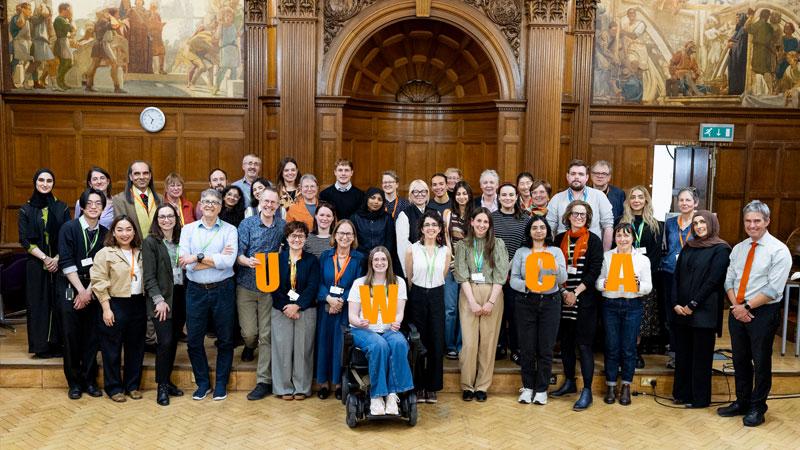
Photo: UWCA 2026 participants shared their experiences at the session celebrating the recommendations
Another recommendation was to appoint a dedicated colleague within each department to help embed climate change into the curriculum across all courses.
Finally, they called for an overarching climate change strategy to be developed in collaboration with students, colleagues and external partners, while also calling for an increase of resources and staffing in the University’s Sustainability Team.
University of Westminster Vice-Chancellor and President Professor Peter Bonfield said: “I’m so proud of our Westminster community - our students, colleagues and contractors - who came together to think deeply about how we can make meaningful contributions to addressing climate change going forward. This is so Westminster. I’m also grateful to our specialist colleagues and external partners who volunteered their expertise to support the assembly in making informed decisions.
“Sustainability has long been a priority for us but hearing directly from our community about the direction they want to take gives us renewed focus on what matters the most. I look forward to working with all to implement the assembly’s recommendations. Go Westminster!”
Graham Smith, Professor of Politics at the University of Westminster and climate assembly expert, who organised the UWCA 2026 with Dr Ro Spankie and Yasmin Kulasi, said: “The University of Westminster Climate Assembly is important for taking climate action forward but also as a way of modelling a different way of engaging the community in decision making. I’m proud this has happened at Westminster – and expect other universities will follow our lead.”
The innovative UWCA consisted of six sessions running between January and March 2026 and involved around 45 assembly members, including students, academics, professional services colleagues and contractors, all selected through democratic lottery to make sure the University’s diverse community was fully represented. Alongside assembly members around 20 other members of the Westminster community - 15 of whom were students – were professionally trained as facilitators to lead the discussions on how the University and its community could take forward meaningful action on climate change. Numerous other students and colleagues were also working behind the scenes to ensure the smooth running of the assemblies, showing the extent to which the University was rallying behind the cause.
Westminster adopted the United Nations’ Sustainable Development Goals (SDGs) in 2019, using the Goals to frame the University’s strategic decisions to support its commitment to being progressive, compassionate and responsible. Building on this work, the Climate Assembly opened a new phase for the University of Westminster in working towards Sustainable Development Goal 13: Climate Action and Goal 16: Peace, Justice and Strong Institutions.
Explore and learn more about the recommendations of the University of Westminster Climate Assembly 2026.
Learn more about the University of Westminster Climate Assembly 2026 on its dedicated Substack feed.
Find out more about Sustainable Development at the University of Westminster.

UWCA 2026 members made personal pledges

Some UWCA 2026 facilitators shared their experiences
Related articles


