A representative group of Westminster students and colleagues has now decided that they would like the University to focus on three areas, including Information and Communication Technology (ICT), community and culture, and teaching and professional development in the fight against climate change. The decision has been made as part of the UK’s first ever university-based climate assembly.
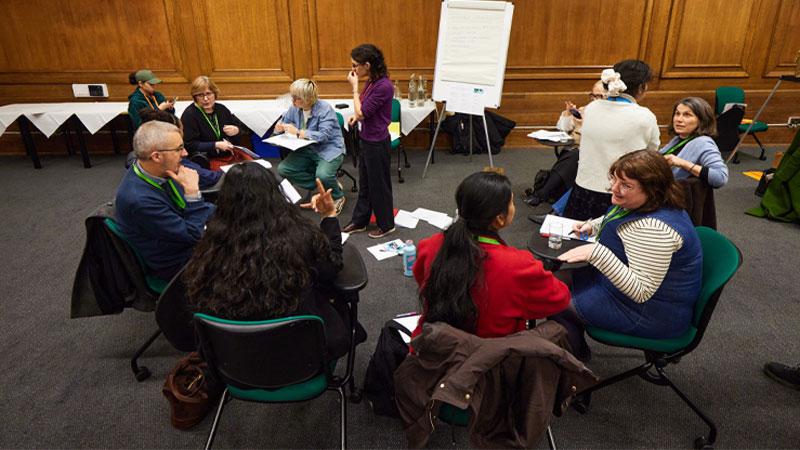
During the second session on 28 January the University of Westminster Climate Assembly (UWCA) members made the decision for ICT to be one of the three broader areas to prioritise. Assembly members narrowed it down to the climate impact of AI, including both individual use and University policies and practices; and reducing and recycling ICT waste, for example looking at hardware lifecycles, planned replacements and personal ICT waste.
The third session took place on 21 March and saw members voting to hone in on community and culture, and teaching and professional development, both of which will be explored further in a later session.
Before concluding that the assembly should prioritise teaching and professional development, members considered how climate is integrated into the formal curriculum and the professional development that is in place to support academics and professional services colleagues in delivering climate education. While the Sustainable Development Goals (SDGs) are now a required element of all courses and modules at the University of Westminster, the assembly reflected on whether the way that the University currently organises teaching provides students with sufficient knowledge and skills to navigate a climate-changed future.
To consider the area of community and culture, assembly members reflected on how the University’s current community and culture enable climate action. They were inspired by stories from within the University, including Dr Ro Spankie introducing ArCCAT, the School of Architecture + Cities Climate Action Task Force; and students Sahara Rahman and Priyambada Sinha Roy talking about the University’s flagship sustainability initiative the Cavendish Living Lab. External speakers have also given plenty of inspiration, including Katie Cross speaking on how clubs and societies can integrate climate action through Pledgeball; Jeremy Till on how bottom-up action reshaped the culture of University of Arts London; and Grace Corn from Westminster City Council sharing how partnerships can be enhanced with local communities.

Photo credit: Barr Kroter
In the subsequent UWCA sessions, the assembly members will be working hard on recommendations related to these three areas, which the University can then adopt to fight climate change effectively.
The innovative University of Westminster Climate Assembly (UWCA) consists of six sessions running between January and March 2026 and involves around 45 assembly members, including students, academics, professional services colleagues and contractors, all selected through democratic lottery to make sure the University’s diverse community is fully represented. Alongside assembly members around 20 other members of the Westminster community - 15 of whom are students - have been professionally trained as facilitators to lead the discussions on how the University and its community can take forward meaningful action on climate change. Numerous other students and colleagues are also working behind the scenes to ensure the smooth running of the assemblies, showing the extent to which the University is rallying behind the cause.
Westminster adopted the United Nations’ SDGs in 2019, using the Goals to frame the University’s strategic decisions to support its commitment to being progressive, compassionate and responsible. Building on this work, the Climate Assembly opens a new phase for the University of Westminster in working towards Sustainable Development Goal 13: Climate Action and Goal 16: Peace, Justice and Strong Institutions.
Learn more about University of Westminster Climate Assembly 2026 on its dedicated Substack feed.
Read more about Sustainable Development at the University of Westminster.

Photo credit: Barr Kroter
Related articles


