The University of Westminster partnered with the Joint Information Systems Committee (Jisc) to host Demonstrating Digital Transformation: People-Centred Digital Futures, a one-day event that brought together colleagues, students and sector leaders to explore how universities can place people at the heart of digital change.
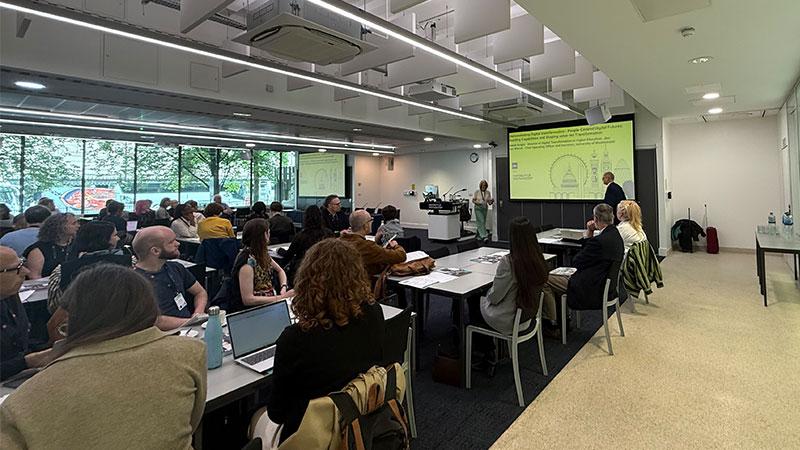
The event, held at the University's Marylebone Campus, drew participants from across the institution for a packed programme of keynotes, lightning talks, workshops and collaborative sessions centred on building digital capabilities and shaping value-led transformation.
Delegates were welcomed by Ian Wilmot, University Secretary and Chief Operating Officer, and Sarah Knight, Director of Digital Transformation at Jisc, who together framed the day around the importance of people-first approaches to digital transformation and skills co-design.
The opening keynote, Keeping it Human: People and Capabilities First in a Digital World, was delivered by Professor Catherine O'Connor, Deputy Vice-Chancellor for Education and Student Experience. Professor O’Connor explored the critical role that people play in shaping and delivering digital transformation, emphasising that as organisations and their associated practices continue to evolve at pace, keeping the human element central remains essential.
A lightning showcase session followed, offering short, focused presentations on digital capability projects from across the institution. Head of Library and Archives Services Lisa McLaren presented Library Lens, highlighting innovative digital approaches within the University’s library services. Stephanie Coelho introduced the Westminster Digital Academy, a platform designed to support digital skills development for students across the University, and Olga Núñez-Pineiro, Senior Lecturer in Languages, explored new developments in Digital Humanities, demonstrating how digital tools are opening up fresh avenues for research and teaching in the humanities.
Attendees then split into three parallel workshops that addressed some of the most pressing themes in higher education today. Digital Learning Development Specialist Anna Klemming and Lecturer in Academic Professional Development Matt Galton led a session on Digital Transformation for People and Planet, examining the intersection of digital change with wellbeing and sustainability. Gunter Saunders, Associate Director for Digital Engagement, and Dr Doug Specht, Head of the School of Media Communications, facilitated a workshop on AI in Management and Administration, inviting participants to consider and comment on an AI competency framework for professional services. Meanwhile, Digital Development Specialist Lucy-Anne McWeeney led Teaching the Teachers, a session that championed a wellbeing-first approach to building educators' digital confidence.
The afternoon opened with a collaborative session on Digital Capabilities in an AI World, facilitated by Dr Specht and Saunders. Participants worked in groups and discussed the evolving relationship between AI and future skills needs. Outputs were captured to inform the future development of the University's capability frameworks, ensuring that the voices heard on the day would feed into institutional strategy at Westminster and elsewhere.
The day's penultimate session was a panel on Digital Skills and the Future of Work, chaired by Jisc's Sarah Knight. The panellists were Dr Specht, Saunders, Principal Lecturer in Law Dr Marloes Spreeuw, Norbert Morawetz, Chief Executive Officer of the company Potentially, recent Westminster graduate Naima Rahman, current Westminster student Chiamaka Cyril-Nwokeke, and Panagiotis Zavatzki. Together they offered wide-ranging perspectives on how digital skills development must adapt to meet the demands of a rapidly changing employment landscape.
Elizabeth Newall from Jisc then offered closing reflections, drawing together the day's key themes and outlining next steps.
The event underscored the University of Westminster's dedication to digital transformation that prioritises people, wellbeing and sustainability, reflecting its broader mission to equip students and colleagues with the skills and confidence to thrive in an increasingly digital world.
It also directly contributes to the United Nations Sustainable Development Goals (SDG) 3: Good Health and Wellbeing, 4: Quality Education, 11: Sustainable Cities and Communities and 16: Peace, Justice and Strong Institutions. Since 2019, the University of Westminster has used the SDGs holistically to frame strategic decisions to help students and colleagues fulfil their potential and contribute to a more sustainable, equitable and healthier society.
Find out more about digital transformation at the University of Westminster.


