The newly established Westminster Centre for Gene Editors of the Future has completed its first international Research and Knowledge Exchange (RKE) tour across India. Led by the Centre’s founder and director Dr Kalpana Surendranath, the tour represented the first step in an ambitious international strategy to establish the Centre as a central hub connecting genome engineering research, research-led education, skills development, industry, international knowledge exchange and student innovation.
The tour was designed not as a series of isolated academic visits but as a means to develop models through which cutting-edge science, infrastructure, expertise and opportunity can be shared more widely.
The programme engaged universities, researchers, students and senior stakeholders across India through workshops, keynote lectures, research discussions and strategic meetings, while exploring longer-term opportunities for joint research, researcher mobility, capacity building and institutional partnerships between the UK and India.
At Kongunadu Arts and Science College Coimbatore, the Centre collaborated with the Postgraduate and Research Department of Biotechnology to deliver a hands-on workshop exploring the three generations of human genome engineering. The engagement was particularly aligned with the Centre’s widening access ambition, as the college serves approximately 5000 students, many from agricultural and from socially and economically disadvantaged backgrounds.
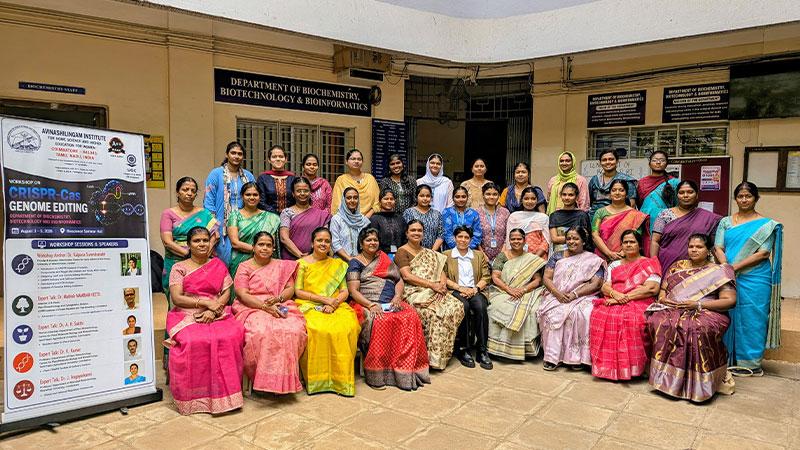
This was followed by a three-day CRISPR-Cas genome editing workshop at the Avinashilingham Institute for Home Science and Higher Education for Women, with Dr Surendranath serving as the workshop anchor. The engagement extended beyond training to women empowerment in STEM, encouraging the visibility of women in science.

Dr Kalpana Surendranath with the Honourable British Deputy High Commissioner to Telangana and Andhra Pradesh in Hyderabad. Photo credit: Taj Deccan.
The tour also included engagement with Tamil Nadu Agricultural University, KS Rangasamy College of Arts and Science and The Gandhigram Rural Institute, where Dr Surendranath delivered a keynote which connected CRISPR with sustainable innovation, entrepreneurship, food and medicine.
The tour culminated in Hyderabad with a meeting with Gareth Wynn Owen, the Honourable British Deputy High Commissioner to Telangana and Andhra Pradesh, providing an opportunity to discuss how Westminster’s leadership in combining research and education could help the connection with one of India’s most significant life sciences and biotechnology ecosystems.
Dr Surendranath said: “The Centre was launched with an ambition to connect cutting-edge genome engineering research with education, innovation and opportunity. Within days, our first Research and Knowledge Exchange tour has taken that vision internationally. What has been particularly striking throughout the tour is not simply the enthusiasm for emerging technologies but the appetite for sustained partnership. I look forward to creating an interconnected UK-India ecosystem to promote mobility of talents while ensuring that our students remain at the heart of that growth. We are grateful to the University for bringing together the support, networks and connections that are helping transform our ambition into meaningful and sustainable long-term ventures”
The RKE tour reflects Westminster’s commitment to connecting research excellence with inclusive education and global engagement. The Centre’s activities directly support the UN Sustainable Development Goals (SDGs) 3: Good Health and Wellbeing, 4: Quality Education and 17: Partnerships for Goals.
Find out more about Biological and Biomedical Sciences at the University of Westminster.


Related articles


