The University of Westminster brought together students, colleagues, alumni, researchers, industry partners and international collaborators to celebrate the official launch of the Westminster Centre for Gene Editors of the Future (WCGEF), the UK’s first gene editing centre connecting cutting-edge research with inclusive future-ready education.
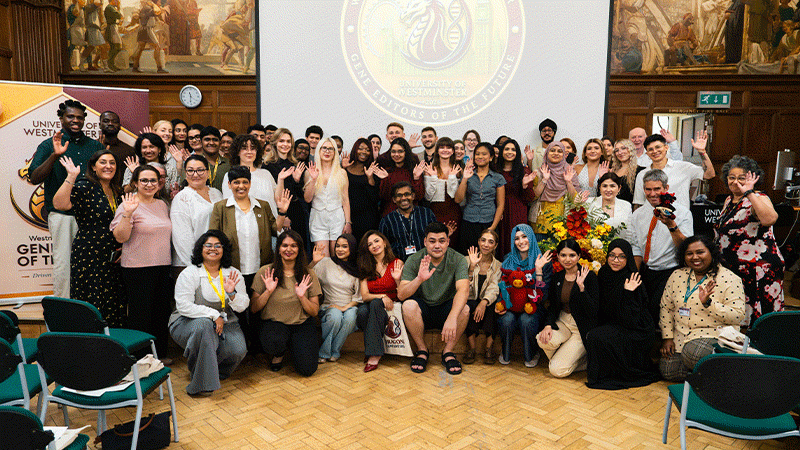
The launch celebrated the journey of the Gene Editors of the Future programme which evolved from a small co-creators initiative into a globally recognised research and education community, engaging more than 1000 student researchers across over 30 countries.
Hosted in Fyvie Hall at the Regent Street Campus, the day opened with an inaugural address from the University’s Vice-Chancellor and President Professor Peter Bonfield. This was followed by a celebration of the completion of the programme’s fifth iteration, where students who completed the Basic Gene Editing Training Programme were recognised with certificates. Dr Sandeep Sundararajan, Technical Specialist at the Wellcome Sanger Institute, then presented the advanced training award for those students who undertook training in in-silico design and high throughput molecular cloning techniques.
At the launch event students had the chance to showcase their research, which featured a wide range of creative and technically advanced projects developed through the programme. Students included Aya Hijazi, Donald Stavri, Nayma Rahman, Umer Asif, Ann Mariya Job, Emily Turnham, Elyka Ramirez, Sinead Hynes and Nyla Hyat. The showcase also highlighted contributions from industry partners including Integrated DNA Technologies (IDT), Azenta Life Sciences (GeneWiz) and Takara Bio, reflecting the Centre’s commitment to connecting education with real‑world scientific practice.
Messages of support were also shared by international collaborators from Al‑Farabi Kazakh National University in Kazakhstan, Erasmus MC in the Netherlands, Kongunadu Arts and Science College in India, A*STAR Institute in Singapore, and partners in Switzerland and Australia, demonstrating the global reach and collaborative spirit of the programme.
Dr Kalpana Surendranath, Founder and Director of WCGEF, led the plenary address, exploring the evolution of the Gene Editors programme along with the vision, mission and future ambitions of the Centre.
Professor John Murphy, Professor of Biomedical Sciences, delivered a keynote presentation showcasing how research activities of the Genome Engineering Laboratory underpin the opportunities provided to the students on the programme. This was followed by a student tribute to Professor Bonfield through a specially curated poem read collectively by the audience, compiled from messages submitted by over 50 Dragons Gene Editors expressing their gratitude for the opportunities to flourish.
In the evening, attendees gathered at the Cavendish Campus for the formal launch of the Centre, which was opened with a welcome address by Professor Alistair Mathie, Head of the School of Life Sciences, who highlighted the student engagement and impact of the programme.
Joshua Fleming, Head of Strategy Oversight and Implementation at the Office for Students, expressed his appreciation for the opportunity to participate in the launch, noting the Centre’s commitment to widening access to cutting-edge science, empowering students through authentic experiences. His presence reflected the importance of the Centre’s mission in advancing excellence and innovation in UK Higher Education.
The launch outlined a five‑year roadmap for expanding the Research-Education Nexus model, celebrated student leadership within the programme and marked a milestone in Westminster’s commitment to widening participation in STEM through accessible, high‑impact scientific training.
The evening also celebrated the journeys of the veteran Gene Editors, Munuse Ceyda Savash from the University of Oxford, and Khalid Akram, final-year PhD student in Biotechnology at Westminster. The Centre’s partnerships with the Queen Mary Centre for Undergraduate Research was also celebrated with a talk by Dr Giuseppe Viola from Queen Mary University of London (QMUL) and Mohammad Ali Illumina from the University of Cambridge.
By working with several high-profile partner institutions including QMUL, Royal Holloway, the Wellcome Sanger Institute, Wellcome Connecting Science, the Quintin Hogg Trust and international partners in Kazakhstan, Netherlands, India and Switzerland, the Centre aims to build understanding among researchers of all levels and empower the next generation of researchers to address global challenges in healthcare, biotechnology and sustainability while fostering innovation, interdisciplinary collaboration and responsible scientific leadership.
About the launch, Dr Surendranath said: “Throughout the day, the energy, enthusiasm and appreciation demonstrated by our students for the opportunities available at the University were truly inspiring. As the most extensive and ambitious Dragons Gene Editors event ever organised at Westminster, the occasion provided a fitting platform to mark the launch of our first full-fledged research-education nexus reinforcing our University’s position as a leader in research-informed education and future-focused learning. We extend our sincere thanks to all our student leaders, colleagues, international collaborators, industry partners and supporters from around the world for joining us in marking this important milestone.”
Professor Dibyesh Anand, Deputy Vice-Chancellor of Global Engagement and Employability at the University, added: “This Centre refuses the tired choice between excellence and belonging: it puts world-class gene-editing science into the hands of students from diverse backgrounds, and makes clear that each of them belong at its bench. That is how we grow not just skilled scientists, but responsible global citizens who understand that scientific questions are never separable from the societies they serve.”
The Westminster Centre for Gene Editors of the Future directly contributes to the United Nations Sustainable Development Goals (SDGs) 3: Good Health and Wellbeing, 4: Quality Education and 17: Partnerships for the Goals. Since 2019, the University of Westminster has used the SDGs holistically to frame strategic decisions to help students and colleagues fulfil their potential and contribute to a more sustainable, equitable and healthier society.
Find out more about the Gene Editors of the Future programme at the University of Westminster.


Related articles


