The University of Westminster hosted its annual CRISPR VIP Festival to celebrate and mark the launch of its new Gene Editors x Dragons collaboration, bringing together the long-running Gene Editors of the Future programme and the University’s community-building Dragons initiative.
Gene Editors of the Future, Westminster’s flagship extracurricular scientific initiative, has been formally designated under the Dragons banner to signify excellence at the intersection of research and education. The Dragons identity celebrates the exceptional students, academics and initiatives across the University community.
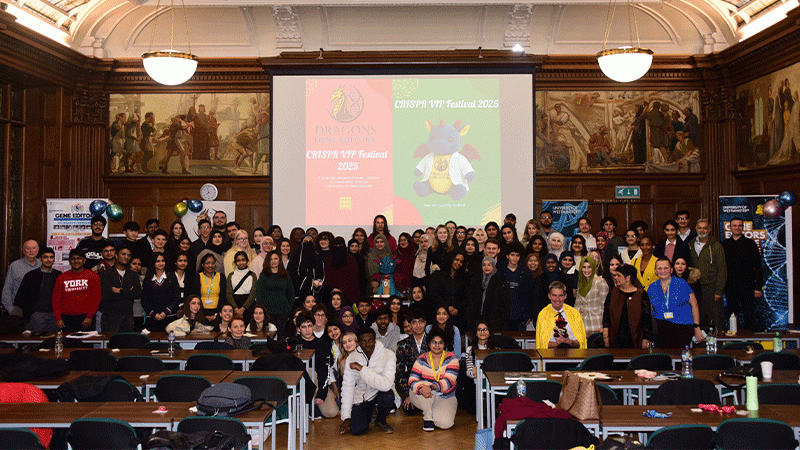
To recognise this excellence, the festival saw over 150 students fill Fyvie Hall on the University’s Regent Street Campus on 12 December for the CRISPR VIP Festival 2025. Hosted by the Gene Editors of the Future programme, the event celebrated student-led innovation, research and the growing impact of research-engaged education.
The event opened with remarks from Vice-Chancellor and President of the University of Westminster Professor Peter Bonfield, who outlined the origins of the Dragons initiative and reflected on its alignment with the excellence represented by the programme. He was joined by Aya Hijazi, Dragons National Boxing Champion, who spoke about resilience, aspiration and the spirit of the Dragons community.
This was followed by Dr Kalpana Surendranath, Reader in Genome Engineering and Director of the Gene Editors of the Future programme, who reflected on half a decade of student progress within the project and the expanding opportunities now available through the new collaboration. She highlighted the inspiration, motivation, underpinning concepts and accomplishments that have defined the programme’s five-year trajectory, including its recent national recognition by Advance HE.
Students and alumni then had the chance to take the stage to speak about their experiences with the initiative. Munuse Ceyda Savash, Biological Sciences BSc Honours alumna and current PhD student at the University of Oxford, and Khalid Akram, PhD student in Westminster's School of Life Sciences, reflected on the transformative influence of research-engaged learning at Westminster. Munuse also presented a hand-crocheted Dragon editing DNA she created to Professor Bonfield as a mark of admiration for the Dragons Gene Editors initiative.
Graduate interns Nadheera Begum, Ann Maria Job and Veronika Sutova from the Genome Engineering Laboratory also offered their insights and explored the lived experience of authentic research environments.
A key highlight of the festival was strengthening the University’s partnership with the Queen Mary Centre for Undergraduate Research (QMCUR). To do this, Dr Giuseppe Viola, Director of QMCUR, showcased how shared undergraduate research initiatives are helping students engage with real-world scientific challenges early in their academic journeys. Drawing inspiration from educational philosophers, both initiatives aim to break down traditional structures in learning and give students a stronger voice as partners in the learning process.
Dr Gulzhan Kerimbekova, Bolashak Fellow and Head of Clinical Diagnostics at the National Research Oncology Centre in Kazakhstan, also shared an international perspective. Currently undertaking a professional internship at the Genome Engineering Laboratory, she presented her mission to build a molecular cancer diagnostic laboratory.
The programme also recognised student achievement through the Advanced Gene Editors and Internship 2025 Awards and an undergraduate research forum titled Engineers Meet Gene Editors, featuring presentations from both Westminster Gene Editors and Queen Mary Engineering students.
Professor Bonfield said: “Huge congratulations to Dr Kalpana Surendranath, her colleagues, helpers and students for the superb work they do to explore and develop the science and techniques of gene editing. A perfect example of science, community, ambition and fun. It's exciting and inspiring to see them become Dragon Gene Editors in recognition of their excellence, strength and community. Wonderful!”

Caption: Dragons cake baked by student Ribana Cristescu.
Ribana Cristescu, Cognitive and Clinical Neuroscience BSc Honours student, who attended the event, added: “The CRISPR VIP Festival felt extraordinary, not only for the science we celebrated, but for the humanity behind it. Every student who spoke shared a journey shaped by curiosity, resilience and a deep desire to make a meaningful contribution.
“The programme was born from the seeds planted by Dr Surendranath, which were nurtured with passion, determination and an unwavering belief in students’ potential. Today, that seedling has become a young tree that needs a guardian to protect it. The Dragon of Excellence now watches over it, symbolising integrity, ethics, quality and the Sustainable Development Goals-guided purpose that shape this programme. The result is a truly unique community where imagination meets scientific rigour and where students feel empowered to grow far beyond what they once believed possible. I was honoured to contribute to such an inspiring evening, and deeply grateful to be part of this remarkable community of excellence at Westminster.”
The Gene Editors x Dragons collaboration directly contributes to the United Nations SDGs 3: Good Health and Wellbeing, 4: Quality Education and 17: Partnerships for the Goals. Since 2019, the University of Westminster has used the SDGs holistically to frame strategic decisions to help students and colleagues fulfil their potential and contribute to a more sustainable, equitable and healthier society.
Learn more about the Gene Editors of the Future programme at the University of Westminster.


