Seven projects, awarded funding in 2025-26 for sustainability-related projects and initiatives through the generous support of Westminster alumnus Graham Hobson, were celebrated at the end of the academic year.
Now in its fifth year, the Sustainability Fund is organised via a partnership between Westminster’s Sustainability Team and its Centre for Education and Teaching Innovation (CETI). The Fund invites students and colleagues to realise a short-term project during the second semester, founded on the principles of sustainable development and equal partnership.
Three out of seven projects - EcoBrick, Slowing Fast Fashion Down II and Microvision - have returned this year to the Fund to continue building on past iterations.
The EcoBrick project, now in its third year, continued developing sustainable bricks that support biodiversity. Working with Bulmer Brick and Tile, the team, including students Clevy Bento alongside Lecturer in the School of Architecture + Cities (SAC) Dr Corinna Dean, experimented with duckweed - 1,700 tonnes of which are removed from London canals annually - and boiled seaweed as a natural binder to create bio-receptive bricks. They also designed a tile mould to encourage bat habitation, with a testing wall planned to be built at the University’s Marylebone Campus. The team has also been invited to present their work on the EcoBrick project as part of the Marylebone Minds series within the Saint Marylebone Festival.
The Slowing Fast Fashion Down II team, involving students Anna Long and Tugce Yigit alongside Senior Lecturer of the SAC Maria Kramer, tested how fabric waste can become an architectural material. Partnering with upcycling design house RE_CONSIDERED, they produced a bench made from clothes discarded by Westminster students, shredded at textile recycling start-up FibreLab and turned into panels using bio-resin. Varnished with hemp oil for outdoor durability, the bench features a truth window showing textile remains which could not be shredded. The team hopes this design will appeal to retailers and public spaces as a way to engage people with circular fashion practices.

Slowing Fast Fashion Down II bench with team members Tugce Yigit and Anna Long
The Microvision project, involving students Oliver Bryan, Tommy Priest, Thomas Russel and Michal Wasowski alongside colleagues Muharrem Maloku and Senior Lecturer in Computer Science and Engineering Dr Saumya Reni, produced a prototype of an affordable, low-power automated medical microscope and slide scanner designed for communities with limited access to expensive medical equipment. This device uses motorised X, Y and Z movement, is controlled by a single-board computer with integrated power management, and can be operated through a web interface. The team now plans to refine the prototype in collaboration with the School of Life Sciences.
This year’s four new projects evoked themes of equality and representation, circular design, healthcare and innovative pedagogies and mental health and wellbeing.
Team Aya, involving students Kaavya Lakshminarayanan, Alice Moore and Aayushi Shahu alongside Lecturers in Media and Communication Dr Nathasha Fernando and Reshel Shah, created a short documentary about a young British-Muslim woman – Life Sciences student Aya Hijazi – who became the first hijabi national amateur boxing champion in Great Britain. The documentary looks past the ring to consider how Aya channels determination, faith, anger and ambition into a space that, unexpectedly, became the one that made sense for her. The team will be submitting their film to festivals and hope to host a screening at the University’s Regent Street Cinema.
BetaCore combined sustainability innovation with the team’s passion for rock climbing to address the sport’s growing environmental impact. The team, involving students Aydan Ackermann, Zeliha Aydin and Marta Massarini alongside Senior Lecturer in Management and Marketing Philip Holden and Senior Lecturer in Organisations, Economy and Society Dr Martin Mathews, designed a modular climbing shoe that allows climbers to replace only worn components, encouraging a repair-driven culture and a deeper connection between climbers, craft and nature. After consulting London-based climbing gyms, they focused on designing a modular training shoe tailored for beginners.
The EcoAnatomy project aimed to transform anatomy education through sustainable, inclusive, and neurodiversity-supportive methods. The team, involving students Vera Bowerman, Elizabeth Daketse and Ruweyda Elmi alongside Senior Lecturer in Life Sciences Dr Joan Liu and Assistant Laboratory Technician Ignas Stankaitis, created reusable 3D-printed anatomical models and interactive activities – such as painting regions of a 3D-printed brain – to replace traditional dissection and reduce exposure to hazardous materials. Using in-house printers, recycled materials and washable paints, they developed affordable teaching tools, focusing on the brain and beginning early prototypes of the nephron.
The final project saw a team of students Bobby Brewe, Fatima Butt, Keira Mannion and Trix Valentine with Senior Lecturer in Media and Communication Dr Christopher Hogg producing the podcast ScreenWell. They explored the importance of wellbeing during turbulent times and asserted that the first step to staying well is communication. Using the screen industries as a launching-point, the podcast explored themes of universal importance for work and life today. Each episode centres around a professional screen-industry guest where they share personal stories, reflect on triumphs and challenges and offer insights on maintaining wellbeing.
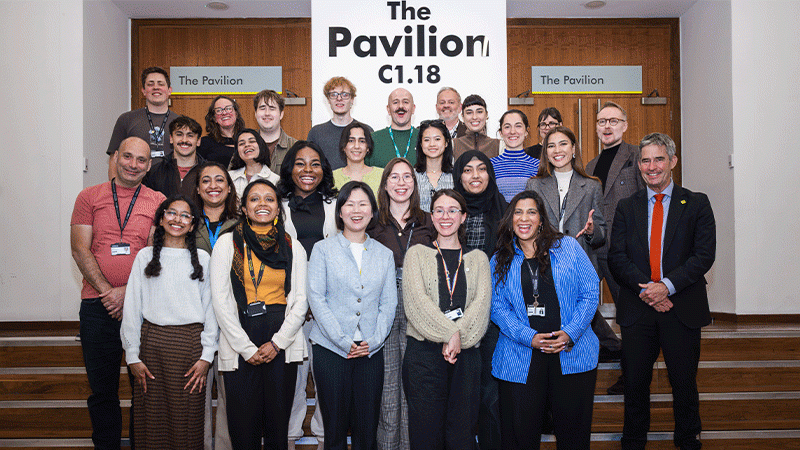
The Sustainability Fund teams presented their projects at a finale event in the Pavilion at Cavendish Campus and met with Graham Hobson at Zone29.
Morgan Lirette, Sustainable Development Advisor in the Sustainability Team and Organiser of the Fund, said: “We whole heartedly thank the students and our colleagues for their dedication to not only participating but going the extra mile in the extracurricular Sustainability Fund – their creativity in and dedication to sustainability continues to be an inspiration.”
Dr Andy Pitchford, Head of the CETI, said: “The projects this year have taken us to a new level. There has always been fantastic innovation with each iteration of the Fund, but this round has seen more ideas that are scalable or that can be turned into enterprise concepts. Each year we are blown away by the quality and ingenuity of the work from colleagues and students. It is such a pleasure to see.”
One student who took part in the Fund added: “The Sustainability Fund successfully encouraged us to develop and implement our creative ideas. It created opportunities for collaboration and learning about project management.”
Another student added: “The Fund provided a sense of teamwork I don’t normally get in regular university work and being able to work with people outside the University has been a great opportunity.”
The Sustainability Fund directly contributes to the United Nations Sustainable Development Goals (SDGs) 4 Quality Education, 12 Responsible Consumption and Production and 17 Partnership for the Goals. Since 2019, the University of Westminster has used the SDGs holistically to frame strategic decisions to help students and colleagues fulfil their potential and contribute to a more sustainable, equitable and healthier society.
Learn more about the Sustainability Fund at the University of Westminster.


Related articles


