The University of Westminster recently hosted the London Higher Equality, Diversity and Inclusion (EDI) Network Annual Summer Conference, welcoming EDI professionals, including practitioners, sector leaders and academics, from across London’s higher education sector to explore some of the most pressing challenges facing higher education today.
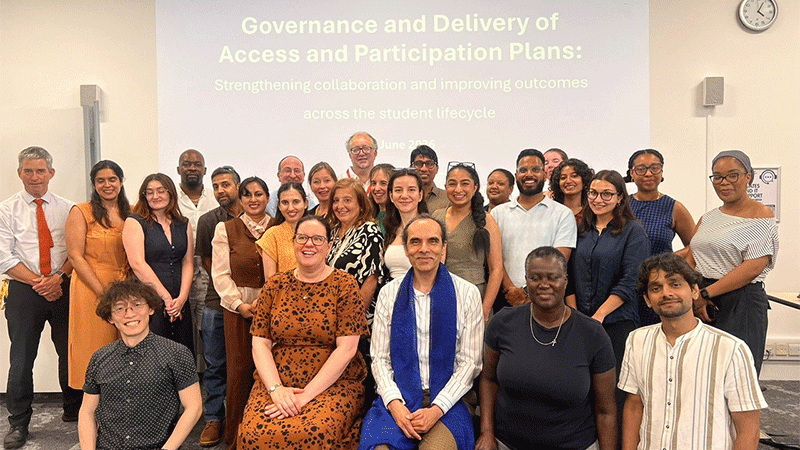
Titled Cohesion and Contestation: EDI in Contemporary Times, the conference, held on 23 June, provided a valuable opportunity for delegates to share knowledge, strengthen professional networks and discuss practical approaches to advancing inclusion within a complex social and political landscape.
The afternoon began with a networking lunch before delegates were welcomed by the University’s Vice-Chancellor and President Professor Peter Bonfield and co-chairs of London Higher’s EDI Network Professor Dibyesh Anand, Deputy Vice-Chancellor of Global Engagement and Employability at Westminster, and Amy Norton, Head of EDI at the London School of Economics and Political Science.
The conference featured three thought-provoking sessions that covered key issues currently shaping the higher education sector. The first session, titled EDI and Contested Political Terrain, was led by Professor Anand, who explored resilience and effective EDI practices within an increasingly polarised political climate.
The second session, Governance and Delivery of Access and Participation Plans, chaired by Dr Richard Boffey, Head of AccessHE, the pan-London network supporting underrepresented learners to access and succeed in higher education, focused on strengthening collaboration to improve student outcomes.
The final session, Understanding and Addressing Antisemitism in University Settings, chaired by Amy Norton, examined practical approaches to creating safer, more inclusive university communities.
Each session encouraged open discussion and the sharing of experiences between institutions, reinforcing the importance of collaboration across the sector in responding to emerging challenges.
The event concluded with reflections from participants, who left with renewed ideas, stronger professional connections and a shared commitment to advancing EDI across the higher education sector.
Reflecting on the event, Amy Norton said: “It's always a pleasure to spend an afternoon in the company of our fellow EDI practitioners across London universities, but the current political climate and pressing issues we're facing – everything from the rise of nationalist politics in the UK and beyond to the recent antisemitic attacks in London – meant that the conference had real purpose and strong engagement from all participants. Huge thanks to Peter and Dibyesh for hosting everyone and to London Higher for all their work to support the EDI network.”
Professor Anand added: “The easy response to a hard climate for EDI is to go quiet and this conference was a refusal to do that. Universities can play a crucial role in generating a culture based on contestation of ideas, freedom of expression, community cohesion and celebration of difference. A network like ours is a space for conversation as well as a soft infrastructure that holds the work together when the pressure is on. I am grateful to colleagues across London for doing it together.”
The conference directly contributes to the United Nations Sustainable Development Goals (SDGs) 4: Quality Education, 10: Reduced Inequalities and 17: Partnerships for the Goals. Since 2019, the University of Westminster has used the SDGs holistically to frame strategic decisions to help students and colleagues fulfil their potential and contribute to a more sustainable, equitable and healthier society.
Learn more about other Equality, Diversity and Inclusion events at the University of Westminster.
Related articles


