The Destinations and Experiences Research Centre (DEX) at the University of Westminster hosted a roundtable discussion to explore how events can serve as living labs for sustainable innovation. Attendees discussed how urban events such as festivals and concerts can be used to experiment with new ideas and sustainable solutions.
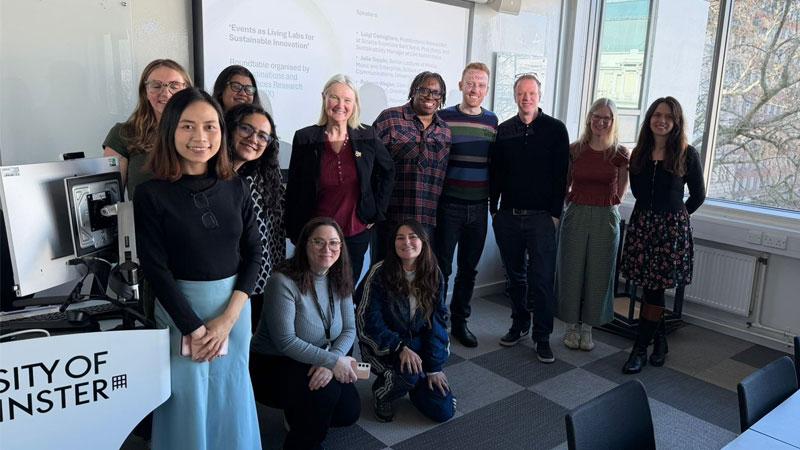
The roundtable event titled Events as Living Labs for Sustainable Innovation brought together speakers and participants from both industry and academia and from a range of subject areas. Attendees gathered at the University of Westminster from a variety of countries, including Italy, the Netherlands, Hong Kong, Vietnam, Palestine, Iran, Colombia and the UK.
The event began with a series of presentations by academics and international guests from across the tourism and events industry, which combined research with insights from professional practice. Westminster colleagues Professor Andrew Smith, Professor of Urban Experiences and Co-Director of DEX, and Julia Toppin, Senior Lecturer of Media, Music and Enterprise, offered research insights, alongside a range of speakers from organisations across Europe.

Guest presentation
Guest speakers included Dr Luigi Cernigliaro, a Postdoctoral Researcher at Scuola Superiore Sant’Anna, Pisa, and Sustainability Manager at Live Nation Italia; Rob van Wegen, Sustainability Coordinator at the Futureproof Group, Netherlands; and Jayni Gudka, Founder and CEO of Sama Sama International London tour providers.
The presentations offered diverse perspectives on how events and temporary cultural experiences can function as spaces for innovation, experimentation, learning and transformation, with impacts beyond the event itself. For example, new ideas can be tested, sustainable innovations can be fostered and participants can experience responsible consumption practices for a limited time.
Dr Ilaria Pappelepore, Reader in Events and Tourism at Westminster, then chaired a roundtable discussion which further explored and challenged ideas and examples from the presentations. A range of themes and ideas related to events as living labs were discussed, including events as experimental urbanism, what distinguishes living labs from other experimental environments, and the challenges involved in translating temporary experiments into lasting systemic change.

Roundtable
About the event, panel chair Dr Ilaria Pappalepore said: “We had a truly fascinating conversation about how and why events can serve as testbeds for sustainable innovation, and it was wonderful to welcome visitors from so many countries. Events are unique: their temporary and experiential nature makes them ideal environments for testing new ideas, policies, systems and designs.
“We now hope to build on these discussions, particularly around how temporary experiments can translate into systemic change and how their legacies can be meaningfully measured, through a second panel discussion, Responsible Cultural Consumption and Production: From Creative Sustainable Practices to Lasting Impact, taking place at the University of Westminster on 29 April.”
This event directly contributes to the United Nations Sustainable Development Goals (SDGs) 11: Sustainable Cities and Communities, 12: Responsible Consumption and Production and 17: Partnerships for the Goals. Since 2019, the University of Westminster has used the SDGs holistically to frame strategic decisions to help students and colleagues fulfil their potential and contribute to a more sustainable, equitable and healthier society.
Find out more about Tourism and Events Management at the University of Westminster.


