The University of Westminster recently hosted Contestations, Cohesion and Communities, the sixth annual Challenging Racisms Conference, bringing together academics, practitioners and activists for a day of insightful discussions and engaging conversations on combating racisms, embracing difference and exploring commonalities.
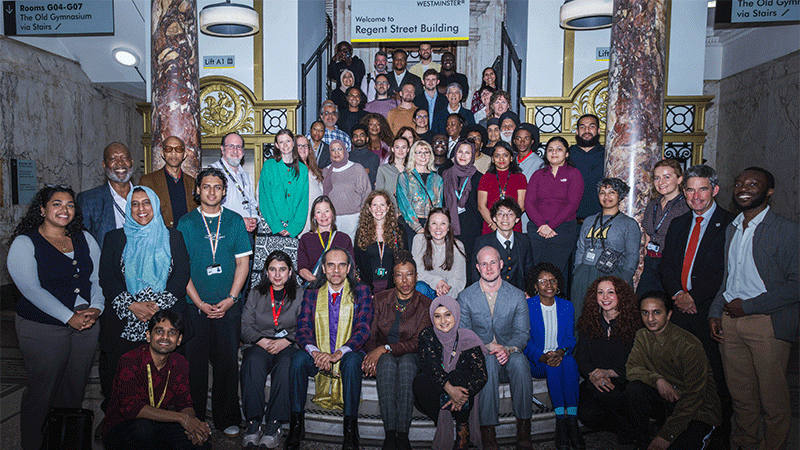
This year, the University nodded to its past to explore legacy and longevity. Held on 7 May in Fyvie Hall at the Regent Street Campus, the event featured three panel discussions and three interactive workshops, where attendees could critically discuss racism, identity, intersectionality and structural inequalities within and beyond academia. These were accompanied by a scenario-based session addressing race and ableism in the workplace and educational settings.
The conference was open to all those committed to equity, inclusion and social justice and aimed to encourage dialogue and create a learning space to generate practical outcomes for anti-racist practice.
The event was opened by the organising team alongside David Bass, Director of Inclusion and Governance at Advance HE and Westminster alumnus in Commercial Music BA Honours, and Vice-Chancellor and President of the University Professor Peter Bonfield.
This was followed by a panel chaired by Dr Deborah Husbands, Chartered Psychologist and Reader in Race and Sociocultural Psychology at the University, on institutional commitments to anti-racism. She was joined by Dr Dave Thomas, Senior Fellow of the Higher Education Academy at Advance HE and Head of EDI at the Royal College of Art, and Dr Lindy‑Ann Blaize Alfred, Lead Consultant of EDI at Advance HE. Together, they kicked off the conference with a glance over the last six years and subsequent wave of institutional anti-racist commitments.
The second panel, chaired by Professor Dibyesh Anand, Deputy Vice-Chancellor in Global Engagement and Employability, explored social tensions spilling over into universities, particularly focusing on antisemitism and Islamophobia. Panelists included Akeela Ahmed MBE, CEO of the British Muslim Trust, Samantha Cass, Head of Campaigns at the Union of Jewish Students, and Robiu Salisu, Senior Consultant of EDI at Advance HE. With their diverse lived and professional experiences, the speakers delved into the experiences of minoritised communities and the challenges they face every day.
The third and last panel, chaired by David Bass, welcomed Chief Officer for Transformation, Change and Communities in Local Government at Advance HE and Pro-Vice-Chancellor of EDI at Durham University Dr Shaid Mahmood, Senior Fellow of the Higher Education Academy in the School of Education and Social Sciences at the University of the West of Scotland Professor Khadija Mohammed, and Professor Anand. This panel left attendees with much food for thought with discussions on representation at a senior level and how to be brave and vulnerable when expressing views and seeking culture change.
Throughout the day various workshops took place where participants were given creative materials to assist in expression and aid those with different working and reflective styles. The sessions centred on the questions of negotiating different experiences and opinions in classrooms, transitioning from a diverse university to workplace and tackling growing pushback against EDI in the wider society.
The event concluded with closing reflections, which highlighted the importance of being bold, honest and relentless, and the significance of partnering with organisations like AdvanceHE to make the sector and society better.
The event was organised by Dr Husbands, Professor Anand and Zahrah Surooprajally, Equality, Diversity and Inclusion (EDI) Event Manager, in partnership with Advance HE.
Professor Anand and Dr Husbands added: “Universities cannot pretend to be sealed off from the social tensions around us. Antisemitism, Islamophobia, anti-Blackness and racism do not stop at our gates and cohesion built on silence is not cohesion, but avoidance dressed up as civility. The question for members of the sector, including the senior leaders, is whether we can hold our nerve through contestation rather than retreat into managerial caution, because allyship and EDI are not optional add-ons but integral to culture change. We are honoured to host these annual conferences that help us explore challenges and opportunities of working together toward an antiracist sector and society.”
Akeela Ahmed MBE said: “Events like the University’s Challenging Racism Conference are vital. Muslim students are navigating campuses while facing real hostility and that cannot be ignored or minimised. When academics, students and civil society come together to name anti-Muslim hate and confront it collectively, we send a powerful message: no form of hatred is acceptable and no community faces it alone.”
Samantha Cass added: “This conference created an important space for honest, challenging and necessary conversations about racism, belonging and the responsibilities of our institutions. Speaking on the panel was a valuable opportunity to highlight the lived experiences of Jewish students, the growing normalisation of antisemitism on campus and the urgent need for universities to confront hatred consistently. At a time of heightened fear and division, spaces like this matter because they remind us that cohesion cannot be built through silence or avoidance, but through accountability and the courage to name the problem clearly.”
The conference directly contributes to the United Nations Sustainable Development Goal (SDGs) 10: Reduced Inequalities. Since 2019, the University of Westminster has used the SDGs holistically to frame strategic decisions to help students and colleagues fulfil their potential and contribute to a more sustainable, equitable and healthier society.
Learn more about equality, diversity and inclusion events at the University of Westminster.


Related articles


