The Regent Street Cinema (RSC) has launched a new film series, Yet Another Movie: Pink Floyd in Film, celebrating the rock band’s long‑standing connection to the University of Westminster. The film festival is set to recognise the band’s impact within the film industry and mark the cinema’s 130th anniversary.
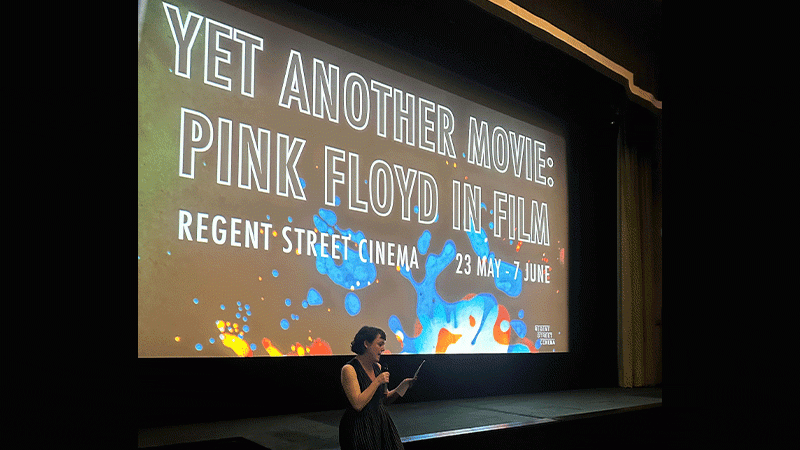
As the birthplace of British cinema, the RSC has been celebrating its 130-year legacy throughout 2026, highlighting the University’s historic relationship with those creators who drew inspiration from their higher education environment.
Between 1962-1966, Pink Floyd members Nick Mason, Roger Waters and Richard Wright studied Architecture at the Regent Street Polytechnic, where the band first formed. To honour the shared heritage between the University and one of Britain’s most influential rock groups, the season will bring together a selection of films featuring their music - either as a band or as solo artists - alongside work by several key collaborators and members of their creative circle.
Curated by film critic and programmer Sophia Satchell-Baeza, the events will take place between 23-24 May and 7-8 June. The mini festival includes an exclusive new interview with Nick Mason, where he will explore this important period of the band’s development.
Screenings will include the remastered 1967 film Tonite Let's All Make Love in London by Peter Whitehead; Barbet Schroeder’s 1969 movie More; the 1970 film The Body by Roy Battersby; Pink Floyd: The Wall, which was made in 1982 by Alan Parker; When the Wind Blows, a film directed by Jimmy T. Murakami in 1986; and the UK premiere of a new 4K restoration of the 1973 film Crystal Voyager. The festival will also feature shorts by Anthony Stern, Kevin Whitney, Robert Short and John Latham. With each new screening the cinema will welcome a range of critics, academics and countercultural participants such as Jenny Fabian, the author of Groupie, to introduce and contextualise each one.
Sophia Satchell-Baeza said: “There are few British rock groups more entwined with the moving image than Pink Floyd. From their rise through 1960s London counterculture, performing in multiple-projection environments and pioneering music promos through to their original film scores for directors including Michelangelo Antonioni, Barbet Schroeder and Peter Sykes, the band’s story is one of how rock briefly became inextricable from counterculture – both in film and beyond it. Some of the films, like Antonioni’s Zabriskie Point, are bona fide classics, while others, like David Elfick’s surfing documentary Crystal Voyager, have resurfaced as cult artefacts. It turns out the band’s connection to cinema was there from the beginning.”
The season directly contributes to the United Nations Sustainable Development Goal (SDGs) 4: Quality Education. Since 2019, the University of Westminster has used the SDGs holistically to frame strategic decisions to help students and colleagues fulfil their potential and contribute to a more sustainable, equitable and healthier society.
Learn more about Film and Television courses at the University of Westminster.
Related articles


