Students at the University of Westminster recently hosted the ninth annual Democratic Education Network (DEN) International Conference, bringing together more than 100 students, colleagues and international partners to explore how Artificial Intelligence (AI) is reshaping the way we learn.
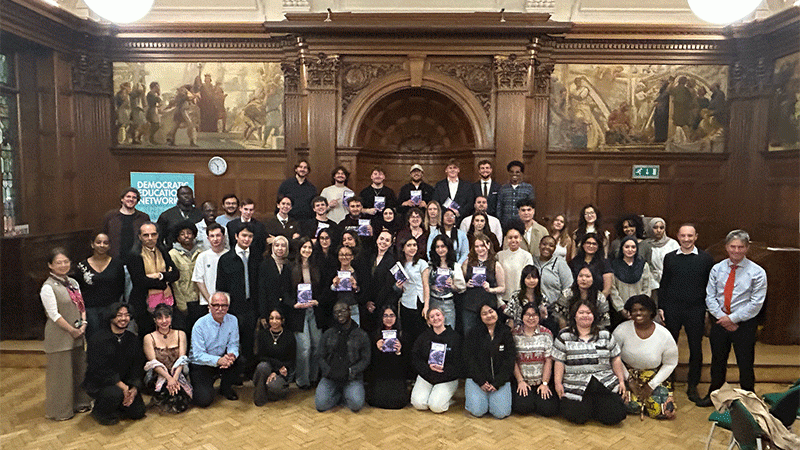
The conference, titled Transforming Education: Innovation for Sustainability in the AI Era, took place on Westminster’s Regent Street Campus on 8 May. From the opening remarks to the closing panel, students designed the themes, selected the panels, edited the publications and chaired the sessions, with colleagues working alongside them as collaborators. DEN's founding principle, that universities work best when students are partners in producing knowledge rather than recipients of it, ran through every part of the day.
The day was opened by Vice-Chancellor and President of the University Professor Peter Bonfield, Deputy Vice-Chancellor for Global Engagement and Employability Professor Dibyesh Anand, Head of the School of Social Sciences Alan Porter and Meyirbek Abdikadirov, Coordinator of the Sustainable Development Goals (SDG) course at Westminster International University in Tashkent (WIUT), one of the University’s Transnational Education (TNE) partner institutions.
Thirty-five speakers and presenters took part from all colleges across Westminster alongside collaborators from WIUT, Kasetsart University in Thailand and Lazarski University in Poland. The day also welcomed students from Capital City College, London, reflecting DEN's commitment to widening participation and building bridges between universities and the further education sector that prepares their students.
This year's presentations ranged from AI in education to global inequality and sustainability. Final-year Politics and International Relations BA Honours student Rita Andreieva opened the first panel with research on the Syrian Civil War, examining the consequences of international competition for the country's development. A group of students from WIUT presented The Silk Road Never Ended: It Just Went Digital, exploring how Central Asia's historic trade routes are being reimagined in the digital age. A dedicated AI in Further Education segment held by students from Capital City College then followed and highlighted how AI is reshaping learning at every stage of education.
A central moment of the day was the launch of DEN's eighth publication, Transforming Education: Innovation for Sustainability in the AI Era. The book brought together 20 student articles, written by contributors from the UK, Vietnam, Thailand, Uzbekistan and Turkey. Like the previous seven volumes, it was written, edited and peer-reviewed by students in collaboration with colleagues.
DEN, established in 2016, is a student-focused initiative at Westminster that empowers students to engage both locally and globally. It helps students build transferable skills and find work and promotes awareness of London’s diverse communities. The network is embedded in the curriculum and collaborates with the Centre for Education and Teaching Innovation (CETI) and the Equality, Diversity and Inclusion (EDI) programmes.
Reflecting on the event, Dr Farhang Morady, Founder of DEN, said: “DEN began with a simple idea that students learn best when they are partners, not recipients. Nine years on, this conference shows what that looks like when it is taken seriously. Students collaborate across borders, share their research openly and create a community built on respect and care for one another. Democracy in higher education is not something we teach - it is something we practice together and every voice that joins us makes the practice stronger.”
Professor Anand added: “DEN captures what it means to be a global university with London energy - students from four continents and from across the educational pipeline, working as equals on the questions that will define their generation. What makes me proud is not that we invite students into the conversation, but that they set its terms - they choose the themes, chair the panels and publish the work. That is the difference between treating students as recipients of knowledge and trusting them as its co-producers and it is where a university like ours is at its best.”
Ribana Cristescu, a mature student in the Cognitive & Clinical Neuroscience Student BSc Honours course, who presented on activating student assets, added: “The DEN conference filled my heart with joy, hope and inspiration. More than an academic event, it felt like a reminder that community spirit is still alive and remains the starting point for making things happen. When Professor Bonfield asked where students came from, countries from all over the world were named. Seeing many young minds united by curiosity, learning and the desire to contribute positively to the world genuinely made my heart sing.”
Rida Butt, a second-year Medical Sciences BSc Honours student who presented on impostor syndrome in higher education, added: “What I appreciated most about the DEN conference was that it created space for honesty. It did not feel like a place where students had to appear perfect or have all the answers. Instead, it was a welcoming and comfortable space. By presenting, I realised that vulnerability can create connection and that sharing personal experiences can sometimes help others feel less alone.”
The event directly contributes to the United Nations SDGs 4: Quality Education, 10: Reduced Inequalities and 17: Partnerships for the Goals. Since 2019, the University of Westminster has used the SDGs holistically to frame strategic decisions to help students and colleagues fulfil their potential and contribute to a more sustainable, equitable and healthier society.
Learn more about the University of Westminster’s Global Engagement strategies.
Read more reflective blogs from students in the DEN’s online magazine, Inside Westminster.


Related articles


