Interdisciplinary research led by researchers at the Westminster Genome Health Hub at the University of Westminster has received prestigious international recognition being named a Commended Project in the Research category at the International Academy for Design and Health Awards 2026. The award recognises the research paper which investigates how social and environmental factors across London influence rates of vitamin D status.
The research, published in July, was conducted by Dr Moonisah Usman from the Centre for Education and Teaching Innovation (CETI), along with several other academics across the School of Social Sciences, School of Architecture and Cities and School of Life Sciences. This included Dr Evren Raman, Dr Maria Woloshynowych, Dr Mehrdad Borna, Dr Rosa Schiano-Phan and Professor Emanuela Volpi.
Using data from more than 43,000 London participants, the team investigated how the social and built environment relates to vitamin D levels. The study identified environmental factors which were associated with vitamin D levels that could potentially be changed, including access to greenspace, air quality and road-network characteristics, such as proximity to a major road. The research also found that people with lower vitamin D levels tend to reside in more socio-economically deprived areas than those with high vitamin D levels. The findings highlight the importance of considering local environmental and social conditions when addressing vitamin D deficiency and health inequalities.
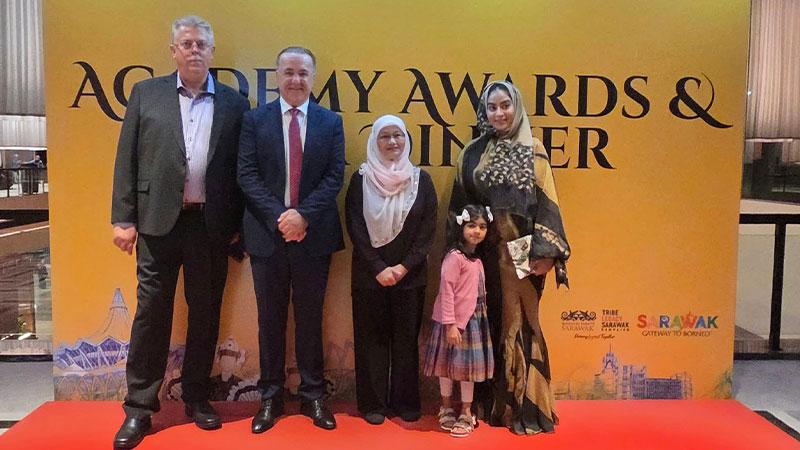
Dr Usman received the award at the 15th World Congress and Exhibition on Design and Health 2026 in Malaysia, where she presented the paper, bringing Westminster’s research to an international interdisciplinary audience.
The project received funding and support from the Sustainable Cities and the Urban Environment Research Community and CETI at the University of Westminster, with UK Biobank providing data access.
The work is now being carried forward through the Genome Health Hub Vertical Integrated Project (VIP), connecting the research with ongoing interdisciplinary, student-engaged research and research-led education.
Recognition through the International Academy for Design and Health Awards places the research alongside international work at the intersection of design and health, highlighting Westminster’s contribution to addressing complex urban health challenges through collaboration across health, social science, architecture and the built environment.
About the recognition, Dr Moonisah Usman, Senior Lecturer in Critical Urban Health at CETI, said: “It’s an honour for us to receive this prestigious international recognition for our work. Vitamin D deficiency is a significant public health concern, particularly for people from ethnically minoritised communities, who are disproportionately affected. In a diverse city like London, understanding these inequalities requires us to look beyond individual factors and consider the environments in which people live. As cities continue to grow, it is increasingly important to understand how urban design, greenspace, air pollution and the wider built environment influence health. I’m proud of the interdisciplinary collaboration behind this work and delighted that we are continuing to build on it through the University of Westminster’s Genome Health hub Vertically Integrated Project.”
The research directly contributes to the United Nations Sustainable Development Goals (SDG) 3: Good Health and Wellbeing, 10: Reduced Inequalities and 11: Sustainable Cities and Communities. Since 2019, the University of Westminster has used the SDGs holistically to frame strategic decisions to help students and colleagues fulfil their potential and contribute to a more sustainable, equitable and healthier society.
Learn more about Biological and Biomedical Sciences and Architecture, Interiors and Planning courses at the University of Westminster.

Dr Sahand Abbasi, Director of the International Academy of Design and Health (IADH) North American Charter and Lead Judge for the IADH Award in the International Research Project Category presenting the award to Dr Moonisah Usman
Related articles


