The specialist research group Ceramics Research Centre-UK within the University of Westminster’s Centre for Research and Education in Arts and Media (CREAM), in partnership with the Victoria and Albert Museum (V&A), recently hosted Permanence/Impermanence: Collecting and Archiving Contemporary Clay Practices, a three‑day conference exploring how artworks in the expanded field of clay can be made accessible to current and future audiences.
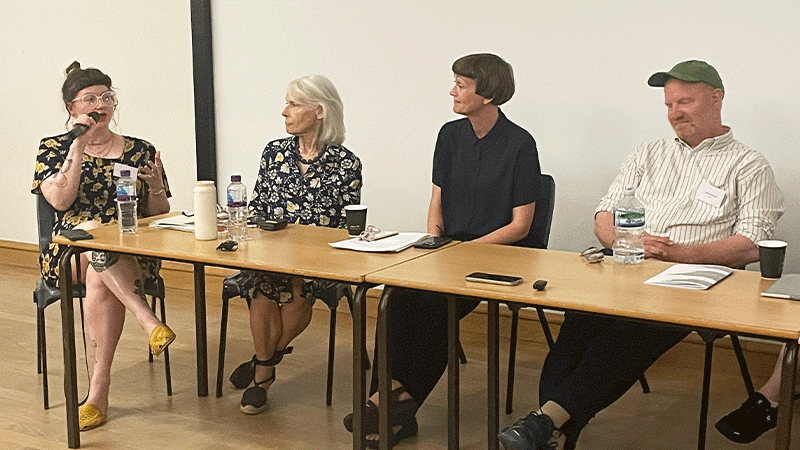
Held between 24-26 June at the Little Titchfield Street site, the event brought together artists, curators, conservators and researchers to explore the challenges posed by clay works that are ephemeral, site‑specific, participatory or live. These forms often fall outside traditional museum collecting practices, raising questions about how such works can be preserved, documented and re‑experienced.
The conference featured a programme of provocations, papers and panel discussions, bringing together leading artists, curators, conservators and researchers working at the forefront of contemporary clay practice to rethink how such artworks can be identified, explored and analysed in the future. Keynotes explored the challenges of collecting and archiving non‑permanent clay works, while additional sessions showcased perspectives from across museums, academia and the wider ceramics community.
Permanence/Impermanence is the first event forming part of Future Ecologies of Clay, a three‑year research project led by the Ceramics Research Centre‑UK at the University of Westminster in partnership with the V&A and funded by the Arts and Humanities Research Council (AHRC). The project involves creating four new artworks with four UK museums, including the V&A, using practice‑based case studies of challenging clay art to generate new content for each museum’s collection. Through this work, the project investigates how museums can better collect, archive and interpret contemporary clay practices that do not result in permanent objects, addressing a significant gap between what artists are making and what museums currently acquire.
Professor Clare Twomey, the Project Lead from the University, said: “The conference drew together voices of convergence and challenge. The AHRC-funded Future Ecologies of Clay research will benefit greatly from the rigorous conversations, presentations and platforms the project has created through the conference. There was a genuine momentum that built a listening and sharing environment to drive the research forward.”
The conference directly contributes to the United Nations Sustainable Development Goal (SDG) 11: Sustainable Cities and Communities and 17: Partnerships for the Goals. Since 2019, the University of Westminster has used the SDGs holistically to frame strategic decisions to help students and colleagues fulfil their potential and contribute to a more sustainable, equitable and healthier society.
Learn more about Art, Design and Visual Culture courses at the University of Westminster.

Deborah Smith (Deborah Smith Projects) and Daniel F. Herrmann (National Gallery)

Performance artist Florence Peake and art critic and author Louisa Buck
Related articles


