The University of Westminster recently hosted an interdisciplinary and interactive event exploring how walking and other mobile methods can support teaching and learning in higher education. The event brought together academics from a range of disciplines and featured six parallel walks around Central London that examined topics including surveillance, sustainability, gentrification, consumerism, food and taste, and the politics of heritage.
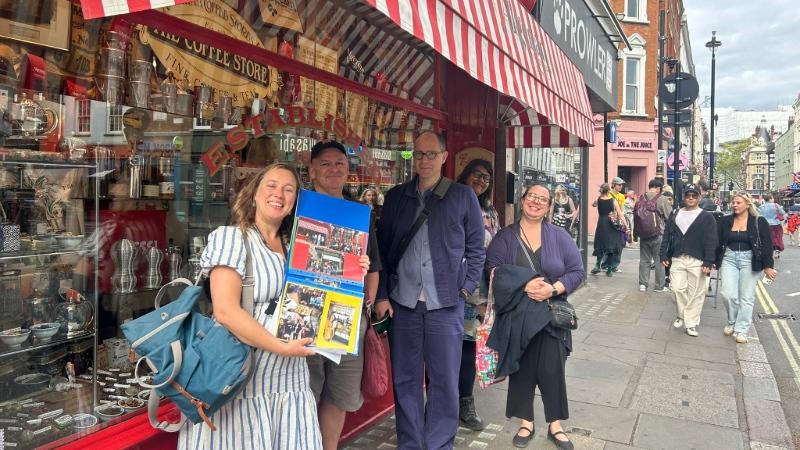
The event showcased how walking can be more than a way of getting from one place to another – it can be an approach to learning. Teaching through walking encourages students to engage with their surroundings as part of the learning process, using movement, observation and direct experience to explore ideas in ways that may not be possible within a traditional classroom. From examining architecture and urban spaces to considering social, cultural and environmental issues, throughout the event participants had the chance to encounter their subjects first-hand and develop new perspectives through their surroundings.
Alongside Westminster academics, the University invited Dr Emma Jackson, Visiting Senior Research Fellow at the London School of Economics, to deliver a mobile workshop and a keynote on walking in teaching as a collective practice with the potential to challenge traditional classroom dynamics. Drawing on 20 years of using walking in teaching and research, Dr Jackson explored how moving through the streets together can create connections between people, ideas and places.
Dr Magali Peyrefitte, Senior Lecturer in the Department of Social and Political Sciences at Brunel University of London, also led a walk investigating gentrification in Soho. Combining walking with body-mapping, the session introduced participants to the use of embodied and creative methods as teaching tools, encouraging them to learn and think both individually and collectively.
The event was co-organised by Dr Emily Falconer, Senior Lecturer in Sociology and Group Leader of the Westminster Interdisciplinary Food Studies Network (FATSAW), and Dr Louise Rondel, Research Associate in the School of Architecture and Cities at the University of Westminster. It was funded by the Centre for Social Justice Research (CSJR) and Destinations and Experiences (DEX) research centres and was concluded with the launch of Westminster’s new FATSAW Network.
Dr Emily Falconer said: “Walking with students as a teaching method has long been a feature of experiential learning here at Westminster, where we use the city as our campus. It was fantastic to bring together so many interdisciplinary colleagues to showcase their innovative walks, and to critically discuss the opportunities and challenges of pedagogical peripatetic practices. We were honoured to welcome Dr Jackson as our keynote, who led delegates on a sociological ‘walkshop’ through Fitzrovia.”
Dr Louise Rondel said: “Thanks to those who carefully facilitated walks during the event, the day provided a generous space to reflect together on the opportunities and challenges presented by using walking and other mobile methods in teaching. From considering practicalities, such as food and accessibility, to discussing the balance between delivering learning content and leaving space for student exploration, in addition to the tensions that can arise when in-situ with students. The event also offered an opportunity to walk and talk with colleagues and share ideas and make new connections whilst on the move, a rare treat in a busy academic calendar.”
The Peripatetic Pedagogical Practices event directly contributes to the United Nations Sustainable Development Goals (SDG) 4: Quality Education and 11: Sustainable Cities and Communities. Since 2019, the University of Westminster has used the SDGs holistically to frame strategic decisions to help students and colleagues fulfil their potential and contribute to a more sustainable, equitable and healthier society.
Find out more about research groups and centres at the University of Westminster.


Related articles


