The University of Westminster launched its new Food and Taste Studies at Westminster (FATSAW) network on 10 September, bringing together researchers from across the University and external partners to explore food and taste from a range of academic and community perspectives.
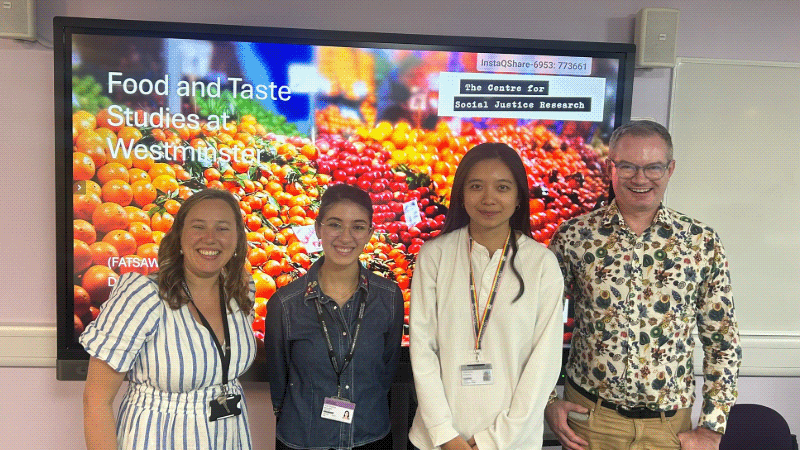
The event was opened by Dr Emily Falconer, Senior Lecturer in Sociology and Group Lead of FATSAW. It gathered an exciting range of interdisciplinary perspectives from colleagues working across nutrition, tourism, sociology, humanities and politics, alongside external colleagues from academia and community food groups.
The event introduced the vision and aims of the network and explored many ways food and taste can be understood in social, cultural and political contexts.
FATSAW members also presented their current research. Dr Daniel Conway, Reader in Politics and International Relations, explored the role of food in political boycotts and protests, and PhD students Mariam Selim and Yumeng Yung, from the Cavendish Living Lab, presented their research in food and diasporic communities in London.
FATSAW will promote and facilitate interdisciplinary research across the University for academic colleagues and graduate students with a scholarly interest in food, drink, taste and consumption.
Benefiting from Westminster’s central London location, the Network particularly focuses on research into food and taste in Greater London and the UK, while also including international research. Topics include food, migration and London’s diasporas; food tourism, marketing and industry; and food, health and the body, among many others. It also explores how the study of food can inspire new methodologies and approaches to teaching and learning.
The Network will host a range of internal and external seminar series, run specialised workshops and academic food tours of central London, and organise networking events to support collaborative research across disciplines. It will also strengthen opportunities for mentoring, doctoral supervision and research funding applications.
Dr Emily Falconer said: “I was delighted by the breadth of interdisciplinary interest in the Network and by the opportunity to bring together colleagues who share an interest in the critical study of food and taste. I look forward to developing the Network and its activities in the future, creating further opportunities for collaboration, research and knowledge exchange across disciplines and with community partners.”
The opening of the Food and Taste Studies at Westminster network directly contributes to the United Nations Sustainable Development Goals (SDG) 2: Zero Hunger, 3: Good Health and Wellbeing and 4: Quality Education. Since 2019, the University of Westminster has used the SDGs holistically to frame strategic decisions to help students and colleagues fulfil their potential and contribute to a more sustainable, equitable and healthier society.
Find out more about the Food and Taste Studies at Westminster network.


