The University of Westminster welcomed 13 international students from universities across the USA onto its newly launched STEM Research Project module. The course ran for the first time this summer as part of the University’s London International Summer School, providing students with the opportunity to immerse themselves in research from the School of Life Sciences (SLS) and build critical laboratory, analytical and scientific communication skills while gaining an insight on how research is conducted in the UK.
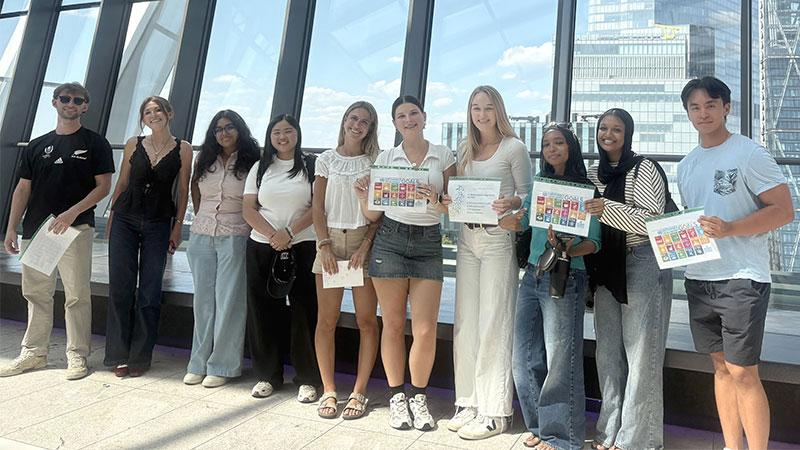
Led by Dr Adele McCormick and Dr Joan Liu, Global Engagement Co-Directors from Westminster’s SLS, the six-week long module gave students the chance to conduct research within a range of topic areas, including ageing, cancer biology, gut health, infectious diseases and drug discovery. Students learnt key aspects in planning and designing a research project and participated in a series of interactive teaching sessions, such as lectures on laboratory health and safety, ethics, resilience in research, scientific writing, communicating science, data analysis and statistics.
Before their trip to the UK, students took ownership of their research project by writing a 2000-word critical review, where they integrated primary literature, identified a research angle and set their goals. At the end of the module, students then shared their research findings via a 20-minute conference-style oral presentation followed by a Q&A. This assessment provided further development of communication and presentation skills and built on the planning, analytical and technical skills acquired during the research project.
During the module, the students also embarked on several field trips. At The Wellcome Collection, they went on a guided tour titled Being Human, which explored what it means to be human in the 21st century, reflecting on people’s hopes and fears about new forms of medical knowledge and their changing relationships with themselves, their environment and the world. Students also visited the Health Services Laboratory in the Halo Building, which houses one of the largest and advanced pathology laboratories in Europe. Lastly, in the Sky Garden, London’s highest rooftop garden offering 360-degree views of the city skyline, students got to learn more about sustainability and participated in an interactive quiz where they were tasked with aligning the research they conducted to the Sustainable Development Goals (SDGs).
During the final week of the module, doctoral researchers in the SLS, Soumya Sharma and Success Ajayi, gave talks on their PhD journeys at the University of Westminster, and Dr Miriam Dwek, Professor Louise Thomas and Dr Polly Hayes provided an overview of inclusive research culture and how to apply for a research degree. Soumya Sharma and Sanika Ghayal from Westminster’s Cavendish Living Lab also spoke about sustainability and global challenges, focusing on areas such as urban food growing, bioplastics and sustainable fashion, water management, waste reduction and community engagement.
Fellow academic researchers in the SLS who offered and supervised the research projects were Dr Kevin Cunningham, Dr Lewis Mattin, Dr Bradley Elliott, Dr David Guiliano, Dr Freddie Partridge, Dr Rouzbeh Chegeni, Dr Aikaterini Anagnostopoulou, Dr Joan Liu, Dr Adele McCormick and Dr Elyn Xu.
Together, Dr McCormick and Dr Liu commented: “This module allows students to gain hands-on research experience that bridges the gap between the classroom and offers the opportunity to work on cutting-edge scientific research projects to gain exposure to global research practices and mentorship from professionals as well as facilitate future international research collaborations. In addition, it supports career development by building critical thinking, problem-solving and communication skills. Thanks to Eduardo Lees, Head of Global Mobility at the University, in forging this global initiative with Arcadia Abroad.”
Aiden Balandan, a student from the University of North Carolina, said: “My research focused on screening for antivirals against COVID-19 variants under the supervision of Dr McCormick, which immersed me into the exciting field of virology while also allowing me to explore the city of London. I certainly valued the in-depth and fast-paced course. I appreciate being close with my mentors and learning about my project in depth and developing useful laboratory skills for the future. I highly recommend this module for anyone looking to get involved in research in an intensive yet exciting way!”
“London is a beautiful and international city that felt like there was a new site at every turn. I certainly enjoyed trying a vast cuisine of international flavours while also indulging in some London local food.”
Uyen Nguyen, a student at Yale University, added: “Going abroad and taking this module let me simultaneously explore both a new country and a new perspective on research. I came in simply expecting to explore a handful of different scientific techniques. By the end of the module, I found that my expectations weren't just met – they were exceeded. My supervisor, Dr Liu, guided me through the reasoning behind each step of our research project, which helped me sharpen my project-planning skills and deepen my understanding of the smaller details that go into good research. These are lessons I'll carry into future work as I keep developing as a scientist.”
The module directly contributes to the United Nations Sustainable Development Goals (SDGs) 3: Good Health and Wellbeing, 4: Quality Education and 17: Partnerships for the Goals. Since 2019, the University of Westminster has used the SDGs holistically to frame strategic decisions to help students and colleagues fulfil their potential and contribute to a more sustainable, equitable and healthier society.
Learn more about Biological and Biomedical Sciences courses at the University of Westminster.


Related articles


