Researchers from the University of Westminster welcomed colleagues from across industry and academia from the UK and South Korea for a workshop reviewing progress on the Innovate UK funded MET-Biofuels project. This collaborative project focuses on enabling the large-scale conversion of organic waste into low-carbon fuel and strengthens research links between the UK and South Korea.
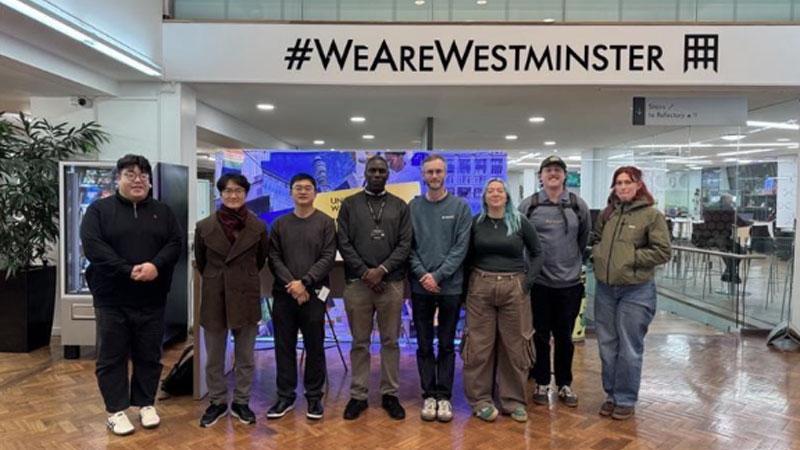
The workshop was held at the University’s Cavendish Campus on 4 December and brought together experts from Westminster and WASE Limited, a UK-based company focused on biogas technology, alongside delegates from NZW Limited, a South Korean company specialising in biotechnology, Pusan National University and Jeonbuk National University.
These organisations work together on the MET-Biofuels project, which focuses on advancing microbial electrochemical technologies (METs) to enable the commercial conversion of organic waste into low-carbon fuels, specifically biomethane and biohydrogen.
The workshop began with a welcome address from Professor Godfrey Kyazze, Principal Investigator for MET-Biofuels and leader of the Sustainable Biotechnology Research Group at Westminster, before a series of presentations spanning reactor engineering, microbial community insights and electrocatalytic upcycling. These were followed by discussions on future plans, milestones and a risk review for the next phase of the project.
The MET-Biofuels project centres around WASE’s pioneering Electro-Methanogenic Reactor (EMR), which uses electrically stimulated microbial metabolisms to transform wastewater and organic residues into clean water, nutrient-rich digestate and high-purity biogas. The EMR boasts a ten-fold reduction in wastewater treatment time, 20% purer biomethane and an accelerated return on investment of three to four years instead of five to seven years compared to conventional anaerobic digestion. It is also designed for breweries, bakeries, dairies and industrial or agricultural businesses to generate their own renewable energy.
In partnership with WASE, the project teams in the UK and South Korea are combining Westminster’s 3D-printed bioelectrodes with Korean microbial electrochemical (MEC) systems and the EMR. Their goal is to create a scalable bioreactor that can produce both biohydrogen and biomethane at up to 98% purity.
Together, the partners are working to support more sustainable industry practices and produce biogas pure enough for use in the UK’s Renewable Transport Fuel Certificate Scheme, opening opportunities for low-carbon agricultural and off-grid vehicles that are difficult to electrify.
The MET-Biofuels project reflects the University’s Being Westminster strategic commitment to being a global university that seeks to make the world a more sustainable, healthier and better place through collaboration and innovation.
About the workshop Professor Kyazze said: “This workshop has allowed us not only to showcase technical achievements but to deepen cross-continental cooperation in the urgent pursuit of low-carbon energy solutions. The exchange of expertise between our UK and Korean partners is critical to accelerating clean-fuel innovation.”
This project directly contributes to several of the United Nations Sustainable Development Goals (SDGs) 6: Clean Water and Sanitation, 7: Affordable and Renewable Energy, 12: Responsible Consumption and Production and 13: Climate Action. Since 2019, the University of Westminster has used the SDGs holistically to frame strategic decisions to help students and colleagues fulfil their potential and contribute to a more sustainable, equitable and healthier society.
Find out more about studying Biological and Biomedical Sciences at the University of Westminster.


