Sir Richard Arnold, Westminster alumnus, Visiting Professor and Court of Appeal Judge, delivered his annual lecture at Westminster Law School on the topic of UK and EU copyright laws post-Brexit. The special event marked the tenth anniversary of his first lecture at the University and the thirtieth anniversary of the University’s Centre for Law, Society and Popular Culture.
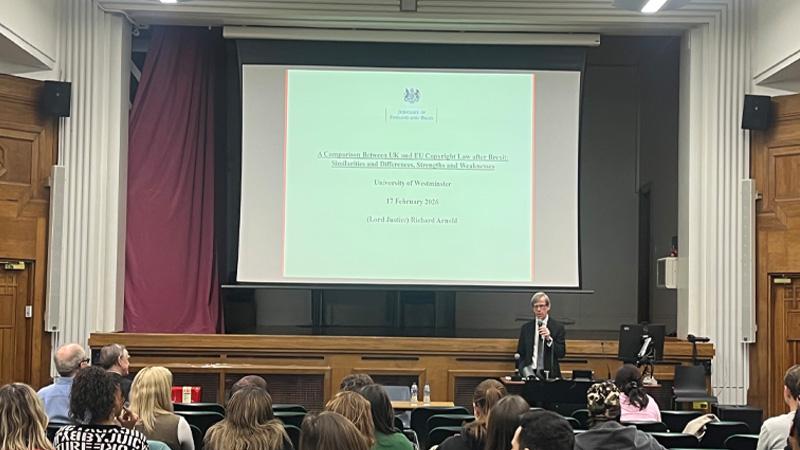
Taking place on 17 February, the lecture was titled A Comparison Between UK and EU Copyright Law after Brexit: Similarities and Differences, Strengths and Weaknesses. The event was organised by the University’s Centre for Law, Society and Popular Culture, which is celebrating its thirtieth anniversary this year and is where Sir Richard is an Associate Fellow. The talk drew together work from the Westminster Law School and wider disciplines across the University, covering areas such as music, sport, film and the media.
The lecture took place at Westminster’s Little Titchfield Street site and was opened by Dr Danilo Mandic, Senior Lecturer and Course Leader for the University’s Entertainment Law LLM programme.

Dr Danilo Mandic delivering the introduction
Throughout the lecture, Sir Richard addressed the ongoing complexity of determining the state of copyright law following the withdrawal of the UK from the EU. Sir Richard clarified the current state of the law and presented a comprehensive overview of the similarities and differences between the EU and UK copyright regimes.
Following the lecture, there was a Q&A session for Sir Richard to take questions from the audience, which consisted of Westminster colleagues, students and external visitors. Attendees then had the opportunity to celebrate the occasion with a networking reception.
Sir Richard received his Graduate Diploma in Law in 1984 from Westminster’s predecessor institution, the Polytechnic of Central London, and was called to the Bar of England and Wales shortly after in 1985. In 2000, he became a Queen’s Counsel (QC) and was appointed to the High Court Bench in October 2008, where he specialised in IP, entertainment and media law as well as data protection - both domestically and in European Courts and Tribunals.
He was then made Chairman of the Code of Practice for the Promotion of Animal Medicines Committee between 2002 – 2008, an Appointed Person hearing trademark appeals between 2003 – 2008 and a Deputy High Court Judge between 2004 – 2008. In 2013, he was appointed to be Judge in Charge of the Patents Court and became an External Member of the Enlarged Board of Appeal of the European Patent Office in 2016.
Westminster awarded Sir Richard an Honorary Doctorate in 2017 for his services to law and his contributions to the Westminster Law School. In 2019, he was appointed as Lord Justice at the UK Court of Appeal.
Sir Richard remains an active supporter of Westminster through contributing to the Ignite Fund, which expands opportunities for students to develop industry-relevant skills through training and practical projects connected to their academic disciplines.

Audience listening to Sir Richard Arnold delivering his lecture
About the lecture Sir Richard said: "It was a great pleasure to be able to deliver my tenth annual lecture as Visiting Professor at the Portland Hall. A lot has changed in that time, but the audience remains as engaged as ever. Once again there was a good turn out from students at the Law School as well as academics from other institutions and practitioners. As usual, there were some good questions at the end, including from students. I have also been pleased this year to be able to support the Ignite Fund with a donation, which will hopefully help prospective students to come to Westminster, and perhaps attend future annual lectures."
Professor Guy Osborn, Co-Director of the Centre for Law, Society and Popular Culture, added: "We were delighted to welcome Sir Richard to deliver his annual lecture. This was the tenth of these Richard has delivered and they have been consistently thought-provoking and entertaining.”
Guest lectures at the University and the work of the Westminster Law School contribute to the United Nations Sustainable Development Goals (SDGs) 4: Quality Education and 16: Peace, Justice and Strong Institutions. Since 2019, the University of Westminster has used the SDGs holistically to frame strategic decisions to help students and colleagues fulfil their potential and contribute to a more sustainable, equitable and healthier society.
Find out more about studying Law at the University of Westminster.
If you are an alumnus who would like to support students at the University, please contact the Development Team.
Related articles


