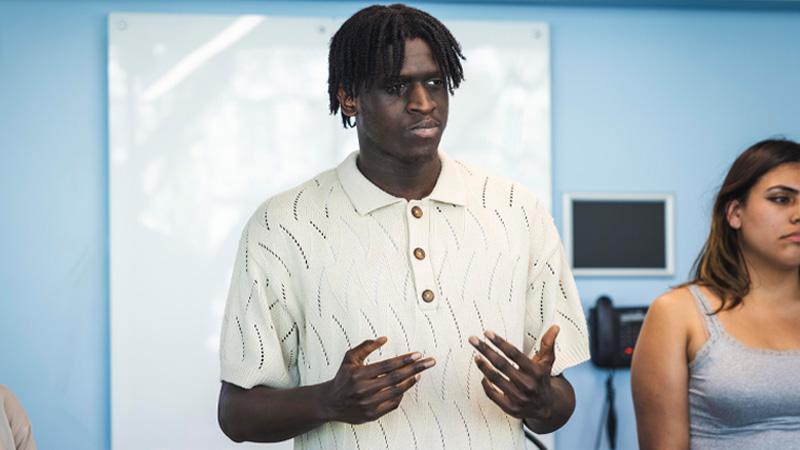
First year Languages and Translation BA Honours student Antonio Mendy took part in a Vertically Integrated Project for Sustainable Development (VIP) where he worked with students from different courses and University colleagues to produce translations for London’s new Migration Museum. VIPs are being piloted by the University as credit-bearing modules that brings together students at different stages of their studies to work together on a real-life solution. Antonio shares his experience about how the VIP helped prepare him for future success while making a difference to the world through promoting accessibility and inclusion.
What encouraged you to sign up to a VIP?
As I am already a translation student, I thought it was a great opportunity to test my translation skills in a professional environment rather than just an academic environment. I knew I would be working for a real museum preparing to open, so I liked the idea of contributing to something that is going to be seen by people across the UK and visitors from elsewhere.
Can you tell us a bit about the Language Matters in Migration project?
I worked with a team of two other Westminster students on a project for the Migration Museum, which is set to open in London in 2028. Our task was to produce translations and audio descriptions for their All Our Stories exhibition, which shares real-life experiences of people who have migrated to England. We were asked to translate written documents into audio descriptions to make them more accessible for visitors who may not speak English or are visually impaired, so everyone can learn from and enjoy their exhibitions.
You worked with students and academics from across different courses on this project. What do you think are the benefits of working with people from different backgrounds?
You get to learn from other people’s experiences. My teammates came from Westminster Business School rather than Languages, so it opened my mind to different perspectives and concerns outside the technical side of translation. For example, even though we all spoke Spanish, I am used to translating Castilian Spanish on my course, while one of my teammates spoke Latin American Spanish. Some words differ or sound different, so we had to work together to decide which version to use for consistency.
Specifically for this project, it was valuable to work with people from different backgrounds because we found ways to relate to each other. We all came from migration backgrounds, and I think being open to migration and to each other is really important.
How did you find working with colleagues from the Migration Museum?
It was really helpful. Liberty Melly, who is Head of Learning at the Migration Museum, gave us a professional brief and delivered a presentation to give us context about the museum, which made the project feel like a real work environment. She explained how the museum started and the work they are doing, which helped us to understand how important our work is within the wider conversation about migration in this country. Liberty also stayed after the presentation and we had a valuable conversation with her about the project and migration as a whole, which made me even prouder to be involved in the project. It made the whole experience feel real and important.
How would you say the VIP has helped you prepare for career success?
I learned a lot about teamwork, which is the main skill I gained. Even though I’ve worked in teams on university projects before, I had never worked on something of this magnitude with other people. We had to stay organised, share the workload effectively and keep in contact. This was especially important because we were also working with students from the University of Granada in Spain, so we had to make sure timings worked for everyone.
It also made me think about different career routes, including interpreting. Working with the Migration Museum showed me how important interpreters are for people adapting to a new country. I can see myself working in a role that helps people adjust and makes things more accessible.
What has been the best part of your VIP experience?
My favourite part was reading the stories as I translated them. They were so interesting, and by translating them, I will help more people experience the amazing stories I got to read. They are such important stories to tell, so knowing I can help more people understand them feels great.
You’re continuing to work on this project next year. What are you most excited for?
We will be focusing more on audio descriptions, since we have mainly worked on translations so far. I have loved learning about audio descriptions because I did not know you could get so creative with them. At first, I thought you just described what you see, but as I dove into it, I learned how to describe an image in a way that conveys the experience. For example, you can say “you feel the sun beaming on your face” rather than “the sun was in the sky”. I like that this gives visually impaired visitors a better experience.
I am also excited to work at the new Zone29 building, which is our new space at the University for careers projects like these. It has an amazing sky room, which I cannot wait to see.
What’s next for you?
I want to keep developing my translation skills and see how good I can become. I want to learn all aspects of translation, which will help me build transferable skills for a range of careers in the field and possibly beyond. I’m excited for my next year at Westminster and to continue working on the Language Matters in Migration project.
VIPs are central to the University of Westminster’s new home for careers and enterprise, Zone29, which provides students and graduates with access to work-related programmes, opportunities and experiences.
Find out more about studying Languages at the University of Westminster.
Learn about Westminster’s commitment to sustainable development.
Related articles


