The University of Westminster recently hosted the inaugural professorial lecture of Professor John Murphy, Professor of Biomedical Sciences, celebrating his academic career that spans more than four decades of teaching and internationally recognised research.
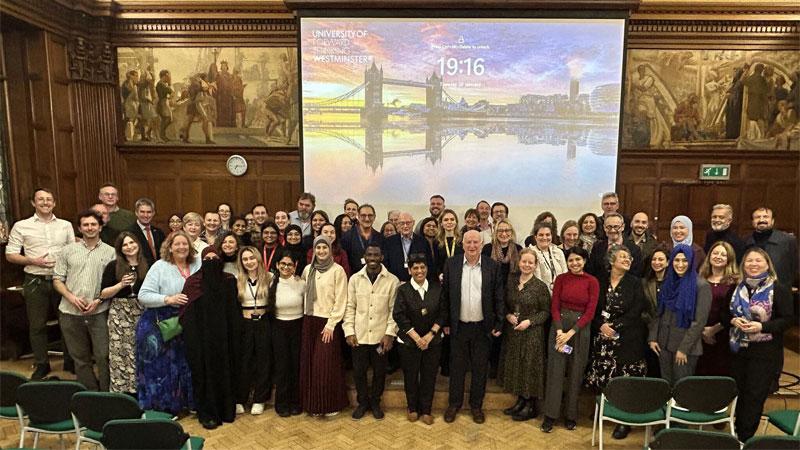
Professor Murphy’s lecture reflected on his academic journey, beginning with his undergraduate and doctoral studies in Pharmacology at University College Dublin, where he completed both his BSc and PhD. He went on to establish his early research career in London, before joining the University of Westminster in 2010 as a Reader in Biomedical Sciences. From July 2014 to August 2018, he served as Head of the Department of Biomedical Sciences, and in August 2024, he was appointed a professorship.
A central theme of the lecture was Professor Murphy’s research journey, which began during his postdoctoral work at the Royal Free Hospital. At that time, he embarked on pioneering research to identify and clone novel human genes known as early response genes. This period during the late 1980s marked a transformative era in molecular biology, with rapidly advancing techniques enabling the discovery of previously unidentified, functionally important human genes.
Professor Murphy highlighted how several genes identified during this early research continue to underpin his work today. One notable example is ZFP36L1, a gene discovered during this period that has since emerged as an important human cancer driver gene and remains a major focus of his current research at Westminster.
While much of Professor Murphy’s research has focused on cancer biology, his work has also contributed to understanding autoimmune conditions. This includes identifying novel autoantibody targets in diseases such as lupus and heart transplant-associated coronary artery disease.
More recently, Professor Murphy has led research projects at the University of Westminster funded by Children with Cancer UK and Action Bladder Cancer UK. These projects have been undertaken in collaboration with Dr Kalpana Surendranath in the University’s Genome Engineering Laboratory, as part of the Medicines Diagnostics and Disease Modelling (MDDM) research group, which they jointly lead. The team is using CRISPR gene-editing technologies in cancer cell models to investigate the roles of key genes, including ZFP36L1, in cancer development and progression.
About the lecture Professor Murphy said: “It was a pleasure to share my research and academic career journey with colleagues, students, friends and family.”
Professor John Murphy’s research contributes to the United Nations Sustainable Development Goals (SDGs) 3: Good Health and Wellbeing and 4: Quality Education. Since 2019, the University of Westminster has used the SDGs holistically to frame strategic decisions to help students and colleagues fulfil their potential and contribute to a more sustainable, equitable and healthier society.
Find out more about studying Biological and Biomedical Sciences at the University of Westminster.


