Westminster Senior Lecturer in Health Data Analytics Dr Dipankar Sengupta has been awarded funding from the UK Research and Innovation (UKRI) Innovation-to-Commercialisation of University Research (ICURe) programme to develop and test the commercial potential of a transformative AI tool that identifies critical minerals in electronic waste.
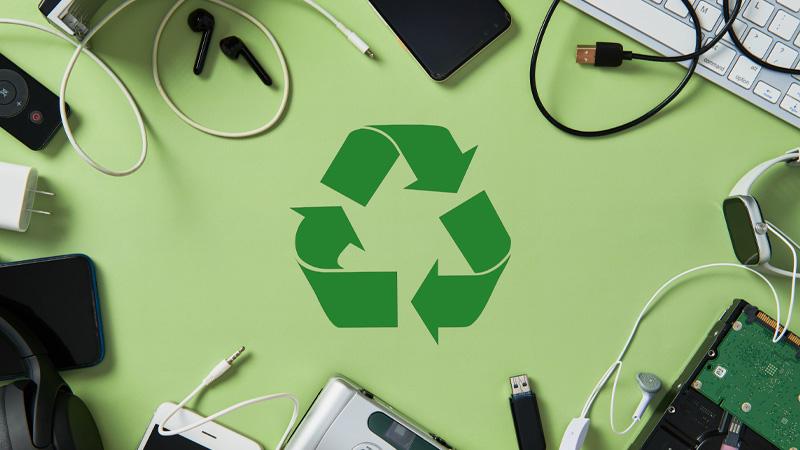
Electronic waste (e-waste) is the fastest-growing waste stream globally, with over 50 million tonnes of e-waste generated worldwide each year. In the UK alone, this is approximately 1.6 million tonnes annually, one of the highest per capita levels in the world. Yet, much of this material is processed with limited visibility, suboptimal recovery and avoidable carbon loss. This represents both an environmental challenge and a missed economic opportunity, particularly as demand for strategic materials such as Germanium continues to rise.
To address this issue, Dr Sengupta is developing RECLAIM-WISE, an AI-driven waste intelligence approach to improve critical mineral identification, value recovery and decision-making in e-waste systems. Designed for integration with existing infrastructure, it can support councils, e-waste management organisations and industry stakeholders in improving circular-economy performance.
This work is part of the Innovate UK ICURe market discovery programme, which provides researchers the opportunity to turn ground-breaking research into investment-ready spin-out companies and license agreements.
Dr Sengupta’s work will also contribute towards the UK Government’s 2035 Critical Minerals Strategy, which aims to ensure at least 10% of UK demand for critical minerals is met through domestic production. It also aims for 20% of the demand to be met through recycling by 2035 and wants to strengthen the circular economy and recovery capabilities. RECLAIM-WISE positions e-waste as a strategic resource rather than a disposal problem, enabling scalable, evidence-based solutions for sustainable material recovery.
About the project Dr Sengupta said: “This idea started at home in 2024, when my then four-year-old daughter asked me a simple question: “What happens to our old TV? Do we throw it in the black bin?” That moment stayed with me. When I investigated it, I realised how much e-waste we generate and how often valuable materials are simply lost. RECLAIM-WISE is my attempt to change that, using interpretable AI to help us see this waste differently and recover what we would otherwise throw away.
“I greatly appreciate the support from the School of Life Sciences leadership and the Research and Knowledge Exchange Officer (RKEO), who have helped promptly in short turnaround times, leading to what this project has achieved in such a short duration. A special thanks to Professor Louise Thomas, who is supporting this project as Principal Scientific Advisor, and Alistair McShee (RKEO) as the Technology Transfer Officer.”
Dr Sengupta’s work directly contributes to the United Nations Sustainable Development Goals (SDGs) 9: Industry, Innovation and Infrastructure and 12: Responsible Consumption and Production. Since 2019, the University of Westminster has used the SDGs holistically to frame strategic decisions to help students and colleagues fulfil their potential and contribute to a more sustainable, equitable and healthier society.
Learn more about Biological and Biomedical Sciences courses at the University of Westminster.
Watch the following video to learn more about RECLAIM-WISE.
Related articles


