The University of Westminster, in collaboration with nine other London-based partner universities, successfully delivered the annual London Student Sustainability Conference (LSSC). The hybrid event welcomed over 300 people to listen and engage with over 90 student interdisciplinary research and extra-curricular projects related to the UN Sustainable Development Goals (SDGs).
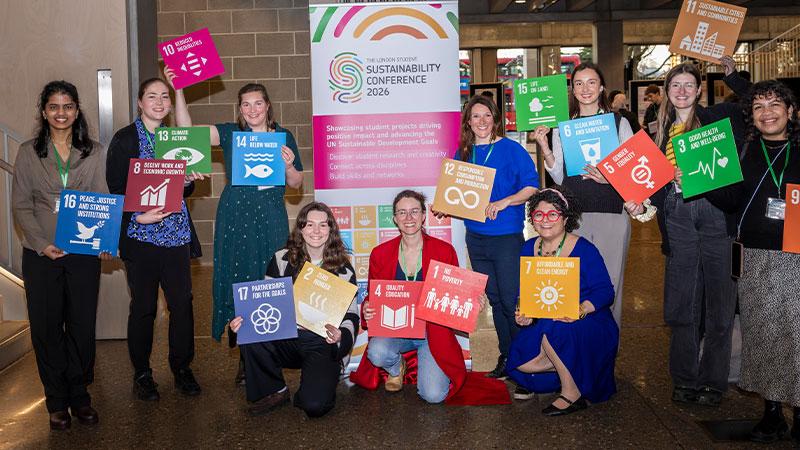
The conference took place on 25 February and was co-organised by student volunteers working alongside colleagues to support promotion and logistics, as well as helping on the day with registration, wayfinding, hosting and chairing sessions. Together, they created a vibrant space where students could connect, amplify their ideas and spark collaborations that contribute to a brighter, more sustainable world.
LSSC was founded in 2019 to provide an opportunity for students from across London to share their sustainability research and extra-curricular projects and has grown year on year. This year’s event was a collaboration between ten London universities: University of Westminster, City St George’s, University of London, Imperial College London, King’s College London, Kingston University London, London School of Economics, London School of Hygiene & Tropical Medicine, University of Greenwich, University of Roehampton, University of West London.
Following a competitive application process, a team from the University’s Cavendish Living Lab, led by final year Biomedical Science BSc Honours student Julia Pinheiro Bassani, gave a presentation on a creative arts piece titled Pack it Green Fitzrovia: Turning Local Action into Lasting Change. For the project the group collaborated with The Fitzrovia Partnership to help promote sustainable business practices in the local area. The initiative culminated with the premiere of a documentary showcasing the research process, which featured discussions with local businessowners about the transition to a greener economy.
Sustainability Management and Innovation MSc student Marta Massarini also presented her work titled The Circular Ascent: Crafting a Sustainable Future for Climbing. The goal of the project is to create the first fully modular climbing shoe with detachable, recycled rubber soles and heels, allowing climbers to replace only worn parts, thus reducing waste. It also seeks to redefine climbing as a craft, fostering a deeper connection between climbers and nature to promote pro-environmental behaviours.
Westminster students were also chosen to present their academic posters throughout the event, including a team from the University’s Cavendish Living Lab, led by Laima Tokhi, who is currently undertaking her PhD in Pharmacology, Toxicology and Pharmacy. She displayed her work titled Greener Future Leaders: Embedding Sustainable Solutions and Food Waste Awareness in Primary and Secondary Schools.
Another team from the Cavendish Living Lab, led by Safia Irfan, who studies Biochemistry BSc Honours, presented an academic poster titled Innovating Sustainable Textiles: Circular Design and Bio-Material Development in the Cavendish Living Lab, while Aminah Chaudry, who is studying English Language and International Communication BA Honours, presented a poster titled Connecting Communities: Global Partnership Strategies for Digital Access and Economic Opportunity.
About the conference Marta Massarini said: “Change comes from the edges. This thought followed me all through LSSC 2026. I was honoured to represent the University of Westminster and present Circular Ascent, a sustainable climbing shoe project my teammates and I have been working on and will develop in the next few months. The atmosphere at the conference was electric, and I was deeply inspired by all the young participants whose projects were a true testimony of stubborn optimism. They aren’t just dreaming of a better future, but actively building it. I left the conference with a new sense of confidence and genuine inspiration for the future."
Julia Pinheiro Bassani added: "Having our documentary and research poster selected as creative pieces of research for the conference was a defining moment for our team. Presenting Pack It Green's findings to researchers and students from across London and seeing the conversations it sparked around sustainable packaging and circular economies reminded me why this work matters. This project has shown me that sustainability knows no disciplinary boundaries, and that student-led research can drive real change when it reaches beyond the university walls."
Westminster’s contribution to the LSSC 2026 directly contributes to the United Nations Sustainable Development Goals (SDGs). Since 2019, the University of Westminster has used the SDGs holistically to frame strategic decisions to help students and colleagues fulfil their potential and contribute to a more sustainable, equitable and healthier society.
Learn more about the Cavendish Living Lab.
Find out more about sustainable development at the University of Westminster.


Related articles


