The University of Westminster has hosted the inaugural IBE Humanoids Construction Humanoids Summit, bringing together a range of industry professionals to explore the potential of humanoid robots to improve health, safety, wellbeing and productivity in the construction sector.
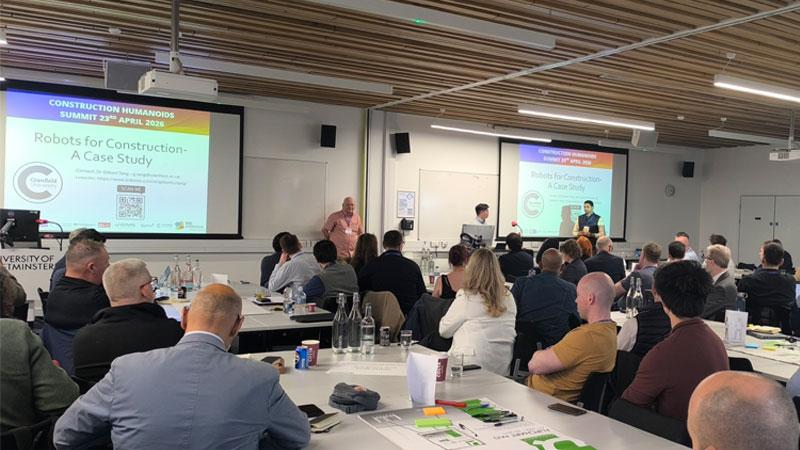
Westminster welcomed public and private clients; contractors such as Mace, Laing O Rouke, Vinci and numerous members of the National Federation of Builders; academics and policymakers from across the construction sector to its Marylebone Campus for the first dedicated forum focused exclusively on humanoid robotics in construction and the built environment. The event was organised by IBE Humanoids in collaboration with Innovate UK Business Connect, the University of Westminster, the University of Warwick, Cranfield University and Moulton College.
At a time when the UK construction sector is under pressure, the summit aimed to explore how humanoid robots could reshape workforce safety, health, inclusion and productivity across the industry. The first-of-its-kind conference represented a new frontier in automation, AI and sustainable collaboration with the human workforce.

Construction robots
Interactive discussions delved into how humanoid robotics can play a critical role in creating a safer, more resilient and socially inclusive workforce, whilst enhancing outcomes and improving sustainability, efficiency and productivity. Attendees had the opportunity to discuss practical humanoid solutions as well as ask questions to experts on how humanoid robots can address their specific needs.
Participants agreed that construction humanoids should augment, not replace, human workers, with human roles becoming more important, not less. They offer real potential to improve safety, wellbeing and productivity, but new risks are equally real. Navigating this development demands leadership and new skills, mindsets, management models and processes to reimagine construction.
Hosting this pioneering conference reflects the University’s strategic vision of being an institution where people stand out as significant contributors to their communities through their innovation, enterprise and problem-solving, making the world a more sustainable, healthier and better place. This was set out by Dr Phillip McGowan, Head of Westminster’s School of Applied Management, in his introduction to the summit.

Summit organiser Vassos Chrysostomou
About the conference Vassos Chrysostomou, Lecturer at Westminster Business School and Founder of IBE Humanoids, said: “The summit highlighted that the challenge ahead is not technological, but organisational, cultural and ethical. The future of Physical AI in construction is not something that will suddenly arrive one day fully formed. It’s being built right now. The leaders at the Summit have committed to inspire it, define it, be it, learn as we build it, and own it!”
The summit directly contributes to the United Nations Sustainable Development Goals (SDGs) 8: Decent Work and Economic Growth, 9: Industry, Innovation and Infrastructure and 10: Reduced Inequalities. Since 2019, the University of Westminster has used the SDGs holistically to frame strategic decisions to help students and colleagues fulfil their potential and contribute to a more sustainable, equitable and healthier society.
Find out more about studying Construction, Surveying and Real Estate courses at the University of Westminster.

Dr Phillip McGowan's Welcome to Westminster

Innovate UK presentation

Interactive activities


Closing remarks from Mark Wakeford, Chairman of the National Federation of Builders

Networking
Related articles


