The University of Westminster hosted a panel event to explore the challenges and opportunities of being Black in the construction industry to conclude its Black History Year (BHY) programme for 2025. The event saw industry professionals share personal stories and offer practical advice for cultivating resilience, hope and success in the construction sector.
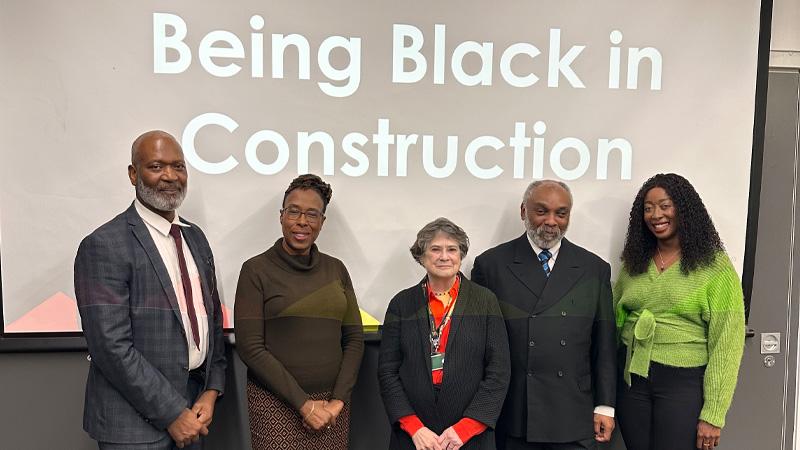
Colleagues, students, alumni and industry professionals attended the University of Westminster on 18 November for the eye-opening discussion on being Black in the construction industry. This was the final event of the University’s BHY programme for 2025, which celebrates Black history, stories, lives, politics, creativity and achievements all year round.
The evening began with an introduction from Dr Deborah Husbands, Reader in Race and Sociocultural Psychology, who established the BHY programme at Westminster five years ago. Professor Lynne Berry, Chair of the Court of Governors, followed with reflections on the importance of hosting such events in university settings.
The panel chair, Wilfred Achille, was then introduced by Professor Peter Bonfield, Vice-Chancellor and President of the University of Westminster. Professor Bonfield also discussed his own expertise in flood management, highlighting his recently published report adopted by the Government on the issue. He reiterated his commitment to increasing diversity within the construction industry and the University’s institutional commitment to equality, diversity and inclusion.
Achille has been a professional studies advisor and module leader in Professional Development for the last 18 years. He has worked at the University of Westminster, the University of Nottingham and Oxford Brookes University, bringing over 30 years of experience as a RIBA chartered architect.

Professor Peter Bonfield
Achille was joined on the panel by industry leaders Renata Dickson-Nwosu and Terrance James. Dickson-Nwosu is the founder of Studio RDN-X, a design and architecture studio that redefines luxury living by blending cultural heritage, contemporary aesthetics and spatial innovation. Drawing from her roots in fine art and fashion textiles, influenced by her Igbo/British upbringing and appreciation for her West African heritage, Dickson-Nwosu is dedicated to design advocacy and mentorship. She actively contributes to discussions on cultural integration in contemporary spaces and serves as a Part III Champion with Professional Architecture Mentors at the University of Westminster.
Terrance James is a Chartered Engineer and senior leader with over 40 years of experience in construction, housing and education. He has led major regeneration and infrastructure projects across the UK and internationally, delivering thousands of new homes and community facilities, while also advising on large-scale NHS and transportation programmes. In addition to his executive career, James is committed to governance and representation. He currently serves as Chair of the Resources Committee on the University of Westminster’s Court of Governors following his appointment earlier this year and as Link Governor for Equality, Diversity and Inclusion at Croydon College.
Achille guided the panel through a discussion about the historical challenges faced by racially minoritised individuals in the UK due to systemic barriers in education and industry, particularly reflected in the lack of representation of Black creatives. Each speaker shared how they had demonstrated leadership in difficult contexts, emphasising the importance of flexibility in seizing opportunities for personal and professional growth. One panellist highlighted their unique ability to visualise objects in 3D due to their neurodiversity, showcasing how this trait became a strength in identifying their vocation in architecture.
The panel’s key messages included recognising the different journeys into construction and embracing this while navigating established structures. They also emphasised the need to craft a purposeful identity and presence by cultivating clarity, culture and mental awareness, with sponsorship and mentorship being crucial for career advancement in the industry.
Other topics discussed included overcoming obstacles by challenging assumptions about professional capability, developing networks and leveraging allyship to open doors and build resilience. The panel also explored opportunities for progression through strong relationships between universities and students, with good governance being essential for establishing inclusive practices in these environments.
The event concluded with an audience Q&A session that provided attendees with valuable insights on how to maximise transferable skills and competencies across various industries. Industry partnerships like this form a key ambition of Zone29, the University’s new home for careers and enterprise due to open in Spring 2026. Zone29 provides students and graduates with access to work-related programmes, opportunities and experiences, and it connects students from all backgrounds to industry professionals.

Panel speakers from L-R: Terrance James, Renata Dickson-Nwosu and Wilfred Achille
About the event Professor Berry said: "This event was a great example of how the horizons of our students can be expanded and their ambitions deepened by engaging with inspirational experts from various professions. The speakers discussed what has helped them navigate and build their careers despite structural limitations. The feedback was overwhelmingly positive, thanks to their generosity and authenticity."
This event and the University’s Black History Year programme directly contribute to the United Nations Sustainable Development Goals (SDGs) 8: Decent Work and Economic Growth, 10: Reduced Inequalities and 17: Partnerships for the Goals. Since 2019, the University of Westminster has used the SDGs holistically to frame strategic decisions to help students and colleagues fulfil their potential and contribute to a more sustainable, equitable and healthier society.
Find out more about Construction, Surveying and Real Estate courses at the University of Westminster.
Learn about equality, diversity and inclusion events at the University of Westminster.
Related articles


