The University of Westminster hosted a conversation with renowned psychotherapist, author and activist Susie Orbach exploring her 50 years of thinking, writing and campaigning on food, bodies, identity, therapy and power. Orbach received an Honorary Doctor of Science degree from Westminster in 2016 for her work campaigning for body diversity and social change.
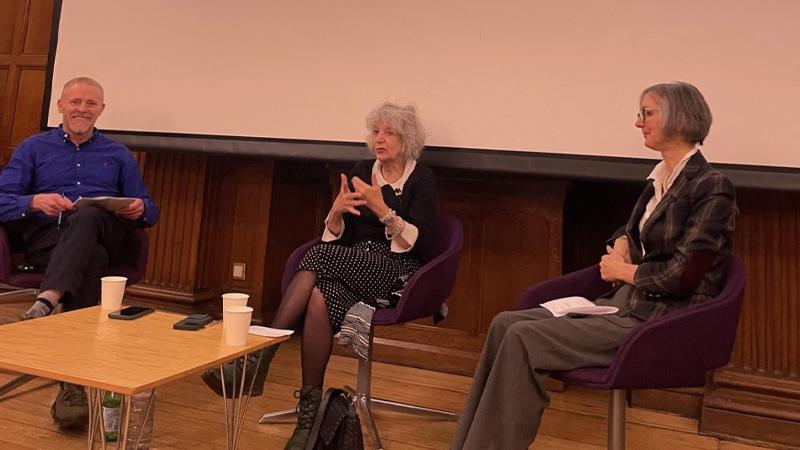
The event, hosted as part of the In Conversation series from the Westminster Centre for Psychological Sciences, brought together students, practitioners, academics and members of the wider community to hear Susie Orbach reflect upon her career. Orbach was joined by Westminster’s Professor Damien Ridge and Dr Alison Fixsen in a panel discussion mediated by Dr Tina Cartwright to explore Orbach’s work on bodies, identity, therapy and social change, which has had a profound influence across clinical practice, feminist theory and public debate.
While Orbach has shaped feminist and cultural debates over several decades, she has resisted being cast in a celebrity role. Professor Ridge, Professor of Psychology at Westminster, asked how public visibility has influenced her. She reflected that, early in her career she was energised by gaining recognition and a platform from which to speak, given women’s marginal position at the time. However, she expressed uncertainty about how younger people establish a voice today within a technologically saturated and rapidly changing society.

Renowned for her powerful feminist writing and activism, Orbach reflected on her early involvement in the civil rights movement and on how women’s resistance to patriarchy had centred on securing greater equality in both domestic and working lives. She went on to discuss how safety is a pressing concern for women today, as alarming cases of institutional misogyny continue to surface, such as those among wealthy elites linked to figures like Jeffrey Epstein, and also within major law enforcement bodies.
As a leading hub for research and education in mental health, the University of Westminster Centre for Psychological Sciences fosters interdisciplinary dialogue and supports events that bring cutting-edge psychological thinking to wider public audiences. This reflects the University’s Being Westminster strategic priority of wellbeing, and its mission to help students and colleagues contribute to a more sustainable, equitable and healthier society.

Susie Orbach
About the event Susie Orbach said: “I loved being at Westminster, where critical thinking, curiosity and care shape how we confront the harms, both inadvertent and intentional, that arise from societal inequalities.”
Nancy Wellman, Development Officer at the University, added: “Hearing from Susie was not only deeply inspiring but also a powerful reminder of the impact our community can have when we come together to support transformative learning opportunities. Events like this highlight how we can better connect as a community, and underscore how donor generosity helps us bring world class speakers and experiences to our students and alumni.”
This talk directly contributes to the United Nations Sustainable Development Goals (SDGs) 3: Good Health and Wellbeing, 4: Quality Education and 5: Gender Equality. Since 2019, the University of Westminster has used the SDGs holistically to frame strategic decisions to help students and colleagues fulfil their potential and contribute to a more sustainable, equitable and healthier society.
Find out more about studying Psychology at the University of Westminster.
Related articles


