As part of the London Festival of Architecture (LFA), students and colleagues at the University of Westminster’s School of Architecture and Cities have co‑designed and constructed an experimental High/Low Impact Straw Bale Pavilion. Creating the structure was a real-life project exploring low‑carbon and regenerative forms of construction.
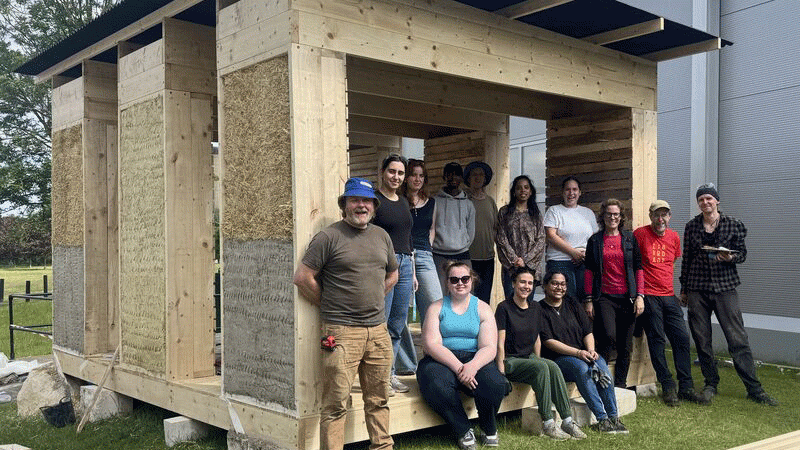
The year-long hands-on project saw students from the Architecture BA Honours course, Architecture with Foundation BA Honours, Architecture and Environmental Design BSc Honours as well as Master of Architecture (MArch) (RIBA pt II) taking part. The project began in the first semester with initial design meetings, including with structural engineer and straw bale specialist Michael Burchert, following into the second semester focusing on finalising the detailing, tendering and getting the materials in place. The final semester saw the construction, completing the structure on 21 May.
Located on the University’s Harrow Campus, the pavilion offers LFA visitors the opportunity to experience first-hand construction techniques using materials made from plants or natural fibres.
The structure demonstrates the potential of straw bale construction, a material that is fire‑certified, low‑cost, resistant to rodents and insects, and stores carbon instead of releasing it, making it net-positive. As an agricultural by‑product requiring no extraction and minimal processing, straw supports healthy indoor environments, regulates humidity and can safely return to the earth at the end of its life. The pavilion’s modules meet Passivhaus standards and are designed to be disassembled and reused.
Alongside the straw bale walls, the project incorporates corrugated hemp roof panels made from rapidly renewable natural fibres, providing a lightweight and durable alternative to conventional roofing materials. The pavilion also uses stone foundations, which significantly reduce carbon emissions compared with manufactured concrete blocks.
Maria Kramer, Senior Lecturer in Architecture, said: “This is the tenth 1:1 Live Project I have led and one of the most challenging and rewarding to date. We hope it will evolve into a modular, low-carbon, Passivhaus-standard straw-bale system designed for co-assembly, showing that high-performance, affordable ecological construction can be delivered through collaborative, low-tech methods. By combining carbon-sequestering straw-bale construction with a flexible, standardised modular approach, we are testing a construction system whose value lies as much in the process of making as in the final outcome.
“This project was funded by the Centre of Teaching Innovation (CETI) at the University of Westminster, with thanks to collaborators and sponsors including Live Projects Practice, Room 102, Webb Yates Engineers, Nicholas Alexander, The StoneMasonry Company, BSW Group, Margent Farm and the Harrow Estate Team.”
Eshe Morgan, a student who participated in the project, added: “Working on the Live Straw Bale Pavilion project was a great opportunity to move beyond drawing and actually build something at full scale with my classmates. Michael Burchert, who came from Germany, guided us through the process, sharing his expertise in traditional straw bale construction methods. I really enjoyed working with the material itself. The project was hands-on, engaging and very different from the digital work we often do in Architecture. It was really rewarding to see the project come together physically and to understand the process through making. Overall, it was a really fun and valuable experience and has strengthened my appreciation for sustainable traditional architecture and collaborative design.”
The project directly contributes to the United Nations Sustainable Development Goals (SDG) 4: Quality Education, 8: Decent Work and Economic Growth and 11: Sustainable Cities and Communities. Since 2019, the University of Westminster has used the SDGs holistically to frame strategic decisions to help students and colleagues fulfil their potential and contribute to a more sustainable, equitable and healthier society.
Learn more about Architecture, Interiors and Planning courses at the University of Westminster.
This project is made possible thanks to funding towards the cost of materials. To find out how you or your organisation can support forthcoming projects contributing towards material costs, please contact The Fundraising Team of the University.


Related articles


