The University of Westminster recently hosted a series of research, educational and employability events for Brain Awareness Week 2026, bringing together around 200 participants including students, colleagues, researchers, practitioners and patients.
The week began by offering students a hands-on laboratory experience where they learnt to stain sections of brain tissue to help them visualise and identify brain cells and structures using equipment from the School of Life Sciences.
This was followed by a Neurodiversity Celebration evening held on 17 March as part of the Westminster Programme for Equity, Belonging and Sustainable Development. Organised by Dr Laura Boubert, Edgar Lee, Zahrah Surooprojally and Psychology MSc student Felix Lupes, the event brought together students, colleagues and guest speakers to explore how to help neurodivergent people thrive in education and beyond.
The celebration began with talks from neurodivergent artists and practitioners, including Isabel Pollen, who shared how her late ADHD diagnosis shaped her professional transition from a successful acting career to coaching and public speaking. She was joined by Gunjan Odedra, a business psychologist and coach specialising in neuroinclusive environments, who led an interactive workshop on navigating neurodivergence in and out of the classroom.
Neurologic Music Therapists Esther Mitchell, Emma Bailey and Mary‑Clare Fearn then delivered a hands‑on workshop introducing therapeutic techniques from Neurologic Music Therapy, demonstrating how these approaches support clients on the Autism spectrum.

The evening ended with a series of participant-centred creative and reflective activities organised by Felix Lupes, which gave attendees the chance to explore neurodivergent experiences through a series of rotating stations.
The next day the University held its third annual Neuroscience Symposium, celebrating interdisciplinary neuroscience research, from clinical approaches to the effect of diet on the life of patients living with neurological conditions. The symposium was chaired by School of Life Sciences doctoral student Vera Bowerman and final-year Biomedical Science BSc Honours student Giulia Cavallo.
Six speakers from Westminster presented on ageing, epilepsy, motor neurone disease, and how menopause, diet and gut health can affect cognitive functions and ageing. Guest speakers included Dr Stavrou from the Cyprus Institute of Neurology and Genetics, who spoke about novel treatment of genetic disorders affecting the brain through gene therapies, and Rozermarijn Kalf from UMC Amsterdam who spoke about the role of inflammatory cells in an epilepsy-related genetic disorder. They were joined by Dr Zammit from the University of Malta and Sheila Mashate, Local Group Representative at the British Neuroscience Association, who spoke about their studies on stroke. Additionally, Professor Jessica Teeling from the Gut Immune Brain Axis network gave a keynote describing how inflammation in the body and gut can affect brain functions and memory. The symposium was closed by Professor Miriam Dwek, Director of the College for Research and Knowledge Exchange (LAS) at Westminster.
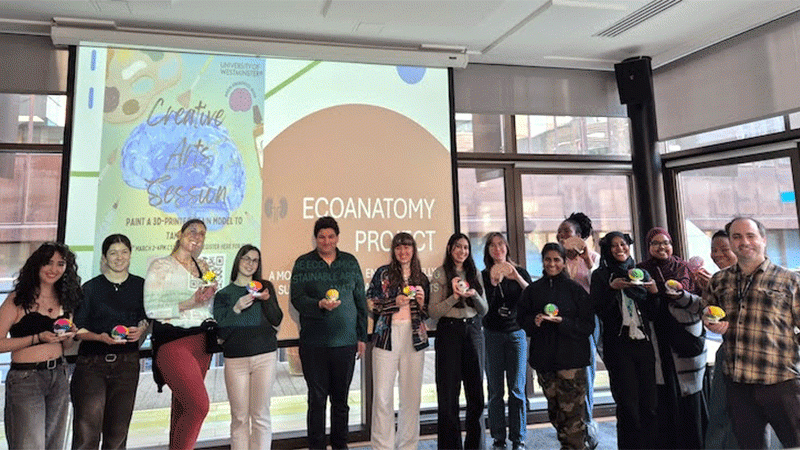
A creative arts session was held the next day, where participants learnt about neuroanatomy through painting 3D human brain models. The 3D brains were printed in-house at Westminster’s Creative & Advanced Technologies Lab (CAT LAB) based on a template created from MRI scans of a human brain. Participants learned about the different regions and functions of the brain, and each one was painted in a range of colours to show unique interpretations of neuroanatomical structures.
The final event was the Neuro-Societies Awareness Evening on 20 March, where representatives from nine societies supporting different neurological conditions were invited to speak. This included Lisa Upton from Brain Buddies UK, Rachel Powell from the Epilepsy Society, Sara da Silva Ramos from Brainkind, Laween Saadi from Silverlining, Katy Barnes from Motor Neurone Disease Association, Megan Naylor from Change Grow Live, and Westminster’s Professor Catherine Loveday who spoke on behalf of Age UK. They gave detailed talks on their missions, career opportunities and current initiatives and research.
The events were funded by the University’s Quintin Hogg Trust, the British Neuroscience Association (BNA) and the Dana Foundation – Federations of European Neuroscience Societies (FENS). The organising team included undergraduate students Elizabeth Dakatse, Ruweyda Elmi and Giulia Cavallo, doctoral candidate Vera Bowerman and senior academics Dr Joan Liu, Dr Laura Boubert and Dr Claire Robertson from the College of Liberal Arts and Sciences, School of Life Sciences and Social Sciences.
Edgar Lees, International Student Engagement Officer at the University of Westminster, said: “The Neurodiversity Celebration event was a great example of what can happen when care and intention come together. Laura led the vision beautifully and our speakers brought both expertise and lived experience into the room in a way that felt open and accessible. It was not just about understanding neurodiversity, but about creating a space where students and colleagues could connect, reflect and feel seen.”
Giulia Cavallo, a final-year Biomedical Science BSc Honours student, said: “The Neuroscience Symposium was a great experience to engage with new ideas and network with professionals from the UK and abroad and expand my understanding and passion for neuroscience research.”
Victoria Sol, a Cognitive and Clinical Neuroscience BSc Honours student, said: “What stood out to me is how much of this work and support from brain charities happens beyond hospitals and research labs. A lot of long-term impact seems to come from community support, education and day-to-day interventions that do not always get highlighted.”
The series of events directly contributes to the United Nations Sustainable Development Goals (SDG) 3: Good Health and Wellbeing, 4: Quality Education and 17: Partnerships for Goals. Since 2019, the University of Westminster has used the SDGs holistically to frame strategic decisions to help students and colleagues fulfil their potential and contribute to a more sustainable, equitable and healthier society.
Find out more about Biological and Biomedical Sciences courses at the University of Westminster.


Related articles


