The University of Westminster’s School of Architecture + Cities recently held its third Climate Action Week, bringing together more than 360 first-year students across the University’s six architecture and built environment disciplines to explore how places and spaces might respond to significant climatic, ecological, social and political issues.
Climate Action Week took place between 13-17 October and saw students from across Westminster’s Architecture BA Honours, Interior Architecture BA Honours, Architecture and Environmental Design BA Honours, Architectural Technology BSc Honours, Urban Planning and Design BA Honours and Architecture with Foundation BA Honours courses take part.
The week opened at the University’s Marylebone Campus with introductions from Interim Vice-Chancellor Professor Dibyesh Anand, Kate Cheyne, Head of the School of Architecture + Cities, Dr Ro Spankie, Director of the School of Architecture + Cities’ Climate Action Task Force (ArCCAT), and Dularee Goonetilleke, the University’s Sustainable Development Advisor. Together they shared the University’s commitment to the UN Sustainable Development Goals (SDGs) and its broader vision on sustainability.
The keynote address was delivered by Professor Jeremy Till, Emeritus Professor at the University of the Arts London, who drew on his 2025 publication titled Architecture is Climate, to ask first-year students “what does the climate emergency do to architecture?” as opposed to “what can architecture do about the climate emergency?” The morning finished with each student writing down one thing they would like to change.
On the second day, students worked in cross-disciplinary groups to take part in Climate Fresk, an interactive card game that explores the interconnected causes and effects of climate change through collective problem-solving. This year, some students and University colleagues also received training to facilitate the game themselves, equipping them with the skills to share their learning with others.
Julia Pandolfi Da Silveira, a second-year Architecture and Environmental Design BSc Honours student and Student President of ArCCAT, said: “Taking part in Climate Fresk and now facilitating a table myself this year has shown me how powerful it can be when we come together to learn, question and imagine a different future. What inspired me the most was seeing how understanding the climate crisis can empower us to act collectively and support one another.”
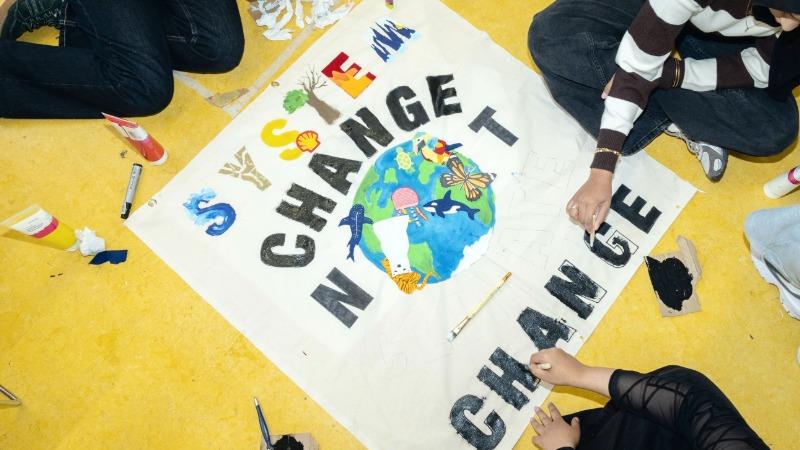
The week concluded with a focus on action and protest. During the Time to Act session, students worked in groups with artist Remiiya Badru to create protest banners highlighting causes they had explored throughout the week. The session ended with students carrying their banners across the Marylebone Campus to the beat of a drum and prizes were awarded for five categories.
Architecture BA Honours student Lisa Henckens, said: “This activity really brings studying architecture into focus. Creating the banner was a very good lesson to take note of how we use materials and the choices we make.”
About the week, Barbara Birtok, Architecture with Foundation BA Honours student, said: “I enjoyed this week because of the atmosphere. Everyone was supportive and friendly to each other, all because we knew why we were there. The week was not only for climate action but to bring us together and to act now, before it’s too late.”
Climate Action Week was organised by Dr Spankie, Richa Mukhia, Senior Lecturer, Jenny Kingston, Lecturer, and Julian Williams, Principal Lecturer, from the School of Architecture + Cities.
Every year, Climate Action Week directly contributes to the United Nations Sustainable Development Goals 13: Climate Action and 17: Partnerships for the Goals. Since 2019, the University of Westminster has used the SDGs holistically to frame strategic decisions to help students and colleagues fulfil their potential and contribute to a more sustainable, equitable and healthier society.
Learn more about Architecture, Interiors and Planning courses at the University of Westminster.
Find out more about the University’s commitment to sustainable development.


Photo credits: Dr Ro Spankie and Dan Ripnar
Related articles


