The Vitae award-winning Black History Year Researchers Network from the University of Westminster recently hosted their annual conference, themed Amplifying Black Scholarship. The conference welcomed researchers, aspiring researchers, those in supporting roles and those interested in new scholarly work to explore how Black researchers are shaping knowledge production across disciplines, communities and global contexts.
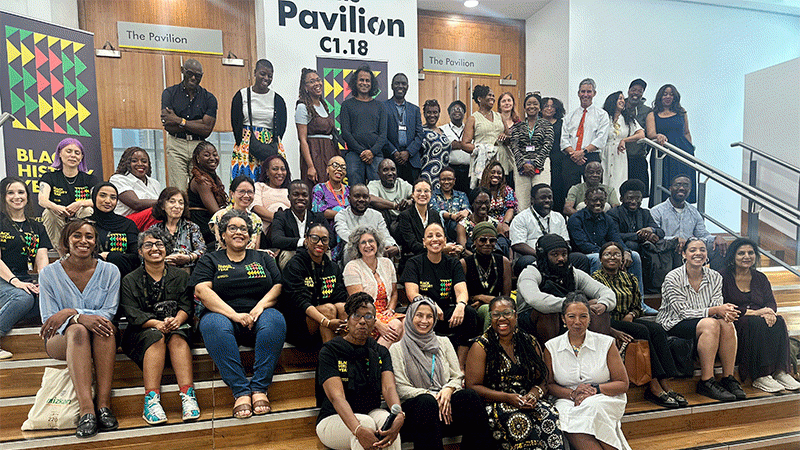
Held on 1 July at the Cavendish Campus and supported by Deputy Vice-Chancellor for Research and Knowledge Exchange Professor Andrew Linn, the conference showcased the breadth, depth and impact of research being undertaken by Black scholars at the University, shining a light on exceptional contributions from inspiring doctoral students to distinguished senior academics. The day opened with a welcome from Professor Linn and Research Development Manager Kate Theophilus, followed by a keynote from Professor Jessica Jones Nielsen, Associate Director of the Wellcome Trust’s Equity Lab, who reflected on equity, research cultures and the future of inclusive scholarship.
The first session, Advancing Black Scholarship, highlighted a diverse range of research. Presentations included an examination of journalism sustainability in Nigeria, an investigation into body dysmorphia and ecology, a study of children’s values in Nigerian primary classrooms, an analysis of youth political disengagement in Jamaica and the UK, and an evaluation of biodiversity disclosure within African sustainability reports. The session concluded with a spotlight on researcher development through Vitae, the national programme that supports the professional and career development of researchers across the UK.
The afternoon session, Black Scholars Rising, chaired by Reader and Senior Lecturer in Marketing at the Westminster Business School Dr La Toya Quamina, explored emerging academic leadership and new directions in research practice. The session began with an address by Julia Hendricks, Academic Engagement Librarian, on the importance of writing communities for Black scholars and included an examination of the continued development of module leadership within higher education by Dr Louis Spring.
Dr Dunni Omeber-Iyari presented her work on how virtual influencers build consumer trust, followed by Dr Elly Nmecha’s investigation into the influence of international AI frameworks on gender equality in tech ecosystems across low‑ and middle‑income countries. The session closed with an intersectional analysis by Dr Uchechukwu Oluwatosin Bagot-Sealey of misogynoir - a form of misogyny directed specifically at Black women, where both racism and sexism intersect - and the racialised harms embedded in UK film authorship law.
The final session, Black Professors on the Couch, chaired by Chartered Psychologist and Reader in Race and Sociocultural Psychology Dr Deborah Husbands, brought together senior academics including Professor Jessica Jones Nielsen, Professor Godfrey Kyazze, Professor Mykaell Riley and Professor Louise Owusu‑Kwarteng to reflect on their academic journeys, leadership, equity and the structural changes needed to support Black researchers across the sector.
The day also featured an introduction to KINSIS – an award-winning social enterprise dedicated to empowering Black women and underrepresented students in higher education founded by Director Jessica Agboola. Vice‑Chancellor and President Professor Peter Bonfield and Deputy Vice‑Chancellor for Global Engagement and Employability Professor Dibyesh Anand concluded the day with closing remarks.
About the event, Dr Husbands said: “Our second annual conference solidified not only its success but also firmly grounded the University's mission to make research for all a reality. From PhD students to academic and professional services colleagues - some of whom were presenting at a conference for the first time - the BHY Researchers Network modelled the principle of being a brave and inclusive space. With recognition from our senior leaders, Vitae, the Careers Research and Advisory Centre and the Black Researcher Consortium, we have shown how impact, culture and engagement can work hand in hand to amplify the scholarly activities of our Black colleagues, keeping Westminster at the forefront of colleague support.”
Kate Theophilus, Research Development Manager at the University, added: “Academia and the research systems across it perpetuate just the same systemic curtailing of progress, visibility and opportunity for Black colleagues as do other sectors. The data continues to bear this out even as enthusiasm for the conversation dims, and still there are beacons of best practice. Westminster is among those and we should be proud. Amplifying Black Scholarship was a day of energy, scholarship and engagement that demonstrated the impact that is possible when meaningful support from the top meets action from committed colleagues across the organisation. This was Westminster at its values-led best and the breadth and brilliance of research presented was an inspiration.”
The conference directly contributes to the United Nations Sustainable Development Goals, specifically 4: Quality Education, 10: Reduced Inequalities and 17: Partnership for the Goals. Since 2019, the University of Westminster has used the SDGs holistically to frame strategic decisions to help students and colleagues fulfil their potential and contribute to a more sustainable, equitable and healthier society.
Find out more about Black History Year at the University of Westminster.


Related articles


