Fashion Design BA Honours students from the University of Westminster have won the opportunity to design vacant shopfronts across Marylebone, London, after taking part in an innovative hackathon organised by the Baker Street Quarter Partnership in collaboration with Portman Marylebone and The Portman Estate.
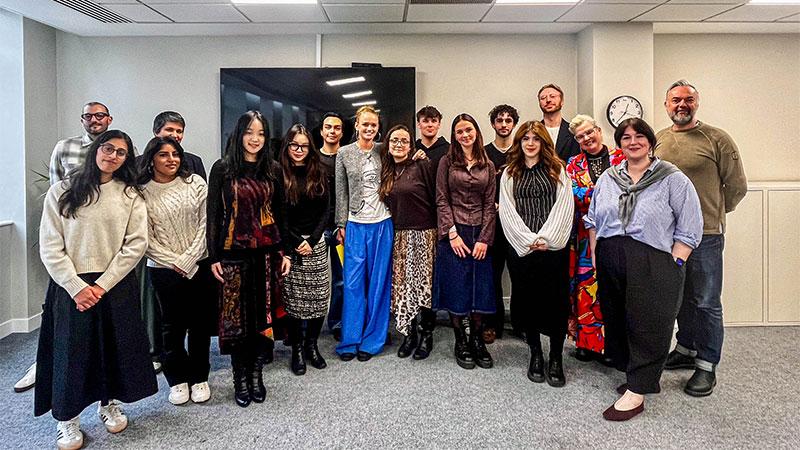
Hosted by the Baker Street Quarter’s Head of Marketing and Communications, Justin Korotva, the hackathon challenged students from Westminster’s School of Arts to respond to a real-world design brief, tasking them to create vinyl concepts for empty shop windows and pitch their ideas to industry professionals. The initiative builds on recommendations from the area’s cultural strategy and offers students the opportunity to contribute to the visual identity of the neighbourhood.
The winning design will be installed across shopfronts in Marylebone, starting with Portman Marylebone sites along Blandford Street. There is also potential for the artwork to be rolled out across additional vacant units and construction hoardings throughout the wider Baker Street Quarter.
As part of the brief, students were asked to create designs that reflect Marylebone’s character, heritage and contemporary culture, while adding colour and creativity to the streetscape. Designs needed to feel welcoming and community-focused, and work as repeatable wallpaper-style vinyl that could adapt to different window shapes and sizes.
At the end of the hackathon, students showcased their visual mock-ups to industry professionals. The winners were selected by representatives from The Portman Estate, Derwent London and the Baker Street Quarter Partnership and were awarded with a £300 Visa Gift Card along with the chance to have their work displayed.
Opportunities to work with external partners such as the Baker Street Quarter Partnership and on real-life projects are central to the University of Westminster’s new home for careers and enterprise, Zone29, which provides students and graduates with access to work-related programmes, opportunities and experiences.
The winning team was made up of Angela Cammarota Perez and Souki Faulkner, whose design drew on a thoughtful blend of historical research and local architecture. Inspired by the River Tyburn, once a vital source of drinking water in London, the concept reflected the idea of hidden flow beneath the city. This narrative is seamlessly combined with the use of bows, a recurring motif found in the architectural detailing of surrounding buildings and townhouses in the Marylebone area.

Angela Cammarota Perez and Souki Faulkner
Angela said: “Bringing my fashion design knowledge into a different area of the arts was particularly interesting and showed me how transferable creative skills can be. One of the key lessons I took away was how to adapt to the specific needs of an industry, company and sector, as well as understanding the importance of negative space and the idea that sometimes less is more. I believe this experience will significantly influence my future studies, encouraging me to approach my modules with a more flexible and interdisciplinary mindset, and perhaps even explore other sectors within the arts industry.”
Zak Peric, Senior Lecturer and Employability Coordinator at the University of Westminster, said: “Hackathons like this are incredibly valuable for students in creative disciplines. They create opportunities to test ideas quickly, collaborate with peers, and respond to industry briefs in a fast-paced environment. These experiences help students build not only creative and technical skills, but also essential professional abilities such as teamwork, communication, and adaptability.
“A big thank you to the Portman Estate for their commitment to supporting our students and creating opportunities that connect education with industry. Partnerships like this play a vital role in preparing the next generation of creative professionals.”
Providing opportunities such as hackathons directly contributes to the United Nations Sustainable Development Goals (SDG) 8: Decent Work and Economic Growth, 11: Sustainable Cities and Communities and 17: Partnerships for the Goals. Since 2019, the University of Westminster has used the SDGs holistically to frame strategic decisions to help students and colleagues fulfil their potential and contribute to a more sustainable, equitable and healthier society.
Find out more about the School of Arts at the University of Westminster.


Related articles


