Business of Film MA students at the University of Westminster have worked with the Regent Street Cinema (RSC) to run On The Brink – Turning Points In Cinema, a three‑day series celebrating landmark works of world cinema as part of the venue’s 130th anniversary. Developed through the University’s World Cinema Project, the programme showcased pivotal international films alongside live performances, expert talks and cultural experiences, giving students hands‑on industry experience in curating and running a professional film event.
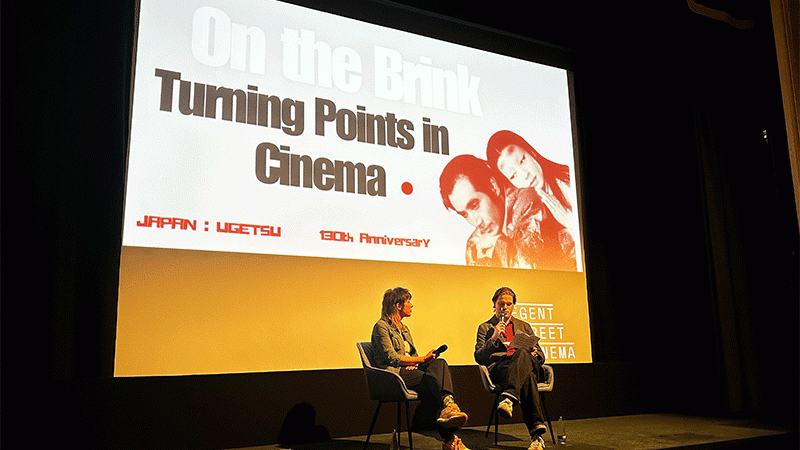
Kicking things off on 10 April, attendees watched Kenji Mizoguchi’s 1953 Ugetsu, a cornerstone of Japan’s Golden Age of cinema. A themed cherry blossom cocktail set the tone for the screening, which was followed by a Q&A with Dr Irene González‑López, an expert in Japanese Film at Birbeck, University of London. During the Q&A, she discussed the film’s themes, its impact on the Japanese film landscape and her research in postwar cinema and issues related to gender and sexuality.
A matinee screening of Güeros on 11 April invited audiences into a black‑and‑white, coming‑of‑age journey through Mexico City, set against the backdrop of the 1999 university strikes. The event opened with live Sierreño acoustic music in the lobby, with Palomas served at the bar and representatives from the Mexican Embassy were invited to discuss the cultural context of the film.
The third screening was a feature of Jean‑Luc Godard’s French New Wave classic Pierrot le Fou. Following the screening, writer and director Joshua Magor explored the film’s enduring influence, its place within the French New Wave and how it was used as a commentary on the state of French society at the time.
This was followed by Ingmar Bergman’s Fanny and Alexander, which offered an exploration of childhood, imagination and resilience set in early twentieth‑century Sweden. The film was introduced by Elin Norquist, Counsellor for Cultural Affairs at the Embassy of Sweden, and audience members were welcomed with a live acoustic performance by Nica Albertson and were offered complimentary Swedish cinnamon buns, sponsored by the Embassy of Sweden.
As part of their core work placement, the students took on hands‑on, industry‑focused roles that gave them a high level of independence and responsibility. Working as a team but with individual ownership of one film and its screening, the students organised financial budgets, carried out audience research and developed partnerships with guest speakers, embassies and subject specialists to deliver the festival.
They also helped shape the marketing and on‑the‑day delivery of each event. The project offered a distinctive real‑world learning experience and resulted in a festival that reflected both the RSC’s identity and its commitment to showcasing global cinema.
Preparing students for career readiness through real life projects such as this forms a key ambition of Zone29, the University’s new home for careers and enterprise due to open in Spring 2026. The opening of Zone29 creates new practical opportunities for learning and engagement with employers within and outside of the curriculum in an inclusive, sustainable environment.
Billy Watson, Managing Director at RSC, said: “We at RSC can provide students studying Film some real-world learning. This can only be replicated within a trading business environment and as a commercial subsidiary of the University, we can provide this experience and enhance their employability.”
Michelle Stoyneva, one of the students who participated, added: “The World Cinema Project allowed me to develop deep understanding and appreciation for the level of work, planning, communication and dedication that actually goes into organising a cinema event. Everyone worked hard behind the scenes, coordinating every detail so that the experience was as smooth as possible for the audience. I am grateful and excited to have been responsible for events that highlighted amazing international films, celebrating culture beyond national borders. The audience feedback has been exceptional and I sincerely hope this initiative turns into a yearly tradition.”
The series of events directly contributes to the United Nations Sustainable Development Goals (SDG) 4: Quality Education, 8: Decent Work and Economic Growth and 17: Partnerships for the Goals. Since 2019, the University of Westminster has used the SDGs holistically to frame strategic decisions to help students and colleagues fulfil their potential and contribute to a more sustainable, equitable and healthier society.
Learn more about Film and Television courses at the University of Westminster.


Related articles


