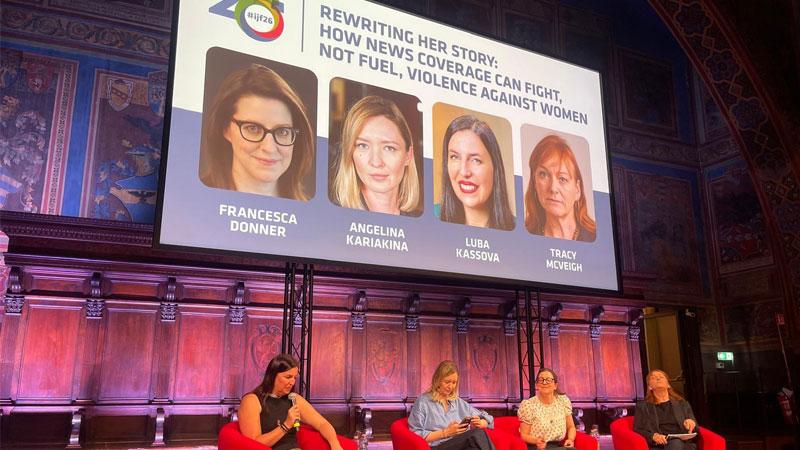
Westminster doctoral researcher Luba Kassova launched the Global Misogyny Coverage Tracker report with a panel event at the 20th International Journalism Festival in Perugia, Italy. The report used innovative methods to gather evidence demonstrating the underreporting of misogynistic harassment and violence against women in the global media.
The report, titled The Global Misogyny News Coverage Tracker: The Missing Misogyny-related Coverage in an Era of Endemic Violence against Women, is the seventh report in the award-winning Missing Perspectives series from Westminster doctoral researcher Luba Kassova and her business partner Richard Addy.
At the International Journalism Festival, Europe’s largest journalism festival, Kassova presented new evidence gathered by the tracker, which analysed over a billion global online news stories since 2017. The findings demonstrated that reporting on misogynistic harassment and violence against women remains scant and that existing reporting is predominantly focused on individual incidents rather than systems enabling the crimes, dominated by male experts and largely excludes survivor voices and solutions-based angles.
A panel of three distinguished editors then discussed what stood out to them most from the report’s findings. This included Tracy McVeigh from The Guardian, Francesca Donner from The Persistent, and Angelina Kariakina, a Ukrainian editor, journalist and co-founder of Public Interest Journalism Lab.
The group offered practical recommendations for interventions likely to improve both the quantity and quality of coverage, such as de-gendering of misogyny-related stories and challenging the traditional makeup of newsroom culture, which centres around men’s perceptions of what constitutes a story, by hiring more female editors and journalists.

The report aims to ensure that stories sharing the perspectives of women and girls are told with more sensitivity and skill so that policymakers who read them can effectively change women’s realities through new laws, initiatives and programmes that both protect women and challenge damaging social norms.
Kassova is currently undertaking a PhD at the University of Westminster’s College of Creative Arts and Technologies, where she researches women in journalism. Her work reflects the University’s Being Westminster strategic vision of being a place where people stand out as significant contributors to their communities through innovation, enterprise and problem solving to make the world a better place.
About the report Kassova said: “The numbers in this report should shock. The blank space where stories should be but are missing is not neutral; it carries real-world consequences. We cannot repair a world we do not recognise as broken.
“I hope that this annual tracker will advance the understanding of women and journalism and act as an incentive for editors to cover more misogyny-related stories, for more journalists to write about both the problem and its solutions, and for funders to support journalism that can catalyse women-centred policymaking.”
This report contributes to the United Nations Sustainable Development Goals (SDGs) 5: Gender Equality, 10: Reduced Inequalities and 16: Peace, Justice and Strong Institutions. Since 2019, the University of Westminster has used the SDGs holistically to frame strategic decisions to help students and colleagues fulfil their potential and contribute to a more sustainable, equitable and healthier society.
Find out more about research degrees at the University of Westminster.
Learn about Westminster’s commitment to equality, diversity and inclusion.


