The University of Westminster's Quintin Hogg Trust (QHT)-funded Live Performance Project partnered with arts collective D-Fuse to host the Nine Earths Summit at its renowned exhibition space Ambika P3, bringing together a variety of audio-visual performances and immersive artworks to explore neurodiversity and the climate emergency. This included a display of self-portraits created by Westminster students to prompt discussions about citizen assemblies.
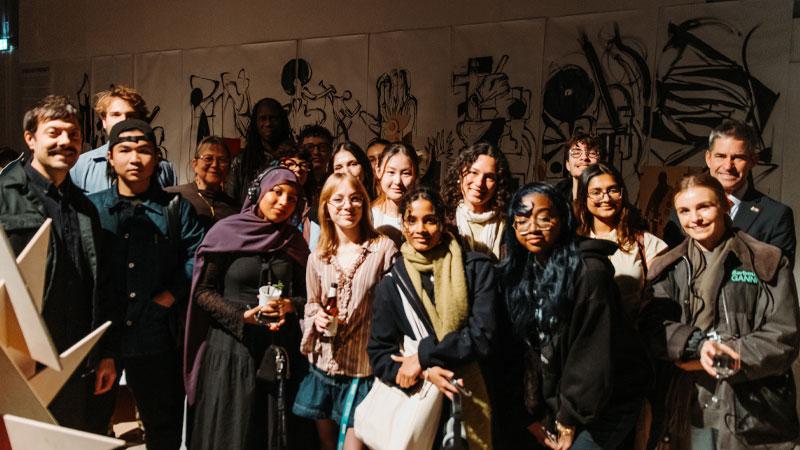
Students and colleagues from the School of Architecture + Cities and the QHT-funded Live Performance Project collaborated with D-Fuse to host the summit, which took place between 29-30 November at the University of Westminster’s Ambika P3, a research and exhibition space for international contemporary art and architecture. The QHT-funded Live Performance Project is designed to enrich the student experience through active participation in cultural programming and collaboration with leading artists, organisations and the local community.
The summit brought together artists, scientists and climate activists for a programme of immersive installations, audio-visual performances, workshops and talks, offering an opportunity to reflect on environmental storytelling and neurodiversity.
The two-day event centred around themes from D-Fuse’s environmental documentary and immersive installation titled Nine Earths, which explore the relationship between everyday life and humanity’s excessive demand for the Earth’s resources. This was told through different stories of consumption from nine citizens across the world, with a focus on what it means to be a citizen.
As part of the summit’s wider conversation around citizens’ assemblies, Westminster Interior Architecture BA Honours students also had the opportunity to create their own citizen self-portraits exploring the multi-faceted nature of being a citizen. Their citizen self-portraits were collectively assembled as if in discussion to encourage the audience to imagine their conversations.
Students were also interviewed by event speaker Jamie Kelsey Fry, Co-founder of the world’s first Global Citizens’ Assembly, about the upcoming University of Westminster Climate Assembly (UWCA). The UWCA is a citizens’ assembly involving students and colleagues that will consider how the University and its community can take meaningful action on climate change and achieve its institutional commitment to sustainable development. Funded by the Quintin Hogg Trust, the UWCA will meet six times between January and March 2026, making Westminster the first UK university to take up the practice of citizens’ assemblies.

Students talking with Jamie Kelsey Fry about the UWCA. Photo credit: Ro Spankie
About the experience final year Interior Architecture BA Honours student Andrea Bonilla shared: “Being part of this exhibition gave us the chance to collaborate on something far more tangible and ambitious than our usual university projects. Working as a team at this scale was incredibly valuable, it felt like a real design practice, where we delegated tasks, shared progress and collaborated as colleagues rather than just classmates. Experiences like this are so important for our development as future designers.”
About her self-portrait titled Luz, Andrea added: “My citizen self-portrait is star-shaped, colourful, and rising upward. It reflects how I see myself in my community, someone who lights the way for others, leads by example and brings a playful, positive energy to the spaces and people around me.”

Andrea Bonilla with her self-portrait, Luz. Photo credit: Hy Le
Dr Ro Spankie, Assistant Head of the School of Architecture + Cities and convenor of the School of Architecture + Cities Climate Action Task Force (ArCCAT), added: “As part of the wider engagement around the University of Westminster Climate Assembly we asked the third year Interior Architecture students to design a Citizens’ Assembly. The design brief asked the students to start with the citizen rather than the assembly space by creating their own Citizen Self Portrait. These large-scale ply figures were displayed as alongside Mike Faulkner’s projection installation and other pieces. The figures will be used in the UWCA to guide assembly members.”
The Nine Earths Summit directly contributed to the United Nations Sustainable Development Goals (SDGs) 12: Responsible Consumption and Production, 13: Climate Action and 17: Partnerships for the Goals. Since 2019, the University of Westminster has used the SDGs holistically to frame strategic decisions to help students and colleagues fulfil their potential and contribute to a more sustainable, equitable and healthier society.
Learn more about Architecture, Interiors and Urban Design courses at the University of Westminster.

Photo credit: Hy Le

Photo credit: Elijah McDonnell

Photo credit: Hy Le

Photo credit: Ro Spankie

Photo credit: Elijah McDonnell

Photo credit: Ro Spankie

Photo credit: Elijah McDonnell
Related articles


