Biomedical Science BSc Honours students from across all three year groups at the University of Westminster have undertaken a two-day extracurricular trip to Cambridge, one of the world's leading hubs for genomics research, to deepen their academic experience and gain a close-up look at how precision medicine is implemented in practice.
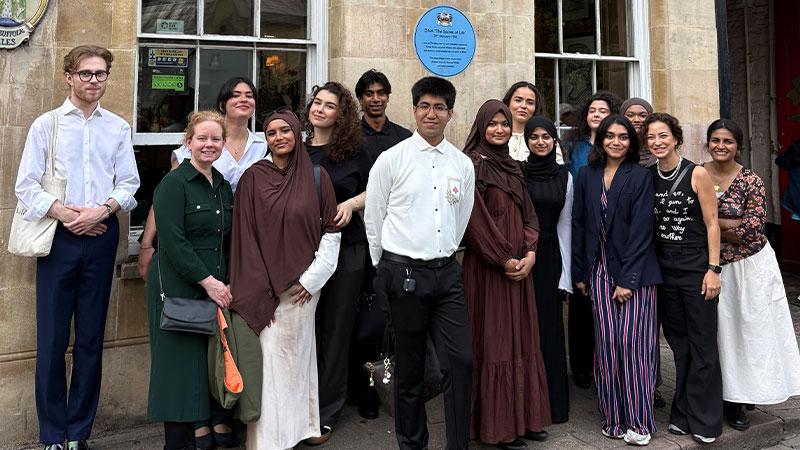
During the trip, students were welcomed at the Stratified Medicine Core Laboratory (SMCL) NGS Hub at the Department of Genomic Medicine, University of Cambridge, where they attended the SMCL NGS Hub MakeFest 2026 – Facility Day and learned how next-generation sequencing technologies are being applied to address real clinical challenges. They were also introduced to exciting new developments in multiomics and witnessed close research collaborations between academia and industry.
Students also gained hands-on insight into high-throughput automated extraction platforms, seeing first-hand how these technologies efficiently process large numbers of samples while maintaining the quality standards required by NHS laboratories.
During the trip there was a chance to visit the University of Cambridge’s Homerton College, where students took part in an inspiring panel discussion with Dr Joelle Nassar, Investigator Scientist at the MRC Laboratory of Molecular Biology (LMB), and Azahara Rodriguez Dominguez, Associate Director for Global Patient Safety. The speakers shared their journeys through both academia and industry, offering students frank and motivating insights into the career paths that await them.
Both scientists in the discussion panel offered an eye-opening look at the collaborative effort behind scientific discovery, from the laboratory bench to publication. Students heard about the involvement of multidisciplinary teams, including experts in ethics, clinical research and bioinformatics analysis, whose contributions ensure that research is robust, responsible and beneficial to society. The session brought home just how much of science happens between disciplines, and how many exciting roles exist beyond the wet lab itself.

For two days, students lived like Cambridge researchers, experiencing the full rhythm of academic life, from a formal dinner to late-night conversations about science. The formal dinner at Homerton College was a particular highlight, offering a taste of Cambridge's rich collegiate tradition and the chance to connect with early-career scientists who were generous in sharing their own routes into research.
Before the dinner, students took part in a walking tour of the city, visiting landmarks including King's College, the Mathematical Bridge and the historic Eagle pub. The Mathematical Bridge, celebrated for its elegant geometric design, brought mathematical and physical principles to life in a way no lecture hall quite can. The Eagle, meanwhile, offered a brush with scientific history; it is claimed that it was there that Watson and Crick famously announced the discovery of the double helix structure of DNA in 1953.
The trip was organised and led by Dr Maria Neofytou, Co-Course Leader in Biomedical Sciences, and Dr Lorna Tinworth, Assistant Head of the School of Life Sciences, with all expenses covered by the School of Life Sciences.
Juliana, a second-year student, added: "The SMCL Symposium was truly inspiring. As an aspiring medic, it is crucial to understand the specific molecular mechanisms we need to uncover through fundamental research, like Dr Joelle Nassar's work, and to consider how this addresses the clinical challenges we see in practice. Spending time with my talented colleagues and two outstanding academics at the Cambridge Institute was a truly refreshing experience."
Another student Safa, said: "I really enjoyed the visit to Homerton College, and speaking with postdoctoral researchers and PhD students gave me a much better understanding of the different career paths available in research and academia. The highlight for me was the talk on type 1 diabetes and how multiomics can integrate data across different biological levels to build a more complete picture of the disease. It was exciting to see how new automated technologies are advancing and helping biomedical scientists to personalise healthcare more efficiently."
The trip closely reflected several United Nations Sustainable Development Goals (SDGs). The focus on improving the understanding, detection and treatment of diseases such as type 1 diabetes aligned with SDG 3: Good Health and Well-being. The opportunity to engage directly with researchers and experience cutting-edge science beyond the lecture theatre supported SDG 4: Quality Education. Finally, the advanced genomic technologies showcased throughout the trip exemplified SDG 9: Industry, Innovation and Infrastructure, demonstrating the role of scientific innovation in addressing global healthcare challenges.
Find out more about Life Sciences courses at the University of Westminster.
Related articles


