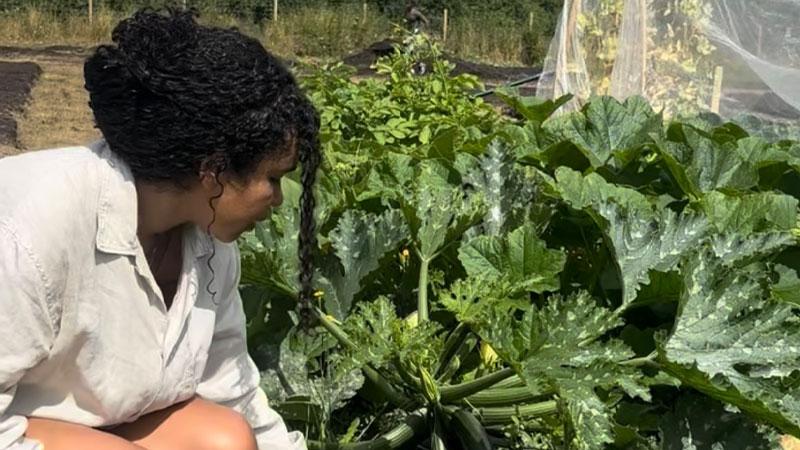
Global Public Health Nutrition MSc student Hayley Biley is putting her learning into practice. Through Westminster’s Students as Researchers Programme, she has contributed to the national Right to Food Commission. Alongside her work with the Food, Farming and Countryside Commission (FFCC), she also runs Nourish Club, a venture bringing people together through community food growing. Here, Hayley shares how her experiences at Westminster have shaped her understanding of food, health and community.
What inspired you to get involved in the Right to Food campaign?
I had the same inspiration for getting involved in the Right to Food campaign as I did for studying my Master’s in Global Public Health Nutrition. I grew up in Croydon, South London, and my particular area has quite high levels of poverty and low income. My mum would wait until the end of the day, take whatever coins she had to Tesco, look at the reduced food and see what she could get. So, when I heard about campaigns like the Right to Food, I wanted to get involved on a personal level because I think everyone should have that right. It doesn’t matter where you come from.
Current interventions are being exhausted and are only short-term solutions. There isn’t a long-term answer. Food banks don’t work forever, so getting involved in research on the Right to Food and exploring different solutions that put communities at the centre and reinforce dignity felt like something I wanted to support.
What did you do as part of the Students as Researchers Programme?
Our research was split into two parts. The first involved looking at place-based workshops to capture the voices of the people in local areas. My research looked at the voices of people of Wales. It was interesting because there was a lot of common ground across the UK, whether in Belfast, Newcastle or Brixton. But there were also things specific to Wales, like an emphasis on community gardening, which led me onto the second part of my research. There we looked at different interventions for the Right to Food in more detail and explored how community gardens and kitchens can help. For example, someone originally from Romania who was struggling with food poverty, so they set up their own community garden and kitchen that was tailored to their community. People would come together, grow food and make culturally adaptive versions of the things that they would eat back home.
After completing our research, we created a podcast to discuss the findings from the workshops we attended, the voices of the community and the specific areas we each focused on. Alongside my research on community kitchens, my co-researchers looked at nutrition during pregnancy, free school meals and food banks, which we spoke about on the podcast.
What did you learn from working on the campaign?
The main thing that came up in every community was dignity. Having to access food banks can create a sense of shame. Often, you’re lining up outside and being watched on the street. Then you get into the food bank and, perhaps because of dietary preferences or cultural reasons, you can’t eat what they’re offering, and you’re shut down because of that. You can’t force someone to eat something they don’t want to.
But something that surprised me was how much putting the emphasis on community changed that perception. When you do it through a garden or a kitchen, where people meet others and it becomes more of a social experience, it doesn’t feel like they’re getting a handout. This made me realise how easily things could be flipped. There’s a lot of unused land in London and across the UK, and if we used it more productively to create community spaces, it would be a better way of addressing food insecurity.
How did your experience at Westminster shape your career goals?
The level of support I’ve felt here, along with the experiences I’ve had during my one-year Master’s, have been incredible. At Westminster, there were opportunities to experience things that aligned with my interests. In May, I got to spend a week on a syntropic farm in the mountains of Spain. It was life-changing, and I learnt so much. That opportunity would never have come up otherwise.
In general, the support from lecturers made me feel like there was time for me, which gave me a sense of confidence. Coming from a low-income background, I spent most of my life feeling like education wasn’t for me. Westminster showed me that wasn’t the case. It’s the support you get, the way people engage with you and how they connect ideas to things you understand.
Now I have a completely different approach, and I put that down to Westminster.
You’ve started a new role at the Food, Farming and Countryside Commission (FFCC). What does your role involve?
I’m a Policy and Research Assistant, and there are three main policy areas we focus on. The first is citizen engagement, which also covers food. For example, we’re running workshops where we will talk to people about food prices, how increased costs are affecting them and what they think the government can do to address it.
Another area is farming, where we’re involved in the political side as the secretariat for the All-Party Parliamentary Group (APPG) on Farming. I’m in touch with politicians and taking ownership of connecting people throughout the farm-to-fork process.
Thirdly, there’s land use, where I offer general support. The great thing about the FFCC is that they’re open to me exploring which areas I’d like to work in and am interested in.
You’ve also started your own venture, Nourish Club. What inspired you to start it?
In the pandemic, I was put on furlough, and suddenly I had a lot of time on my hands. I decided to try growing some vegetables. Living in social housing in Croydon, I don't have access to good green space, so on my bedroom window, I got a planter box and grew carrots, tomatoes, herbs and all sorts of things. That made me think, “Why is everyone not doing this? Everyone needs to know about this!”
I started having conversations with people, and they were shocked that I’d grown food on my windowsill, rather than in a greenhouse or garden. This made me think about starting workshops where people could learn how to grow their own food.
I now run Nourish Club workshops and they’ve been super successful. I put a post on TikTok and 600 people reached out! I ended up running an additional workshop where everyone had found me through TikTok.
What do you hope to achieve with Nourish Club?
I'd love it to live as something in people's homes as a way of addressing food insecurity. I want to get into schools so people can learn about growing food from a younger age, because we need to take more control of our food autonomy. People should know what’s in the food they’re eating because they’re growing it themselves.
I also want to create neighbourhoods of people with a shared interest in food and connect them to green spaces. Not everyone has access to green space or can grow things in their garden, so Nourish Club workshops provide an opportunity to do so.
What’s next for you?
I want to build more connections in the agriculture sector, dive into urban farming and develop my role with FFCC. They’re supportive of my interest in urban farming, so watch this space. I’m also trying to go a bit more full steam ahead with Nourish Club, because the feedback I've gotten in the past year shows me this could really go places.
Find out more about Health courses at the University of Westminster.
Related articles


