Students and colleagues from the University of Westminster have contributed to the UK Parliamentary Commission on the Right to Food as it presented its interim findings to Members of Parliament (MPs) during key evidence sessions.
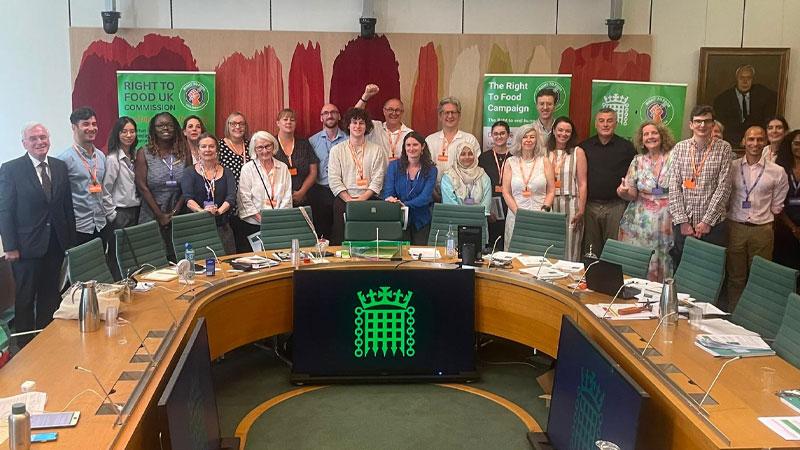
The evidence sessions took place on 8 and 9 July and marked a significant milestone in the Commission’s work to develop a roadmap towards ending food insecurity in the UK. The Commission, which officially launched in Parliament on 17 November 2025, has since gathered evidence from communities, academics, public health experts, campaigners, trade unions, local authorities, businesses and people with lived experience of food insecurity across the country.
The sessions were attended by several MPs, including John McDonnell, who praised the campaign's core demands and the potential of community kitchens and restaurants to reduce stigma, rebuild communities and address the social costs of food insecurity, including poor mental health, isolation and weakened community bonds. Reflecting on testimony from people with lived experience, McDonnell said he would remember the powerful phrase that many are forced to “eat the rent”.
Baroness Ruth Lister also emphasised that social security is fundamental to the Right to Food and warned against the persistent negative narrative surrounding welfare. She argued that social security must be defended as a vital public good rather than treated as an area for cuts.
The evidence sessions followed hearings held across the UK, including in Liverpool, Newcastle, Belfast, Cardiff and Glasgow, as well as community evidence-gathering sessions in Grangemouth, Aberdour, Northumberland and Birmingham. Across these sessions, the Commission heard from more than 600 people and received over 100 submissions exploring the causes, impacts and potential solutions to food insecurity.
The Commission has consistently heard that hunger in one of the world's wealthiest countries is neither inevitable nor acceptable. Its final recommendations will set out practical legislative and policy solutions to tackle food insecurity and could challenge the UK Government, devolved administrations and policymakers across all areas of the UK to recognise access to food as a fundamental human right.
Westminster colleagues and course leaders of the Global Public Health and Nutrition (GPHN) MSc programme Dr Regina Murphy Keith and Dr Sharon Noonan-Gunning have played a key role as commissioners. They have contributed to analysing evidence gathered from across the UK and are writing chapters for the Commission’s final report, which will launch later this year.
Seven MSc students and one doctoral researcher have joined Dr Murphy Keith and Dr Noonan-Gunning to support the Commission through data analysis and report writing. The students will also produce a podcast sharing their experiences of being involved in the Commission’s work.
The University’s GPHN course has worked closely alongside Ian Byrne MP on the campaign since 2023. They have embarked on a five-city trek to support the Right to Food across the UK, hosted the World Public Health Nutrition Congress 2024 and created a student-produced documentary film about the fight against food insecurity. The Commission was announced at the Right to Food UK Conference held at the University in September 2025.
Following the conference, students launched a cross-University Right to Food Society, involving students from GPHN, Public Health BSc Honours, the School of Life Sciences, Politics and International Relations and the Democratic Education Network (DEN).

The University of Westminster group with Ian Byrne MP
About her role as Commissioner Dr Murphy Keith said: “It has been a privilege to be a Commissioner on the UK Right to Food Commission this year. We have travelled all across the UK and have had over 100 submissions, meeting more than 600 people along the way.
“Their voices have been clear: the solutions to addressing 14 million people going hungry must be cash first, not waste food redistribution. Solutions need to be created with communities, be culturally appropriate and ensure nutritious food reaches all school children every day. Community food provision needs to be supported and benefits and salaries need to cover the costs of essentials for a family with dignity.”
Co-Commissioner Dr Noonan-Gunning added: “Community evidence sessions highlighted the profound impact of poverty and inadequate access to food on young people. Mothers were tearful as they described the harsh realities their teenage children faced: a crushing sequence of circumstances of poverty, food insecurity, exclusion and exposure to street life. Their testimonies highlighted the human cost of food insecurity and reinforced the urgent need to enshrine the Right to Food in UK law.”
Nutrition PhD student Fabia Hannan Mone, who supported the evidence analysis, said: “The evidence across the UK underscores a system failure where low incomes, rising costs and institutional gaps strip working families, children and disabled individuals of basic dignity. It reveals an urgent need for structural financial reform rather than charitable food relief.”
The work of Westminster colleagues and students on the Right to Food Commission reflects the University’s strategic commitment to finding solutions to make a difference for the world through research and knowledge exchange.
The Right to Food Commission contributes to the United Nations Sustainable Development Goals (SDGs) 2: Zero Hunger, 3: Good Health and Wellbeing and 10: Reduced Inequalities. Since 2019, the University of Westminster has used the SDGs holistically to frame strategic decisions to help students and colleagues fulfil their potential and contribute to a more sustainable, equitable and healthier society.
Find out more about studying Health courses at the University of Westminster.
Related articles


