The University of Westminster recently hosted the annual Critical Legal Conference, bringing together legal scholars, researchers, academics and students from across the globe to explore critical approaches to law in transnational, regional and international contexts.
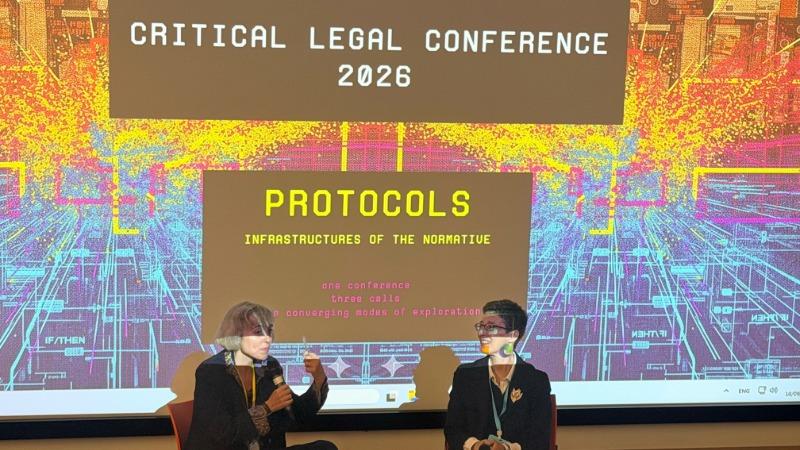
Established in 1984, the Critical Legal Conference (CLC) is an annual gathering for legal scholars and researchers. This year, it was held for the second time at the University, hosted by Westminster Law School between 9-11 September. The conference was centred around the theme of Protocols: Infrastructures of the Normative and examined how rules, standards and systems influence how law is applied and understood.
Delegates from Europe, North America and the Arctic came together to discuss how the authority of law is changing, responding to recent developments in technology, digitalisation, finance and international law. They also examined how protocols, such as templates, forms, standards and terms of use, can influence behaviour and shape the way rules are applied in everyday life.
Across the three days, there were a variety of talks including one from Professor Peter Goodrich, Professor of Law at Cardozo School of Law, and Ingrid Guardiola Sánchez, cultural theorist and lecturer at the University of Girona. There were also a wide range of panels covering subjects such as medical law and assisted reproduction, data and AI archiving, asylum and privacy, and legal education.
A significant part of the conference was dedicated to material practices and creative experiments using elements such as water, paper, paint and fanzines, alongside acoustic sessions, performances and installations. These activities transformed spaces across the Law School into settings where law could be considered through embodied, spatial and artistic forms of expression.
Alongside the paper panels, 16 sessions offered alternative ways to present and discuss ideas, giving participants an opportunity to collaborate, develop and exchange ideas. These sessions used exhibitions, workshops, performances and installations to consider legal questions beyond traditional academic formats. Four installations ran throughout the three-day conference, such as Blue Whisper by Ulrike Schmitz, while other sessions featured performances exploring themes including non-human life, justice and the relationship between law and its surroundings.
The conference concluded at Ambika P3 with a poetry performance by Bisi, a former Westminster Law LLB Honours student who is now a poet and actor.
The event demonstrated the interdisciplinary approach of the Westminster Law and Theory Lab, which connects theoretical work with creative practices. Through its research, teaching and events, the Lab aims to support collaborative scholarly activities, providing a space for new research and ideas to develop.
The event was convened by Westminster Law and Theory Lab members, Co-Director of the Westminster Law and Theory Lab and Principal Lecturer Julia Chryssostalis, Senior Lecturer Dr Daniela Gandorfer, Co-Director of the Westminster Law and Theory Lab Professor Andreas Philippopoulos-Mihalopoulos, Lecturer Dr Simon Thorpe, and Westminster Law School PhD researcher, Callum Kirwin. The team was also supported by Law School students who helped deliver the event through registration, audiovisual support, speaker liaison and room stewarding.
Professor Andreas Philippopoulos-Mihalopoulos said: "Law is traditionally thought of as a text without much potential to become political, specific to one’s conditions, and truly transformative. CLC offers to bring these legal notions in conversation with other disciplines, including art, fiction, choreography, science, politics and come up with entirely novel ways of representing the law that involve bodies, habitats and the surrounding politics."
The conference directly contributed to the United Nations Sustainable Development Goals (SDG) 4: Quality Education and 16: Peace, Justice and Strong Institutions. Since 2019, the University of Westminster has used the SDGs holistically to frame strategic decisions to help students and colleagues fulfil their potential and contribute to a more sustainable, equitable and healthier society.
Find out more about Law courses at the University of Westminster.


Related articles


