Commissioned by the former UN Special Rapporteur on human rights defenders Mary Lawlor and based on analysis of significant new material, a new report led by Westminster researchers finds a range of protection and accountability failures in five separate killings from around the globe.
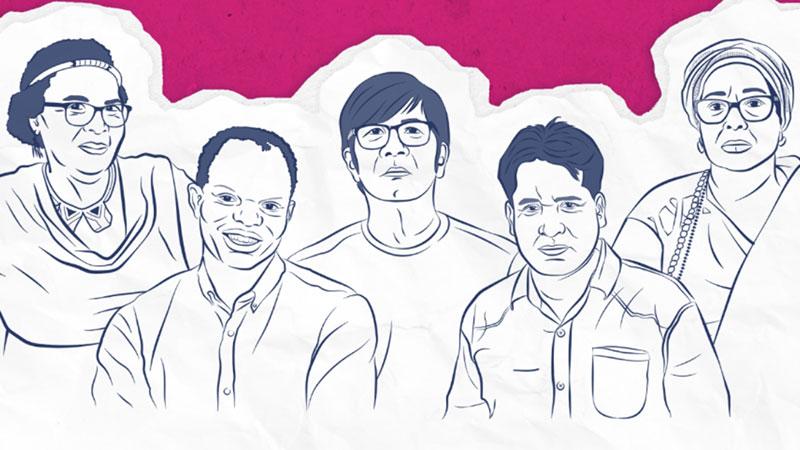
Led by Unredacted researcher Claire Lauterbach and supported by Namir Shabibi, the Chasing Shadows report investigates the murder of five human rights defenders (HRD). These are Fikile Ntshangase from South Africa, Thulani Maseko from Eswatini, Jude Fernandez from the Philippines, Quinto Inuma Alvarado from Peru and Maria Bernadete Pacifico from Brazil.
Unredacted is led by Professor Sam Raphael, Professor in International Relations and Human Rights, and Dr Jac St John, Senior Lecturer in Politics and International Relations at Westminster. The team, which includes two Quintin Hogg Trust (QHT)-funded PhD students, Namir Shabibi and Lydia Day, investigates and documents secretive UK state and corporate practices in the context of national security. Their work helps to uncover the details of secretive practices and identify abuses of power, enabling others to hold governments and corporations to account.
Human rights defenders around the globe frequently operate in contexts which see them and their communities pitted against a range of vested political, economic and criminal interests. Hundreds are killed each year. In the vast majority of cases, the killers are never identified, never face criminal charges or are never convicted for the crimes they commit. In turn, this has severe consequences not only for the families and communities connected to those killed but also the ability of others to engage in similar activism against environmental, social and human rights abuses.
Identifying the protection failures and accountability gaps in real-life cases can support in-country attempts to address the lack of justice for the killings of individual defenders. Identifying cross-case themes can also assist the global human rights community to build capacity and strategies for challenging state and corporate actors more broadly.
The five cases profiled in depth are Joyce Fikile Ntshangase, a South African grandmother and community leader opposed to mining expansion, who was murdered by hitmen in her rural home in October 2020; Thulani Maseko, a prominent Swazi lawyer and democracy activist, killed in his rural homestead by a single unknown person in January 2023; Jude Thaddeus Fernandez, a Filipino labour rights and union activist, killed in his urban home by police officers under suspicious circumstances in September 2023; Quinto Inuma Alvarado, a Peruvian conservationist and indigenous leader opposed to land grabbing and criminality, murdered while travelling in the Peruvian Amazon by individuals linked to organised crime in November 2023; and Maria Bernadete Pacífico, a Brazilian quilombo leader and activist for the rights of her racial minority community facing environmental pollution, murdered in her rural home by individuals linked to organised crime in August 2023. The murder of her son Flavio Gabriel Pacífico dos Santos in 2017 is also discussed in the report.
For each of these cases, the report examines the threats the murdered defender faced during their work, and the protection failures and missed opportunities that occurred in the run-up to their killings; the bottlenecks and obstacles preventing accountability or justice for their killings, particularly failures by duty-bearing state actors; the most effective ways of supporting justice and accountability for these cases, and more generally for killings of HRDs; and the support and interventions by international actors such as the Special Rapporteur or other bodies that are most likely to be effective in promoting justice for HRDs killed for their work.
Unredacted’s work directly contributes to the United Nations Sustainable Development Goals (SDG) 10: Reduced Inequalities and 16: Peace, Justice and Strong Institutions. Since 2019, the University of Westminster has used the SDGs holistically to frame strategic decisions to help students and colleagues fulfil their potential and contribute to a more sustainable, equitable and healthier society.
Read the full report.
Related articles


