The Communication and Media Research Institute (CAMRI) at the University of Westminster hosted a sold-out panel event which brought together leading online safety campaigners, digital researchers and academics to discuss how the public can reclaim their social lives from big tech.
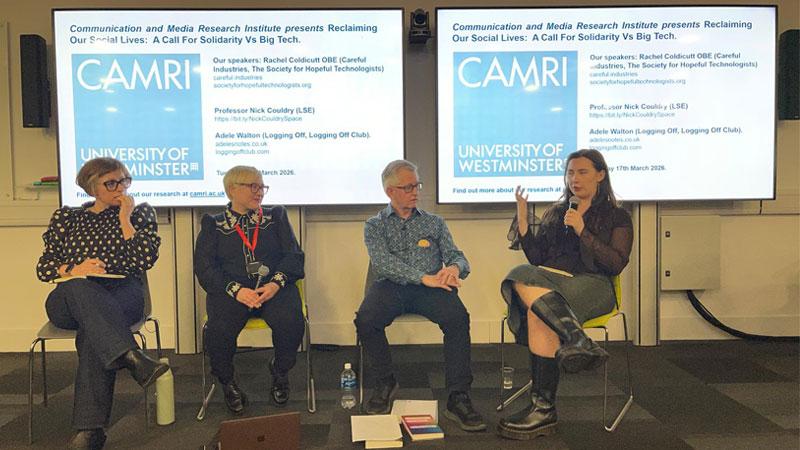
The panel presented an interdisciplinary alliance of digital thinkers united by the same cause: to reclaim social lives from the likes of Meta, TikTok and X, and to create greater solidarity versus big tech within communities and the wider general public.
Chaired by Debbie Ball, Westminster Lecturer in Data and Society and persuasive design doctoral researcher, the panel featured a range of speakers from across academia, industry and campaigning. This included Rachel Coldicutt OBE, Founder of Careful Industries research studio and the Society For Hopeful Technologists network; Professor , Professor of Media, Communications and Social Theory at the London School of Economics (LSE); and Adele Walton, online safety campaigner and author of Logging Off: The Human Cost of Our Digital World.
Ball was inspired to join Professor Couldry’s call for greater solidarity to fight back against Big Tech after watching his keynote at the 50 Years of Media at Westminster conference in May 2025. Couldry discussed how people have sacrificed their social lives for the enrichment of social media companies, the key argument of his 2025 Space of the World book. Following several discussions, Ball co-organised this event as part of the CAMRI Research Seminar Series with Dr Toby Bennett, Senior Lecturer in Media, Culture and Organisation.

Rachel Coldicutt OBE and Debbie Ball. Photo credit: Maria Lira
Discussions focused on the growing demand for better solutions to the problems arising from commercial social media and AI tools. Despite the recent Australian social media ban for under 16s and a burgeoning investigation in UK Parliament, the panel questioned whether governments are listening sufficiently to people’s concerns about their all-consuming smartphone habits and social media use. The panel expressed their hopes that political leaders can decouple themselves from tech solutionist visions and Big Tech business alliances to create meaningful solutions to how social media has vastly affected everyday lives.
The event created a diagnosis of fundamental problems, made bold proposals for policy change and conveyed a strong sense of what more people stand to lose if society fails to urgently address these issues.

Photo credit: Maria Lira
About attending the event Westminster AI, Data and Communication MA student Veasna Chheong said: “Listening to Nick Couldry, Rachel Coldicutt and Adele Walton, I found myself reflecting on how deeply platforms like Instagram, TikTok and Facebook are woven into our everyday lives. Walking away from the discussion, I felt hopeful. While Big Tech has a powerful hold, we still have agency and controls. Sometimes, reclaiming our social lives begins with something small stepping back, reconnecting offline and choosing how we want to engage, rather than letting algorithms decide for us.”
Professor Couldry said: “A movement is building about the need to reclaim control of social space back from Big Tech elite. Last night’s meeting was both critical and hopeful, putting the emphasis on what people can build by themselves, based on what they already know and understand.”
Panel chair Debbie Ball added: "Reflecting afterwards, we were cheered about how we managed to keep the conversation positive, proactive and fundamentally human. It was all the more inspiring that we covered empowering topics during our discussion, from finding ways to live our lives in joyful ways with selective use of technology, to quitting accounts that stress us out, from critiquing the social media ban as a quick fix solution to a complex situation and lobbying MPs to educate them about greater accountability for Big Tech. We all agreed that it's crucial to change the UK government's technological solutionist trajectory of AI adoption. We do have agency to change our digital habits and provide hope for our better, healthier technological futures.”
This event directly contributes to the United Nations Sustainable Development Goals (SDGs) 3: Good Health and Wellbeing, 16: Peace, Justice and Strong Institutions and 17: Partnerships for the Goals. Since 2019, the University of Westminster has used the SDGs holistically to frame strategic decisions to help students and colleagues fulfil their potential and contribute to a more sustainable, equitable and healthier society.
Find out more about studying Media and Communication courses at the University of Westminster.
Related articles


