Being the London FameLab hub, the University of Westminster has hosted the 2026 London Final of FameLab, the world’s largest science communication competition, where contestants competed for a place in the UK FameLab Final in Cheltenham later this year. The prize was awarded to Westminster doctoral researcher Fabia Hannan Mone.
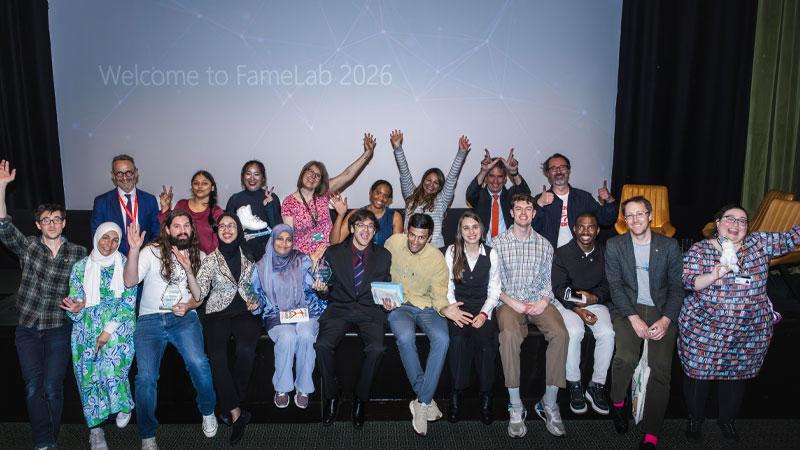
Contestants from universities across the UK gathered at the University of Westminster’s Regent Street Cinema for the annual London FameLab Final. FameLab is an international competition which sees contestants from over 30 countries explain a scientific, engineering, mathematical or social science concept in an engaging and accessible way in under three minutes, without PowerPoint or notes.
Westminster was named the London hub for FameLab in 2024 and has since hosted the regional finals each year, organised by the University’s Senior Knowledge Exchange Manager Anna Christodoulou. Prior to the finals, each contestant was provided coaching for their presentations by Westminster colleagues and science communication experts Dr Bradley Elliott and Professor Lewis Dartnell.
This year’s event was hosted by actor and author Dan Hope from the Science Museum’s science comedy troupe Punk Science Studios, who introduced a range of entertaining and thought-provoking science talks from regional finalists. These were Success Ajayi and Fabia Hannan Mone, doctoral researchers at Westminster’s School of Life Sciences; Nada Ahmed, Ramaa Sri Lalitha Sahitya Puvvada, Beatriz Silveira De Arruda and Qing Zhang from University College London; Marifatul Amalia from University of Edinburgh; Rohit Das and Raman Van Wee from University of Oxford; Sam Horrell from Imperial College London; and Conor Noonan from the Royal Veterinary College.

Success Ajayi
Success’ presentation explored the science of heart rate recovery and why it is an important indicator of cardiovascular health. Using the analogy of the heart as a sports car, he explained that while many people focus on how fast the heart can accelerate, it is just as important to understand how effectively it can “hit the brakes.” The talk highlighted the role of the autonomic nervous system, the health implications of heart rate recovery and how regular aerobic exercise can improve the heart’s ability to recover.
Beyond the competition, Success is bringing science to wider audiences through musical theatre. He will soon perform alongside Westminster colleague Dr Daniel Brayson in a chorus of 60 healthcare workers and scientists in Lifeline, a production which warns of the global threat of antibiotic resistance through music and storytelling.
Fabia’s presentation addressed how difficulty swallowing, also known as dysphagia, in end‑of‑life care affects more than just nutrition; it also impacts culture, memory and identity. Blending scientific insight with personal storytelling, she highlighted how illness can take away not just the ability to eat but also the pleasure and meaning attached to food.
Her talk advocated for person‑centred care that recognises food as a vital source of comfort and dignity, emphasising the importance of culturally sensitive approaches in palliative and end‑of‑life care. Fabia’s touching storytelling brought many audience members to tears.
Each presentation was followed by questions from a panel of expert judges featuring Westminster cognitive neuroscientist Professor Catherine Loveday, science communicator and nanochemist Suze Kundu, and last year’s London finalist Tiffany Baptiste. The judges awarded first place to Westminster’s Fabia, who will represent London at the UK FameLab finals later this year.
The judges also awarded prizes to first runner-up Sam Horrell from Imperial College London, who won a place on the podium for the second year running, with his humorous and passionate talk about the structure of DNA and how it is almost always wrong in TV, movies and even emojis. Second runner-up Connor Noonan represented the Royal Veterinary College and talked about chicken parasites and chicken diseases, winning the judges with his informal and conversational style.
Attendees were able to vote for their favourite presentation and awarded the audience prize to Rohit Das from the University of Oxford, who talked about hydrogen and how nature has already showed the way on how to use hydrogen to produce energy without the technological challenges that come with fuel cells. To the crowd’s amusement, he compared enzymes to club bouncers.

Fabia with the FameLab London trophy and Professor Andrew Linn
About the competition Fabia said: “FameLab felt like a really special space to share my research in a way that connects with people’s lived experiences. My PhD focuses on a sensitive but important topic, and it meant a lot to present it in a way that felt accessible, meaningful and rooted in stories that feel familiar to many of us. My intention was never to make people feel sad, but to gently reflect experiences that many people carry quietly. Seeing how the audience responded was incredibly moving and reminded me why this work matters, because science is ultimately about people, connection and understanding."
Success commented: “Taking part in the London Finals was an exciting and rewarding experience, giving me the opportunity to communicate complex science in an engaging and relatable way while growing as a science communicator.”
Professor Andrew Linn, Deputy Vice-Chancellor for Research and Knowledge Exchange, said: “Our University’s predecessor, The Royal Polytechnic Institution, was founded on the principle of sharing the latest scientific discoveries with the general public, and 180 years on, it feels absolutely right that Westminster is still committed to this important task. And what a showcase of talent we enjoyed and admired in our Regent Street Cinema. Amidst such talent from across the university sector, I am delighted that it was one of our own stars who shone brightest on the day!”
Hosting the science competition directly contributes to the United Nations Sustainable Development Goals (SDG) 4: Quality Education and 17: Partnerships for Goals. Since 2019, the University of Westminster has used the SDGs holistically to frame strategic decisions to help students and colleagues fulfil their potential and contribute to a more sustainable, equitable and healthier society.
Find out more about research at the University of Westminster.

Dan Hope introducing the judging panel

Professor Catherine Loveday (left) speaking on the judging panel next to Tiffany Baptiste (centre) and Suze Kundu (right)

Judges applauding last year's winner and fellow judge Tiffany Baptiste

Fabia Hannan Mone

Dan Hope

Professor Andrew Linn

Regent Street Cinema
Related articles


