Professor Abdelhafid Benamraoui, Professor of Finance at the School of Finance and Accounting at the University of Westminster, recently attended a governmental Treasury Committee meeting to provide oral evidence on the UK’s Financial Inclusion Strategy.
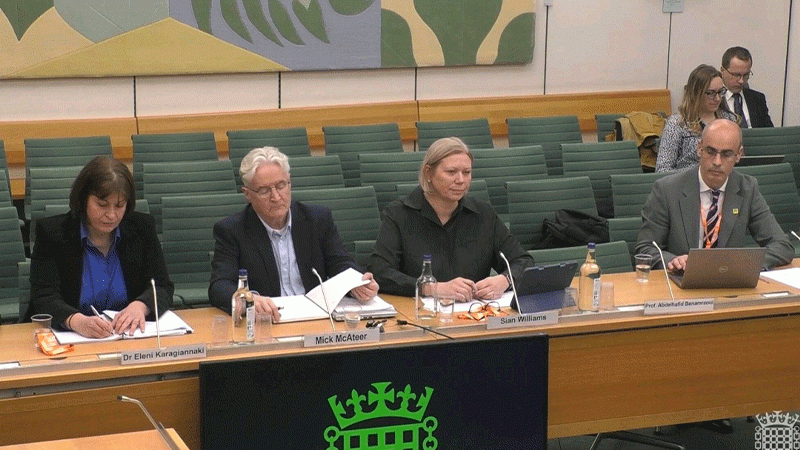
Held on 3 February, the session explored a variety of key issues, including the practicality of initiatives set to address financial exclusion, such as setting up banking hubs, reforming credit unions, increasing funding for debt advice, testing new insurance products, supporting digital inclusion and strengthening financial education.
The meeting looked at the biggest challenges facing financial inclusion in the UK and questioned whether the current strategy is strong enough to tackle different areas of financial exclusion. It discussed if the targets that have been set are realistic and achievable and whether the way progress is being measured actually works. Through providing this additional oral evidence to the Treasury Select Committee, the group worked towards ensuring the UK Financial Inclusion Strategy is robust, effective, clearly designed and with no gaps left in terms of the initiatives set, planned delivery and stakeholders involved.
Speakers talked about a range of issues, including access to basic financial services, affordable credit and insurance products, the cost of financial products, support with debt and the role of financial education.
In his talk, Professor Benamraoui pointed out that the UK Financial Inclusion Strategy lacked clear targets and accountability, and he argued that the stated targets should follow Specific, Measurable, Achievable, Relevant and Time-bound (SMART) goals to make it easier to see what success looks like and who is responsible for its delivery.
He also emphasised the need for more evidence and data to show whether current initiatives are working. In particular, he called for clearer explanations of how civil society groups and community finance organisations contribute to improving access to financial services.
Professor Benamraoui further highlighted that funding allocation should be justified based on specific key performance indicators and outreach. He made a number of points on digital inclusion, strengthening regulations and incorporating artificial intelligence to enhance financial education and capability.
About this talk, Professor Benamraoui said: “Participating as a witness at the Treasury Select Committee has allowed me to respond to the questions raised about the scope, gaps, robustness and effectiveness of the strategy initiatives. I did draw on my expertise in the area and hopefully the input made strengthens the strategy and its policy implications, economic and societal.”
Professor Benamraoui’s contribution directly contributes to the United Nations Sustainable Development Goals (SDGs) 1: No Poverty, 8: Decent Work and Economic Growth and 10: Reduced Inequalities. Since 2019, the University of Westminster has used the SDGs holistically to frame strategic decisions to help students and colleagues fulfil their potential and contribute to a more sustainable, equitable and healthier society.
Learn more about Accounting and Finance courses at the University of Westminster.

From left to right: Sian Williams, Chair at Financial Inclusion Commission; Mick McAteer, Co-director at Financial Inclusion and Markets Centre; Professor Abdelhafid Benamraoui, Professor of Finance at University of Westminster and Dr Eleni Karagiannaki, Research Fellow at Centre for Analysis and Social Exclusion at London School of Economics and Political Science
Related articles


