The University of Westminster has hosted the FemIDEAS Conference 2026, providing a space for international scholars, activists, survivor-leaders and policymakers to address inequalities across universities worldwide.
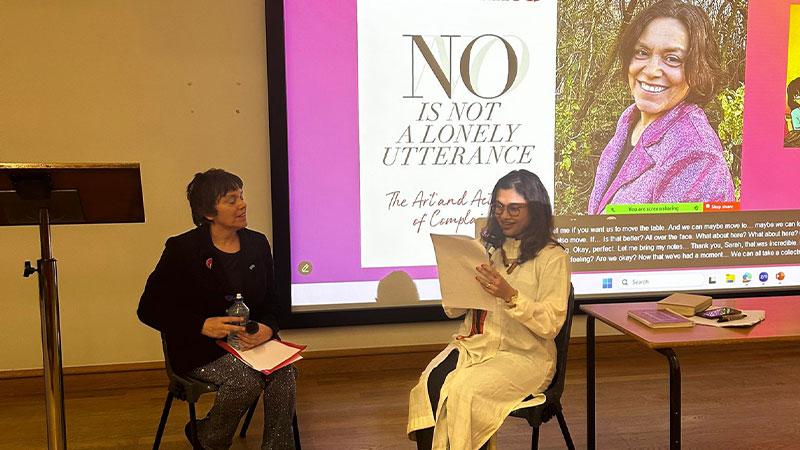
Organised by the FemIDEAS research project, a feminist, intersectional, decolonial initiative collaborating across South Africa, Nigeria, Brazil and Argentina, the transnational conference offered free access to participants and aimed to bridge theory, policy and practice to better prevent and respond to sexual and gender-based violence (SGBV) in higher education institutions.
The Westminster based project is funded by UK Research and Innovation (UKRI) and led by Dr Adrija Dey, Reader in Social Science, and supported by Dr Erin Shannon, Postdoctoral Research, and Kyra Araneta, Lecturer in Student Partnership and Social Justice.
Convening online between 3-6 February, the event began with a moving pre-conference session led by Chair Srila Roy that celebrated the life and work of Crystal Dicks, a prominent South African activist and former Director of the Gender Equity Office (GEO) at the University of the Witwatersrand. Speakers reflected on her legacy of challenging institutional complacency, advancing gender justice and inspiring ongoing student and community mobilisation against campus sexual violence.
On 4 February, the formal programme opened with a keynote panel titled Addressing Sexual and Gender-Based Violence in Higher Education and Building Transnational Solidarities. Chaired by Dr Dey, the panel featured leading voices from South Africa, Nigeria, Brazil and Argentina who discussed the regional and global dimensions of SGBV in academic settings.
Afternoon sessions took these discussions further with talks on solidarity and activism, spotlighting legal responses to harassment in India and the lessons learnt from global movements like #MeTooSTS that challenge academic power structures.
Throughout 5–6 February, the conference programme wove together panels exploring survivor-centred policies and prevention practices. A panel titled Survivor-Centred Policies and Practices examined how institutions in Brazil, Chile, Australia and the UK engage with gender violence prevention and response, emphasising the need for structural transformation rather than superficial reforms.
One collaborative session held was with editors from the Open Gender Journal and Debate Feminista, which invited attendees to submit their research for special thematic publication projects on gender-based violence in academia to further support cross-regional scholarly exchange and visibility.
The conference concluded with a series of talks and collaborative sessions that gave voice to lived experiences, including narratives from student activists confronting systemic silencing and organisational barriers within university complaint systems.
The highlight of the event was a talk from Sara Ahmed, an independent queer feminist scholar whose work is concerned with how power is experienced and challenged in everyday life. In this lecture, she spoke about her latest book No is Not a Lonely Utterance: The Art and Activism of Complaining. She shared thoughts on hopefulness and how it came into the work from the act of bringing so many complaints, made at different times and in different places, together.

Dr Dey said: “The conference was successful beyond our imagination. Over 400 people signed up online from across the world, and about 200 people attended the hybrid closing keynote in person with Sara Ahmed. The greatest success of the conference was that it created a thoughtful, caring space where academics, activists and practitioners could come together.
“Creating spaces like this is deeply important, as it is an attempt to disrupt the imperial geographies of knowledge production and to highlight the inspiring work taking place across large parts of the Global Majority. Making this platform free, accessible in multiple languages, and creating opportunities for publication is also an effort to redistribute resources.”
This event directly contributes to the United Nations Sustainable Development Goals (SDG) 3: Good Health and Wellbeing, 5: Gender Equality and 16: Peace, Justice and Strong Institutions. Since 2019, the University of Westminster has used the SDGs holistically to frame strategic decisions to help students and colleagues fulfil their potential and contribute to a more sustainable, equitable and healthier society.
Find out more the Centre for Social Justice Research at the University of Westminster.
Related articles


