Peter Cunliffe-Jones, Visiting Researcher and Lecturer at Westminster’s Communication and Media Research Institute (CAMRI), was recently invited to deliver training for leaders of 19 Arab fact-checking organisations. The training aimed to help the fact-checkers be more effective in identifying and countering potentially harmful misinformation.
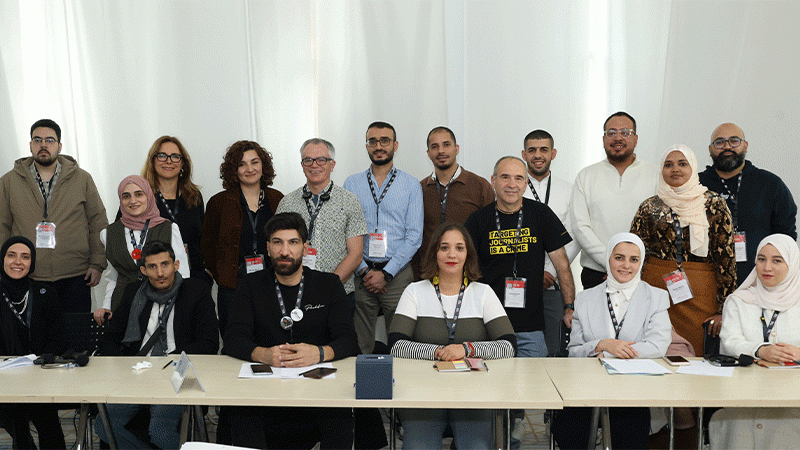
Held in Amman, Jordan, between 5-7 December, the workshop took place during the 18th annual forum of the Arab Reporters for Investigative Journalism (ARIJ), the largest investigative journalism gathering in the Arab world. The training was organised by the Arab Fact-Checkers Network (AFCN) and funded by the Norwegian Investigative Journalism Foundation (SKUP). Sessions were conducted in both Arabic and English, with live translation throughout.
Over 20 leading fact-checkers from Egypt, Iraq, Jordan, Lebanon, Libya, Morocco, Palestine, Sudan, Syria, Tunisia and Yemen explored a new model for prioritising which claims to verify when confronted with large volumes of false or potentially incorrect information. The workshop drew on Cunliffe-Jones’s global surveys of fact-checking organisations and on the harm-assessment model he developed between 2021-25. This model forms the basis of his recent book, Fake News – What’s the Harm?, which was published in June and sets out a framework to help fact-checkers, policymakers and platforms curb harmful consequences while protecting freedom of expression.
In addition to leading the workshop, he also participated in a panel discussion on the increasing attacks by authoritarian regimes on both fact-checkers and misinformation researchers.
Peter Cunliffe-Jones said: “Every day, fact-checkers seeking to counter the tide of false and misleading information have to make choices about what to check. The training builds on years of research, aimed at helping these organisations think through the goals of their work. The aim is then to select claims to help them reach key audiences, meet the highest standards of impartiality and reduce the real-world harms that misinformation causes.”
Saja Mortada, the head of the AFCN, added: “The Arab region is witnessing an overwhelming surge of false and misleading information, making harm-based prioritisation a crucial professional standard. Adopting this approach directs fact-checking efforts toward claims that affect public safety, human rights and cause harm to wider society in the sensitive context of the region.”
Abdullah Al-Masoudi from the fact-checking organisation Sidq in Yemen, added: “Over these three days, I realised that identifying harm in misinformation is far more complex than I first thought. Peter’s guidance helped us see how context, audiences and consequences must all be assessed carefully. This workshop has genuinely reshaped the way we approach our work.”
Salma Koafi, who works at She Checks in Libya, added: “This workshop helped me to understand how to monitor dangerous claims, especially those that could have consequences for society within the Libyan context. It helped me learn how to develop a more accurate perspective for assessing the potential harm of these claims and the clear criteria for our monitoring priorities at She Checks.”
The workshop directly contributes to the United Nations Sustainable Development Goal (SDG) 16: Peace, Justice and Strong Institutions. Since 2019, the University of Westminster has used the SDGs holistically to frame strategic decisions to help students and colleagues fulfil their potential and contribute to a more sustainable, equitable and healthier society.
Learn more about Media and Communication courses at the University of Westminster.


Related articles


