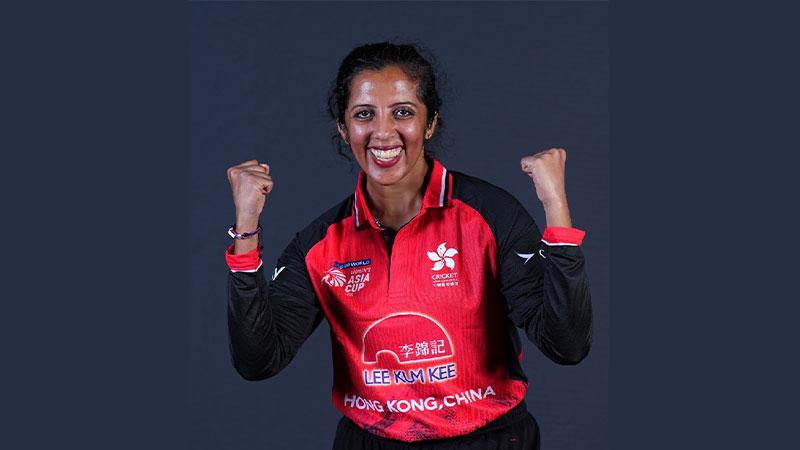
Westminster doctoral researcher and Centre for Nutraceuticals (CfN) member Ruchitha Venkatesh recently participated in the DP Women’s World Asia Cup cricket tournament, representing the Hong Kong national team. Here, Ruchitha shares her experience of the competition and how she balances her PhD studies with a professional sports career.
Could you tell us about your cricket career?
I am of Indian origin and grew up in Hong Kong where international schooling exposed me to a mix of cultures and sports. My father introduced me to cricket and I fell in love with it fast! In high school, I joined a club and in one of my first league games I managed to impress one of the selectors who invited me to national trials. Months later, I was in the Hong Kong U19 team. I worked hard and made my senior national debut while at university. Since then, I've been representing Cricket Hong Kong's (CHK) senior women's team internationally. What I'm most grateful for is what the game has taught me. How to face fear head-on, handle pressure and bounce back from setbacks. Cricket has given me the strength, patience, perspective and mindset to put the team ahead of myself. Those lessons carry straight into other areas of life. That is why sportspeople have such strong mentalities. I have learned it from my cricket coaches and peers, and through experience.
How was your experience at the tournament?
The DP World Women’s Asia Cup was unforgettable. We played against the best teams in Asia in front of the world at Dubai International Stadium, broadcast live on TV. It was our first tournament at that level and our first time facing full-member nations. We were playing against our idols. A treasured moment for me was getting the wicket of Shafali Verma, India’s opener, which will stay with me for life. Playing against India and Pakistan was incredible. This tournament has left us more determined than ever to work hard, reach further as a team and qualify again for the Asia Cup where we hope to deliver better results and qualify for the World Cup too.
How do you juggle your time between your studies and cricket career?
Balancing a PhD with international cricket while living alone in a foreign country has been a tough but rewarding experience. I was previously a visiting researcher at the Centre for Nutraceuticals (CfN), where its director, Professor Mohammed Gulrez Zariwala, noticed my potential and encouraged me to pursue a PhD after my Master’s degree. However, I was hesitant. I knew a life sciences PhD would be intense and time-consuming and I couldn't simply give up my passion for cricket.
I am lucky to have the full support of my family who encouraged me to pursue both. Additionally, my supervisors, Professor Zariwala, Professor Vinood Patel and Dr. Sanjoy Deb, approved of a plan that let me complete my degree within the required timeframe while allowing for international tours.
I learned that nothing can be achieved without hard work and sacrifice, as one of my cricket coaches back home always told me. To make this work, I gave up small comforts and social activities to protect my fitness and skills. My days consisted of 9-12-hour lab shifts running human studies and lab experiments along with other PhD duties. Early mornings and late nights were dedicated to fitness and skill sessions. During spring and summer, weekends were for matches and I'd complete extra PhD work on weekends to make sure I could get leave for international tours. I also had to balance my mindset. For the past few years, finishing the PhD was my first priority. So, instead of expecting my absolute best in both areas, I slowly learned to let go and be the best within what I could control. I learned to accept whatever comes my way and give my best regardless.
What is your research about and how does it relate to your cricket career?
My PhD investigates how iron levels affect cognitive performance under exercise fatigue in active females and the biological mechanisms behind it. Because of menstrual blood loss and training demands, female athletes are disproportionately affected by low iron and may not be able to perform at their best.
There's already research on how iron affects the physical side of athletic performance but far less on how it affects cognition. Cognition is the brain's ability to learn, remember and process information. For athletes, it means reading the game, drawing on past experience and executing the right action, sometimes under pressure and while fatigued.
As a female athlete myself, I want to help us reach our full potential and I believe scientific research counts as an investment in that. Previous studies have been designed around male athletes for too long and assumed to apply to everyone. That's the gap I want to help close.
Why did you choose to study at the University of Westminster?
The CfN runs pioneering clinical studies on nutritional interventions for longevity, brain health and performance, and Professor Zariwala is one of the world’s leading researchers on iron metabolism. The group has expertise in supplements, sports nutrition and functional foods for optimising health and performance, areas directly relevant to my research interests. Its multiple international industry partnerships make its research translational, providing evidence-based science to support several product claims.
The CfN’s research model pairs human clinical studies with cellular work and my own PhD project reflects that. This combination is rare for a PhD student and it helped me improve as a researcher. I learned to design and run studies, handle human participants, take blood samples and apply the latest human physiology and cell-based techniques to my research. I was also trained in the ethical and legal frameworks that govern research and the interpersonal skills needed to work with human participants and maintain industrial collaborations.
What makes the University of Westminster stand out is that students gain practical, hands-on skills, not only theoretical knowledge, and the University genuinely caters to people from every social, ethnic and economic background.
What has your experience been like so far at the University?
One highlight was attending my first international academic conference, representing the CfN at the European Iron Club (EIC) conference in Innsbruck, Austria, where I presented my PhD research. My participation was supported by Westminster’s Globally Engaged Research Doctoral Scholarship Scheme (GER). The experience pushed me out of my comfort zone. I presented to leading iron researchers from around the world and learned a great deal from their talks on iron metabolism.
A key part of my PhD journey was the supervision experience. Professor Zariwala encourages his PhDs to supervise undergraduates and Master's students for their final projects, so I learned a lot by teaching. I enjoyed meeting students from different backgrounds and loved helping them grow, even in small ways.
I've had a great time at the University. The highlight has been the people, students and colleagues, who I hope to stay in touch with long after graduation. I’ve grown particularly close to the CfN post-docs, students and colleagues who are all accomplished researchers and have been a great support. I've met people from many different nationalities, ethnicities, religions and all areas of life. The campus in the heart of central London still feels simple and homely. Though, it might be because I worked there until it was only me and the night-time security guards!
What is your long-term vision for your career?
I haven't planned that far ahead yet but I would like to keep balancing both. Once my PhD is finished, I want to put cricket at the forefront and become the best athlete I can be. Athletes have a limited window to play professionally and internationally, so I want to make the most of it and achieve what I've dreamed of and live out my passion.
At the same time, I plan to stay involved with the Centre for Nutraceuticals, whether through work or collaboration. I'm already planning other research projects on female athletes in areas similar to my PhD to carry on after I finish. The research side isn't going anywhere. I want to keep creating and sharing knowledge in this field.
Find out more about research degrees at the University of Westminster.


Related articles


