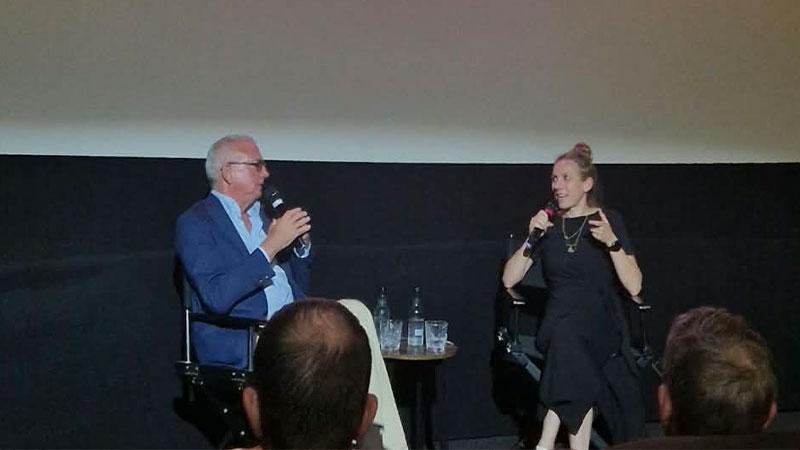
Dr Ludivine Broch, Senior Lecturer in History at the University of Westminster, hosted a preview screening of De Gaulle: Résistance at the Curzon Bloomsbury cinema, giving audiences an early look at the new film that explores the journey of former French president Charles de Gaulle during World War Two. The screening was followed by a Q&A with Professor Julian Jackson, whose book inspired the film.
The film was inspired by Professor Jackson's award-winning biography of the French president titled A Certain Idea of France: The Life of Charles de Gaulle (2019). The book traces the life of De Gaulle from a little‑known general in 1940 to the leader who rebuilt France, shaped the Fifth Republic, challenged global powers and left a political legacy that still defines modern France.
The film, directed by Antonin Baudry, first aired at the Cannes Film Festival in May and has since received outstanding reviews from The Guardian, The Observer, The Financial Times and The Times.
At its premiere UK screening on 27 August, Dr Broch hosted a discussion with Professor Jackson who explored the link between the book and the film and outlined how he and Baudry collaborated to ensure De Gualle was depicted accurately.
Professor Jackson also discussed how the book and the film operate as two distinct forms of interpretation. His biography is grounded in archival research and historical accuracy, whereas Baudry’s film uses creative techniques to convey the story on screen. He highlighted that the director’s portrayal of De Gaulle’s personality reflects a strong engagement with historical detail, while the film’s more fictionalised focus on Fernand Bonnier de la Chapelle - the young man who assassinated Admiral Darlan in 1942 - serves as a deliberate narrative device to help audiences connect with the period. He emphasised that incorporating imagined episodes from Fernand’s life is a legitimate creative choice within the film format and that history and cinema can each offer valuable insights in different ways.
Dr Broch’s involvement in the event reflects her expertise in the history of modern France and her research on the Second World War, particularly the French Resistance, Vichy France and the politics of memory. Her work examines how wartime experiences are interpreted, remembered and represented, including through film and public history. As a specialist in 20th century France and the author of research on railway workers, occupation and resistance, she brought academic insight into the historical themes explored in De Gaulle: Résistance and provided context on how historians and filmmakers navigate the relationship between archival evidence and creative interpretation.
Reflecting on the event, Dr Broch said: "I was so honoured to host the Q&A with historian Professor Julian Jackson, whose book inspired director Antonin Baudry to make his film. The Curzon Bloomsbury put on a wonderful viewing and evening. It was particularly great to hear Jackson's reflections on working so closely with a film director, and on the fluidity between historical and creative interpretations. De Gaulle: Résistance is a must-see film!"
Ludivine's work directly contributes to the United Nations Sustainable Development Goal (SDGs) 4: Quality Education. Since 2019, the University of Westminster has used the SDGs holistically to frame strategic decisions to help students and colleagues fulfil their potential and contribute to a more sustainable, equitable and healthier society.
Learn more about History courses at the University of Westminster.
Related articles


