This year’s Steve Hewlett Memorial Lecture was delivered by Analysis and Investigations Editor at Global and Co-Presenter of The News Agents podcast Lewis Goodall. Organised by the Royal Television Society (RTS), The Media Society as well as Steve Hewlett's son Freddie Hewlett, the lecture takes place each year at the University of Westminster to raise funds for the Steve Hewlett Scholarship Fund, which provides financial assistance to journalism students from low-income backgrounds.
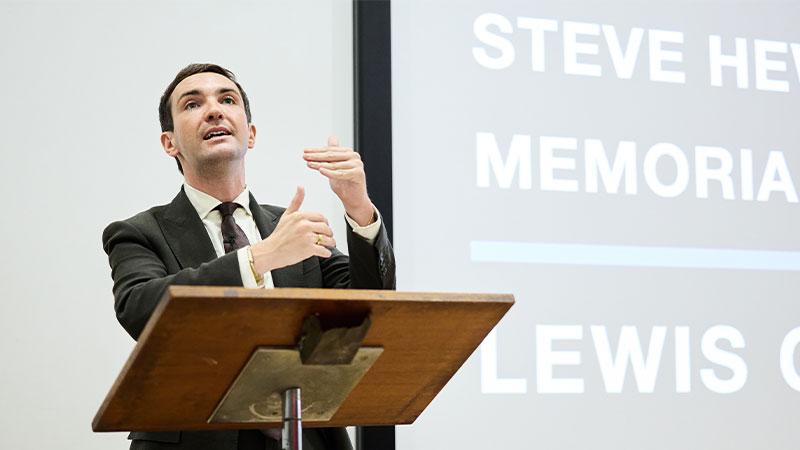
Held on 21 October, students, colleagues and professionals from across the media industry visited the University's Little Titchfield Site to hear Goodall deliver the lecture titled Same Screen, Different Rules: Reinventing News for the 21st Century.
Goodall has established himself as one of the UK's leading political journalists, with a career spanning the BBC, Sky News and Global. The lecture explored how news organisations are adapting to a rapidly changing media landscape, examining the impact of digital platforms, shifting audience habits and the growing influence of social media on how people access and engage with journalism. He also reflected on the challenges facing traditional broadcasters and the need to rethink news production and storytelling for a new generation of audiences.
The net proceeds of the event go to the Steve Hewlett Scholarship Fund, which provides financial assistance to journalism and TV production students from low-income backgrounds. The scholarship is presented each year to one recipient studying an undergraduate broadcast journalism course in the UK.
Steve Hewlett was a print and radio journalist who shared candid accounts of his fight against cancer through his columns in The Observer and his interviews with Eddie Mair on BBC Radio 4. The scholarship recognises his commitment to improving access to careers in the media for all and improving social mobility.
The event was introduced by Dr Doug Specht, Head of the School of Media and Communication at the University of Westminster, who connected the lecture with the School’s commitment to critical enquiry and responsible journalism, highlighting the recent student-led On Air broadcast as an opportunity to put these principles into practice.
The event concluded with a Q&A session, where journalism students had the chance to gain first-hand insight into the industry ahead of their future careers.
About the event, Dr Specht said: "It was a pleasure to welcome Lewis Goodall to Westminster for the Steve Hewlett Memorial Lecture. Hosting this event is important to us because a media school should be a place where journalism is not only taught, but questioned. To ask whom it serves, how it holds power to account, and how it can do better, all things Goodall sought to do in his career. We want our students to approach that responsibility with curiosity and confidence, recognising that challenging power requires evidence as well as conviction."
Westminster’s collaboration with RTS and The Media Society showcases the University’s strategic commitment to the United Nations Sustainable Development Goals (SDGs). By spotlighting the importance of journalism in amplifying voices, informing the public and holding power to account, the University is helping drive forward SDG 10: Reduced Inequalities, 16: Peace, Justice and Strong Institutions and 17: Partnerships for the Goals.
Find out more about Media and Communication courses at the University of Westminster.


Related articles


